Why there are Amazon links here: Brave Review is paid a commission for qualifying Amazon purchases made through the links below. Your price does not change, and using our links is entirely optional. How this works
Deco BE63 3-Pack: A Whole-Home WiFi 7 Mesh for Big Houses
The Deco BE63 3-pack is a tri-band WiFi 7 mesh system built for large homes that need wide coverage and fast wired backhaul without a stack of separate boxes. It suits households with multi-gig internet, lots of connected devices, and dead zones a single router cannot reach. This review covers the specifications that matter, what each one means in daily use, and where the system falls short.
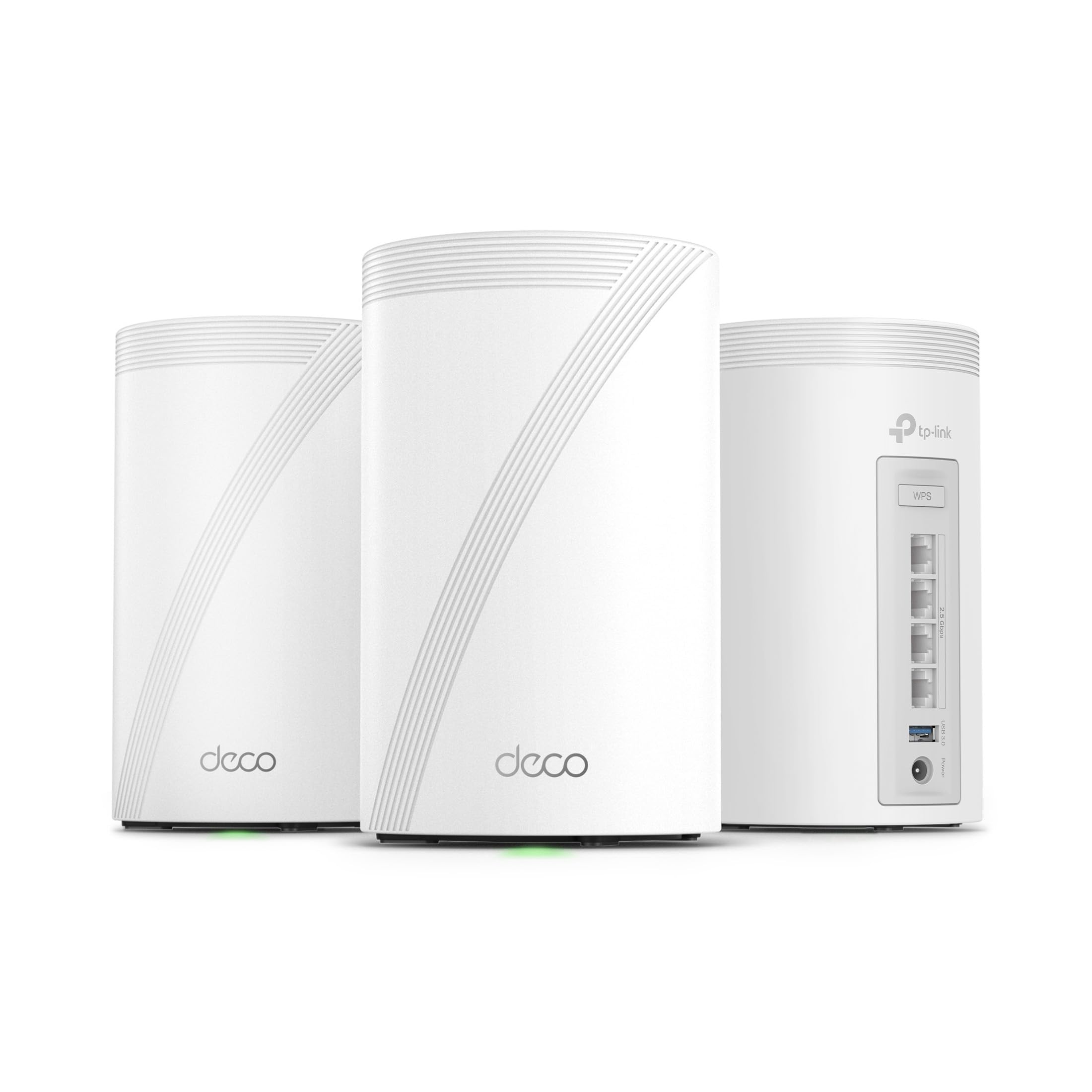
Features and Specifications
Type: Tri-band WiFi 7 whole-home mesh system (3-pack)
WiFi Standard: WiFi 7, BE10000
Streams: 6-stream
Wired Ports: 4 x 2.5G ports with wired backhaul
Antennas: 4 x smart internal antennas
Coverage: Up to 7,600 sq.ft
Security and Features: VPN, HomeShield, AI-Roaming
The BE10000 rating and 6-stream design put this system in the upper tier of consumer mesh hardware. WiFi 7 adds wider channels and multi-link operation over older standards, which matters most when several devices pull data at once. The 2.5G ports are the practical highlight: they let the units talk to each other over a wired backhaul instead of relying on wireless links alone.
Coverage is rated up to 7,600 square feet across the three units, which places it in large-home territory. Four internal antennas per unit handle the radio work without external stalks, so each node stays compact enough to sit on a shelf. VPN and HomeShield cover the software side, while AI-Roaming manages how devices hand off between units as they move through the house.
Build and Design
The Deco line favors a simple, furniture-friendly look, and the BE63 follows that pattern with internal antennas and a clean shell. Each unit is meant to be placed out in the open rather than tucked into a cabinet, because internal antennas work best with clear space around them. The three-pack format assumes a spread-out layout: one unit near the modem and the others positioned toward the far ends of the home.
The 2.5G ports are the most important physical detail. Each unit carries four of them, which is generous for a mesh node and gives wired devices room to connect directly. Buyers with a wired backhaul can link the units by cable, and that setup is where this system performs closest to its rating.
Capacity and Performance
The BE10000 tri-band design splits traffic across three radios, and the 6-stream layout gives the system headroom for many devices at once. WiFi 7 is the reason to consider this model over a WiFi 6E mesh: it is built for households where phones, laptops, TVs, and smart-home gear all compete for airtime. Multi-gig internet plans are the natural pairing, since the 2.5G ports can carry more than a standard gigabit link.
Wired backhaul is the difference-maker. When the units are cabled together, the wireless bands stay free for client devices instead of spending capacity on node-to-node traffic. In a large home with the three units spread out, that arrangement is what makes the 7,600 sq.ft coverage claim realistic rather than optimistic.
Trade-off: The full coverage and speed figures depend on a wired backhaul and a multi-gig plan; buyers who place the units wirelessly and run a basic cable connection will see far less of what the hardware can do.
Security and Management
HomeShield covers the network-security side, and VPN support lets remote devices connect back to the home network. AI-Roaming handles device handoffs automatically, so a phone moving from one end of the house to the other switches units without a manual reconnect. These are management features rather than raw-speed features, and they matter most in busy households where stability is worth as much as peak throughput.
Setup and control run through the Deco app, which is the standard path for this family of products. Buyers who prefer a browser-based admin panel with deep per-setting control may find the app-first approach limiting.
Who It Suits and Who It Does Not
This system fits large homes, multi-gig internet subscribers, and households with a heavy device count. Buyers who can run Ethernet between units get the most value, because wired backhaul unlocks the 2.5G ports and keeps the wireless bands clear. Anyone planning a WiFi 7 upgrade around a fast fiber or cable plan is the core audience.
It is not for small apartments, where a single router covers the space for far less money. Buyers on a standard internet plan with no intention of wiring the units will pay for capability they cannot use. Renters who cannot run cables should weigh whether a wireless mesh at a lower tier makes more sense.
Check the current price on Amazon
FAQ
-
What is the Deco BE63 3-pack?
It is a three-unit WiFi 7 mesh system rated BE10000, with tri-band radios, 6 streams, and four 2.5G ports per unit for wired backhaul. -
How much square footage does the Deco BE63 cover?
The manufacturer rates the three-pack for up to 7,600 square feet. Real-world coverage depends on layout, wall materials, and whether the units use wired backhaul. -
Does the Deco BE63 support WiFi 7?
Yes. It is a WiFi 7 system, which is the main reason to choose it over older WiFi 6 or 6E mesh hardware. -
What are the 2.5G ports for?
They connect wired devices and link the mesh units together. A wired backhaul between units frees the wireless bands for phones, laptops, and other client devices. -
Is the Deco BE63 good for gaming?
The wired ports and tri-band design suit gaming setups that can use Ethernet. Console and PC players who wire directly to a unit get the most stable connection. -
Does the Deco BE63 include VPN support?
Yes. VPN is part of the feature set, alongside HomeShield security and AI-Roaming for device handoffs. -
How many devices can the Deco BE63 handle?
The 6-stream tri-band design is built for busy households with many connected devices. The exact device count depends on how the network is used and how the units are placed. -
Is the Deco BE63 worth it over a single router?
For large homes with dead zones, yes. A single router cannot cover 7,600 square feet, and the mesh format spreads coverage across three units. -
Can the Deco BE63 units be placed wirelessly?
Yes, but wireless placement gives up much of the performance advantage. Wired backhaul is what makes the 2.5G ports and the top speeds meaningful. -
Who should skip the Deco BE63?
Small-apartment residents, renters who cannot run cables, and buyers on basic internet plans will get better value from a simpler, cheaper mesh or router.
Bottom Line
The Deco BE63 3-pack is the right pick for a large home with multi-gig internet and the option to wire its units together. The 2.5G ports, tri-band WiFi 7 radios, and 7,600 sq.ft rating add up to a system built for heavy device loads and wide coverage. Buyers in small spaces or on basic plans should look at a simpler mesh instead, because much of what this system offers would go unused.