Why there are Amazon links here: Brave Review is paid a commission for qualifying Amazon purchases made through the links below. Your price does not change, and using our links is entirely optional. How this works
EF ECOFLOW DELTA 3 Max Portable Power Station: 2 kWh of Home Backup That Fits the Garage Shelf
The EF ECOFLOW DELTA 3 Max is a 2048Wh LFP portable power station with 2400W of output, 3400W X-Boost for heavy-draw appliances, and a 0-80% charge in 1.13 hours from a wall outlet. It is the pick for a household that wants one box to cover a blackout, a tailgate weekend and a camper build without buying three separate devices. This review covers the specifications, what each number means in practice, and where the DELTA 3 Max falls short.
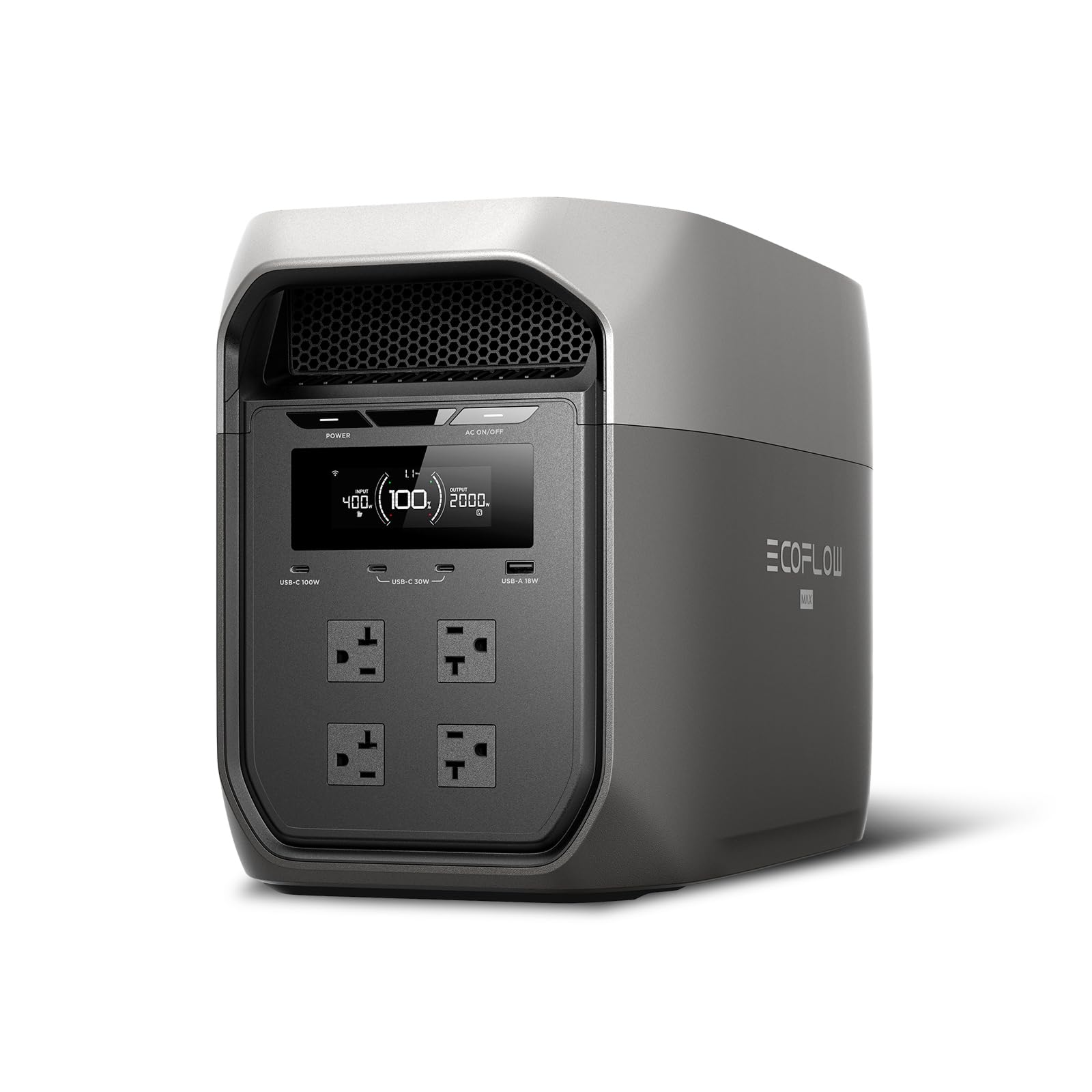
Features and Specifications
Battery Chemistry: LFP (lithium iron phosphate), 2048Wh capacity
Rated Output: 2400W continuous
X-Boost Output: 3400W for high-draw appliances
Recharge Time: 0-80% in 1.13 hours from AC
Intended Use: Home backup, RV camping, solar generator
Solar Input: Solar panel optional, sold separately
The headline number is the 2048Wh LFP battery. Lithium iron phosphate is the chemistry that has taken over this category because it tolerates deep discharges and high heat better than older lithium-ion packs, and it holds up over a longer service life. In practical terms, 2048Wh is roughly the capacity needed to run a refrigerator through an extended outage while still leaving headroom for lights, a router and phone charging.
The 2400W continuous rating sets the ceiling on what can be plugged in at once. Buyers running a sump pump, a space heater or a microwave should look at the 3400W X-Boost figure instead, since that mode is designed to start and carry appliances that momentarily pull more than the continuous rating. X-Boost is a compromise, not a free upgrade, but it widens the list of appliances that work without tripping the unit.
The 1.13-hour recharge figure is the specification that separates this model from most of the category. A 2048Wh pack that refills to 80% in a little over an hour means an outage that ends in the afternoon still leaves the unit ready for the evening. Solar charging is supported but the panel is optional and sold separately, so buyers planning off-grid use need to budget for that on top.
Trade-off: The fast AC recharge and the 2048Wh LFP pack put this unit in the premium tier of the category, so buyers who only need to top up phones and a laptop through a short outage are paying for capacity and charging speed they will rarely use.
Check the current price on Amazon
Build and Portability
A 2048Wh LFP pack is not light, and the DELTA 3 Max follows the pattern of the category: this is a unit with wheels-and-handle ergonomics or a two-person lift, not something that goes in a backpack. That matters for the buyer’s use case. Home backup means the unit sits in a closet or garage and gets rolled out twice a year, which suits the weight. RV camping means it gets loaded and unloaded at every stop, which makes the weight a recurring chore.
The build follows the established DELTA family pattern — a rigid shell with recessed handles, a front panel of AC outlets and DC ports, and a display that reports input, output and remaining runtime. Buyers who have owned an earlier DELTA will recognize the layout. The shell is designed to take the knocks of garage storage and truck beds rather than to be weatherproofed for permanent outdoor installation.
Trade-off: The capacity that makes this a credible home backup unit is the same thing that makes it awkward to carry up stairs or into a tent, so buyers who need true grab-and-go portability should look at a smaller pack.
Capacity and Runtime
The question buyers actually ask is what 2048Wh runs and for how long. The honest answer is that it depends entirely on the load, and the unit’s display is the tool for working it out. A refrigerator cycling on and off draws far less over a day than its rated wattage suggests, while a space heater draws its full rating continuously and will drain the pack quickly.
The practical framing is this: 2048Wh covers the essentials of a typical home — refrigeration, lighting, communications, medical devices — through a multi-hour to multi-day outage depending on how frugal the household is. It does not cover whole-home backup. Buyers picturing central air conditioning or an electric water heater running through an outage are looking at the wrong product category entirely.
Trade-off: The runtime buyers get is entirely a function of discipline during an outage, and a household that runs a heater or a hair dryer on the pack will find 2048Wh disappears far faster than expected.
Power and Output
The 2400W continuous rating covers most household essentials and a long list of power tools. The 3400W X-Boost rating is the more interesting figure, because it is aimed at appliances with motors and heating elements that pull a surge at startup. A refrigerator compressor, a circular saw or a microwave can all demand more than their steady-state rating for a moment, and X-Boost is designed to ride that out.
Two cautions apply. First, X-Boost is a mode, not a guarantee — some appliances with strict power requirements will still refuse to run, and buyers with a specific device in mind should verify compatibility before relying on it. Second, running high-draw appliances continuously shortens runtime dramatically, so the output rating and the capacity rating have to be read together.
Trade-off: The 3400W X-Boost headline is easy to over-read, and buyers should treat it as a way to start stubborn appliances rather than as a licence to run a whole workshop off one unit.
Charging and Maintenance
The 0-80% in 1.13 hours AC recharge is the feature that makes this unit livable day to day. Most portable power stations in this capacity class take considerably longer, which turns recharging into an overnight project. A fast top-up means the unit can be cycled back to ready between outages rather than sitting drained for a day.
Solar charging is supported, but the panel is optional and sold separately, so the total cost of an off-grid setup is higher than the unit price alone suggests. Buyers planning to rely on solar should size the panel array to the pack — an undersized panel will take days to refill 2048Wh, which defeats the purpose.
LFP chemistry is the maintenance story here. The pack tolerates being stored at partial charge and tolerates heat better than older chemistries, which suits a unit that lives in a garage. Buyers should still expect to top it up periodically during long storage so it is ready when needed.
Trade-off: The fast AC charging is the strongest argument for this unit, but the optional solar panel means buyers building an off-grid system are paying for a feature that only pays off if they also buy the accessories.
Who the DELTA 3 Max Is For — and Who It Is Not
This unit suits a specific buyer: a homeowner who wants one device that handles blackouts, weekend RV trips and occasional job-site power, and who values fast recharging enough to pay premium-tier money for it. It also suits the buyer who has been waiting for LFP chemistry to reach this capacity class and wants a pack that will hold up over years of storage.
It is not for the buyer who needs true whole-home backup — that is a permanently installed system, not a portable box. It is not for the backpacker or tent camper who needs something to carry by hand. And it is not for the buyer on a tight budget who only needs to keep phones and a laptop alive through a short outage, because the capacity and charging speed here are far beyond that job.
Trade-off: The DELTA 3 Max is a strong all-rounder, but its price tier means buyers should be honest about whether they need 2048Wh and 1.13-hour charging or whether a smaller, cheaper unit would cover their actual outages.
FAQ
-
How long does the EF ECOFLOW DELTA 3 Max take to charge?
From a standard AC outlet, the unit charges from 0 to 80% in 1.13 hours, which is among the fastest in its capacity class. A full charge takes a little longer, and solar charging times depend entirely on the panel array the buyer connects. -
What can the DELTA 3 Max power during an outage?
The 2400W continuous output covers refrigeration, lighting, routers, phones, medical devices and most power tools. The 3400W X-Boost mode extends that to appliances that surge at startup, such as a refrigerator compressor or a microwave. -
Is the 2048Wh battery enough for a home blackout?
For most households, 2048Wh covers the essentials — refrigeration, lights, communications — through a multi-hour to multi-day outage, depending on how disciplined the household is about what gets plugged in. It is not sized for whole-home backup or for continuous heating and cooling. -
Does the DELTA 3 Max come with a solar panel?
No. The product listing describes it as a solar generator with the solar panel optional, so buyers planning off-grid charging need to purchase a compatible panel separately and budget for it. -
What is LFP and why does it matter?
LFP stands for lithium iron phosphate, a battery chemistry that tolerates deep discharges, heat and long storage better than older lithium-ion formulations. It is the reason this unit is a reasonable long-term purchase rather than a disposable one. -
Can the DELTA 3 Max run an RV?
It is marketed for RV camping and can power an RV’s essentials — lights, fridge, electronics — for a stretch, but it is not a replacement for a full RV electrical system. Buyers should size their expectations against the 2048Wh capacity and their actual draw. -
How much does the DELTA 3 Max weigh?
The unit is heavy enough that it is a two-person lift or a wheeled move rather than a one-hand carry. Buyers planning to move it frequently should factor that into the decision. -
Is X-Boost safe for all appliances?
X-Boost is designed for appliances that surge at startup, but not every device will run on it, and some appliances with strict power requirements will refuse to start. Buyers with a specific device in mind should verify compatibility before relying on X-Boost. -
Can the DELTA 3 Max be stored in a garage?
Yes. LFP chemistry tolerates heat and partial-charge storage better than older lithium-ion packs, which makes a garage a reasonable home for the unit. Periodic top-ups during long storage keep it ready for an outage. -
Who should not buy the DELTA 3 Max?
Buyers who need whole-home backup, buyers who need true carry-it-in-a-backpack portability, and buyers who only need to charge phones and a laptop through a short outage are all better served by a different product or a smaller unit.
Bottom Line
The EF ECOFLOW DELTA 3 Max is the right pick for a household that wants one unit to cover outages, RV weekends and job-site power, and that values the 1.13-hour recharge and LFP chemistry enough to pay premium-tier money. Buyers who need whole-home backup or true hand-carried portability should look elsewhere. For everyone in between, the EF ECOFLOW DELTA 3 Max portable power station is the one to check the current price on.