Why there are Amazon links here: Brave Review is paid a commission for qualifying Amazon purchases made through the links below. Your price does not change, and using our links is entirely optional. How this works
Emporia Vue 3 Home Energy Monitor: Whole-Home Power Data Without the Guesswork
The Emporia Vue 3 is a whole-home electricity monitor for homeowners who want to see where the power bill actually goes. It reads real-time consumption, tracks solar production and net metering, and feeds that data to a phone app. This review covers what the hardware does, how it installs, what the specs mean in practice, and which households get real value from it. Buyers who just want a smart plug with a wattage readout should look elsewhere; this is panel-level gear.
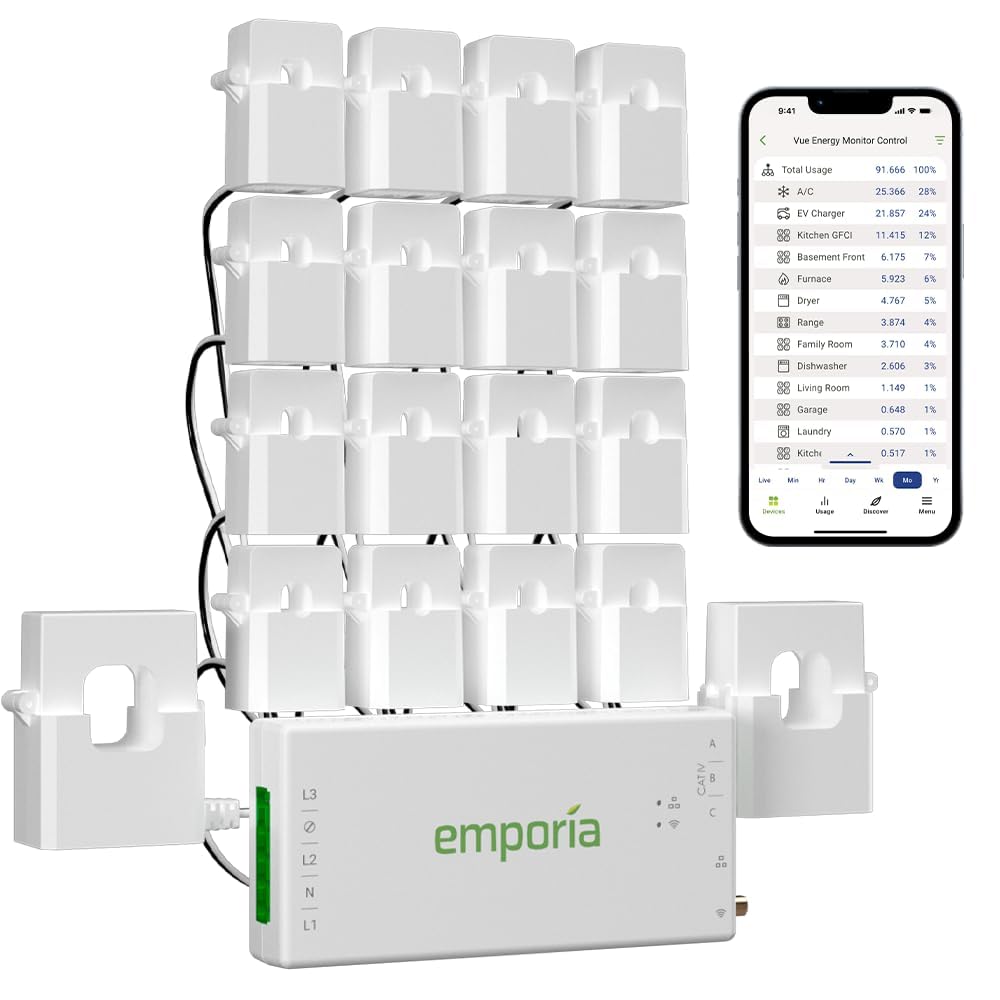
Features and Specifications
Product Type: Whole-home energy monitor and smart home automation module
Function: Real-time electricity usage monitoring and power consumption metering
Solar Support: Solar production tracking and net metering
Safety Certification: UL certified
Connectivity: App-based monitoring with smart home automation integration
Installation: In-panel module wired to household circuits
Price Tier: Mid-range, roughly $200
The core job here is measurement at the breaker panel rather than at a single outlet. A plug-in meter tells a buyer what one appliance draws; the Vue 3 is built to read the whole service and break consumption down by circuit. That distinction is the entire reason the product exists and the reason it costs what it does.
The UL certification matters more than it might seem on a spec sheet. Anything wired inside a load center sits next to live mains voltage, and a listed device is the difference between a DIY-friendly install and an insurance problem. The solar and net metering support is the other headline feature: households with panels can watch production and consumption side by side instead of reconciling two separate utility reports.
Check the current price on Amazon
Build and Installation
The unit is a panel-mounted module with current sensors that clamp around individual circuit conductors. That means installation happens inside the electrical panel, not at a wall outlet. Buyers comfortable removing a panel cover and identifying breakers can generally handle it; everyone else should budget for an electrician.
The practical constraint is panel space. A full load center with no spare room for sensor clamps is a real obstacle, and older panels with crowded wiring make the job slower. Buyers should open the panel and count open circuits before ordering, because the number of monitored circuits is the limiting factor on how useful the data becomes.
This is also the point where the product separates itself from cheap alternatives. A single-sensor monitor gives one whole-home number. Multiple clamps give a breakdown — HVAC versus water heater versus EV charger — and that breakdown is what actually changes behavior. The trade-off is that the install is a genuine electrical job, not a five-minute setup.
Power Monitoring and Solar Net Metering
Real-time monitoring is the feature that earns the price. Utilities bill monthly and report in aggregate; the Vue 3 shows consumption as it happens, which lets a homeowner switch on a device and watch the number move. That immediate feedback loop is how buyers find the phantom loads and the always-on draws that quietly pad a bill.
Solar and net metering support extend the same logic to production. A household with panels can see generation against consumption in the same dashboard rather than waiting for a true-up statement. For anyone sizing a battery or deciding whether an EV should charge midday, that comparison is the whole point.
The caution is data without a plan. A monitor produces numbers, not savings. Households that will not act on circuit-level data — changing thermostat schedules, shifting laundry, killing standby loads — get less from this than from a cheaper single-point meter. The value scales with how much the buyer intends to change.
App, Automation and Daily Use
The smart home automation angle is what separates this from a passive meter. Consumption data can drive automation rules, so high-draw events can trigger notifications or device responses rather than sitting in a report nobody opens. That is a meaningful step up from a display that only shows a running total.
Daily use centers on the app: live readings, historical trends, and per-circuit comparisons. The quality of that experience depends on a stable Wi-Fi connection at the panel location, which is worth checking before install. A weak signal at the load center undermines the whole product, since the hardware is only as good as the data it can deliver.
Trade-off: The Vue 3 is a panel-level instrument priced accordingly — buyers who want plug-in simplicity, renters who cannot touch the electrical panel, or households unwilling to act on circuit data will pay for capability they never use.
Who It Suits and Who It Does Not
The strongest fit is a homeowner with a high or confusing power bill, a panel with spare capacity, and the intent to actually change usage. Add solar panels or an EV charger and the case gets stronger, because net metering and circuit-level tracking answer questions a monthly statement cannot.
The poor fit is just as clear. Renters cannot modify a panel. Households in apartments or with sealed panels have no path to install. Buyers who want a simple "what is my house using right now" number can get that from a much cheaper single-sensor device, and buyers who will not act on the data should not pay for the resolution.
FAQ
-
What does the Emporia Vue 3 energy monitor actually measure?
It measures whole-home electricity consumption in real time and breaks usage down by monitored circuit, with support for solar production and net metering. -
Does the Emporia Vue 3 need professional installation?
It installs inside the electrical panel, so it involves mains wiring. Handy homeowners often do it themselves, but an electrician is the safer choice for anyone unsure about panel work. -
Can the Vue 3 monitor solar panels and net metering?
Yes. Solar production tracking and net metering are named features, which makes it useful for households comparing generation against consumption. -
Does the Vue 3 work without Wi-Fi?
The monitoring and automation features depend on a network connection to deliver data to the app, so a stable Wi-Fi signal at the panel is effectively a requirement. -
Is the Emporia Vue 3 UL certified?
Yes. UL certification is stated in the product name, which matters for a device wired into a load center. -
How many circuits can the Vue 3 track?
Circuit count depends on the sensor configuration and available panel space. Buyers should confirm open breaker slots before ordering. -
Is the Vue 3 good for renters?
Generally no. It requires access to and modification of the electrical panel, which most rental agreements do not permit. -
Will the Vue 3 lower a power bill on its own?
No. It provides measurement and automation triggers. Savings come from what the household does with that information. -
Does the Vue 3 integrate with smart home automation?
Yes. It is marketed as a smart home automation module, so consumption data can drive rules and notifications rather than sitting in a static report. -
Who should skip the Emporia Vue 3?
Households that cannot access their panel, buyers who only want a single whole-home reading, and anyone who will not act on circuit-level data.
Bottom Line
The EMPORIA Vue 3 Home Energy Monitor is the right buy for a homeowner who wants circuit-level electricity data, solar and net metering visibility, and automation hooks in one UL-certified panel module. It is not a renter-friendly gadget and it is not a magic bill reducer — it is a measurement tool, and it earns its mid-range price only when the household intends to use what it reports. Buyers with panel access and a real question about their power use should check the current price; everyone else can solve the problem more cheaply.
