Why there are Amazon links here: Brave Review is paid a commission for qualifying Amazon purchases made through the links below. Your price does not change, and using our links is entirely optional. How this works
Best Energy Monitoring Plug for Appliances
An energy monitoring plug turns any wall outlet into a meter, showing exactly what a fridge, space heater, or gaming PC draws over time. This guide covers five picks: three Wi-Fi smart plugs for scheduled, app-based tracking, and two standalone watt meters for quick spot checks without an account or router. The overview table below lines up each option by key spec, best use, and price tier, so a pick can be made in under a minute before reading the full reviews.
The Picks at a Glance
| Product | Key Spec | Best Use | Price Tier |
|---|---|---|---|
| Emporia Energy Monitoring Smart Plug (4 Pack) | 15A, 2.4GHz Wi-Fi, Alexa/Google | Whole-room appliance tracking | Mid |
| Tapo P115 Smart Plug (4 Pack) | 15A, 1800W max, ETL certified | Certified everyday smart plug | Mid |
| Tuya Smart Plug with Energy Monitoring (4 Pack) | 15A, 1800W max, ETL/FCC listed | Budget multi-pack tracking | Budget |
| Upgraded Watt Meter Power Meter Plug | 7-mode backlit display, overload protection | No-app spot checks | Budget |
| WiFi Smart Plug Energy Monitoring Socket | 16A max, 3680W, AC85-265V | High-draw appliances | Budget |
1. Emporia Energy Monitoring Smart Plug (4 Pack)
Type: Wi-Fi smart plug with energy monitoring
Pack Size: 4 plugs
Amperage: 15A
Connectivity: 2.4GHz Wi-Fi only
Voice Control: Alexa and Google Home
App Features: Timer, scheduling, mobile app
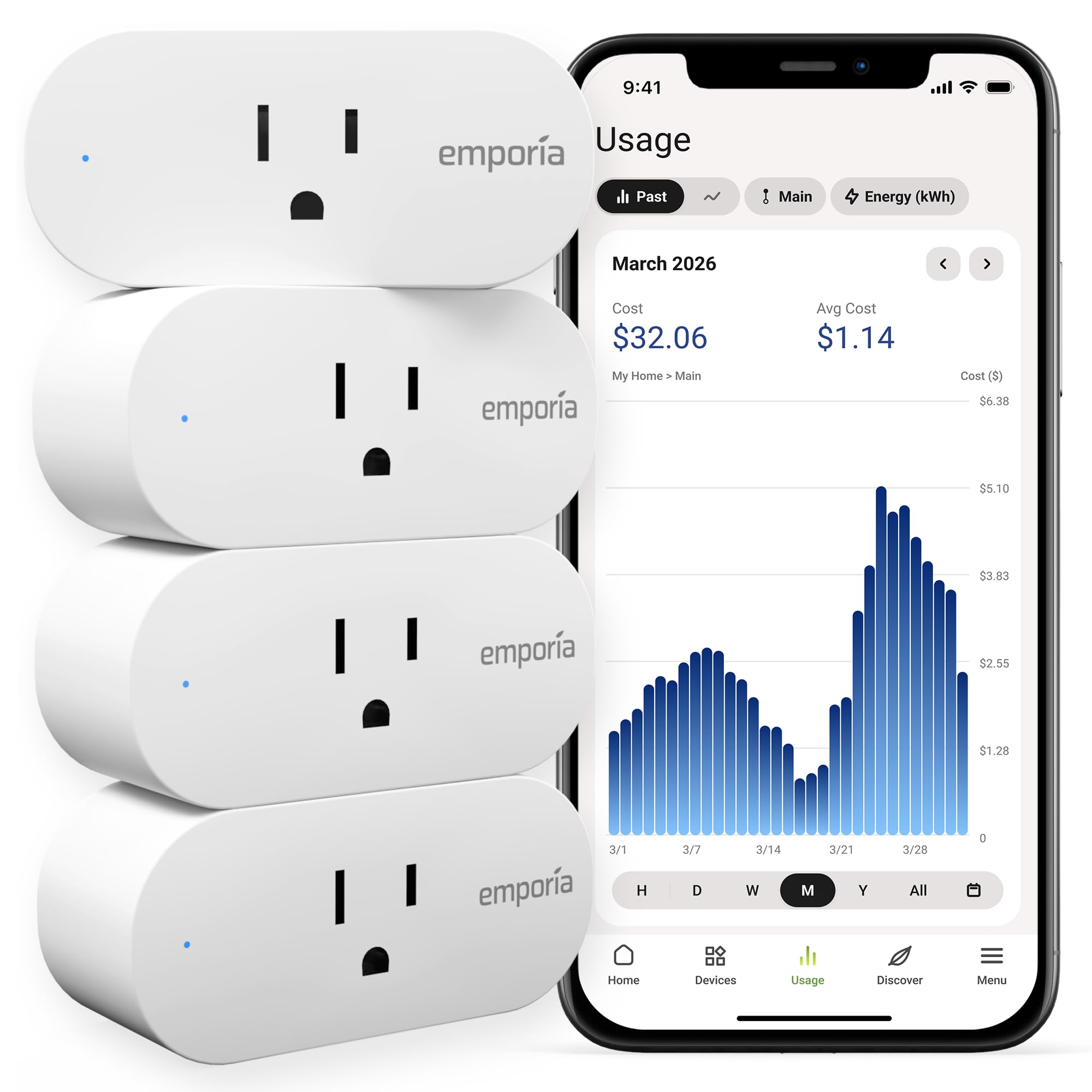
Emporia Energy Monitoring Smart Plug (4 Pack)
The Emporia four-pack is built around a compact plug body that fits a standard 15A outlet, with the monitoring hardware reporting consumption back to a mobile app over 2.4GHz Wi-Fi. Scheduling and timers run alongside the energy readout, so a plug can both cut power to a device at set hours and show what that device used before the cut. Alexa and Google Home voice control handle on/off commands, while the app carries the actual consumption data. The four-plug format suits a household that wants to map several appliances at once rather than test one at a time.
This pick earns its place for buyers who want to compare multiple appliances in the same app without buying plugs one by one. A four-pack covers a fridge, a TV stack, a washer, and a space heater simultaneously, which is the fastest way to find the real power hogs in a home. The main caution is the 2.4GHz-only radio: a router that broadcasts a single 5GHz band, or a mesh system that separates bands awkwardly, can make setup frustrating. Buyers on newer dual-band-only networks should confirm a 2.4GHz band is available before committing.
Trade-off: The four-pack price is higher upfront than a single plug, and the 2.4GHz-only radio limits setup on some modern routers.
2. Tapo P115 Smart Plug (4 Pack)
Type: Wi-Fi smart plug with energy monitoring
Pack Size: 4 plugs
Amperage: 15A
Max Load: 1800W
Certification: ETL certified
Compatibility: Alexa, Google Home, Samsung SmartThings
Connectivity: 2.4GHz Wi-Fi only

Tapo P115 Smart Plug Wi-Fi, Energy Monitoring (4-Pack)
The Tapo P115 pairs a 15A, 1800W-rated plug body with energy monitoring and a timer, and it carries ETL certification for the electrical build. Three ecosystems are supported — Alexa, Google Home, and Samsung SmartThings — which is broader than most plugs at this tier and matters for households already split across platforms. The four-pack covers a full room of appliances, and the 1800W ceiling handles most household loads short of large heaters and dryers. Monitoring data lives in the Tapo app alongside the schedule controls.
This is the pick for buyers who want a certified plug that speaks to whichever smart home hub is already in the house, without locking into a single ecosystem. The 1800W maximum is the honest limit here: a plug-in space heater on high, a microwave, or a window AC unit can push past it, and the plug is not the right tool for those loads. Buyers shopping specifically for high-draw appliances should look at the 16A option further down instead.
Trade-off: The 1800W ceiling rules out the biggest household loads, so this pack is best for fridges, TVs, fans, and small kitchen appliances rather than heaters or AC units.
3. Tuya Smart Plug with Energy Monitoring (4 Pack)
Type: Wi-Fi smart plug with energy monitoring
Pack Size: 4 plugs
Amperage: 15A
Max Load: 1800W
Certification: ETL listed, FCC certified
App: Tuya App
Voice Control: Alexa and Google Assistant
Connectivity: 2.4GHz Wi-Fi

Tuya Smart Plug Outlet with Energy Monitoring (4-Pack)
The Tuya four-pack runs on the Tuya app, a widely used platform that supports schedules, timers, and energy monitoring across a 15A, 1800W-rated plug. ETL listing and FCC certification cover the electrical and radio sides respectively, and Alexa plus Google Assistant handle voice commands. The four-plug count makes it a direct budget alternative to the two picks above, with the same core feature set at the entry price tier. The plug body is a standard single-outlet design that fits most wall plates without blocking the neighboring socket.
This pick suits buyers who want maximum plug count for the money and are comfortable managing devices in the Tuya app rather than a first-party ecosystem app. It is the cheapest route to four monitoring plugs, which makes it a sensible starter set for a renter testing a whole apartment. The caution is app polish: Tuya is a third-party platform shared across many brands, and its interface and update cadence are less tightly controlled than a single-brand app. Buyers who want a tightly integrated experience may prefer the Tapo or Emporia route.
Trade-off: The Tuya app is a shared third-party platform, so the experience depends on a vendor the buyer did not choose directly.
4. Upgraded Watt Meter Power Meter Plug
Type: Standalone plug-in watt meter
Display: Backlit, 7 modes
Functions: Electrical usage monitor, voltage, amps, consumption
Protection: Overload protection
Connectivity: None — no app or Wi-Fi

Upgraded Watt Meter Power Meter Plug with 7-Mode Display
This is a different tool from the smart plugs: a standalone watt meter that plugs into the wall, accepts an appliance, and reads out voltage, amps, and consumption on a backlit display across seven modes. There is no app, no Wi-Fi, and no account — the numbers appear on the device itself, which makes it the fastest way to test a single appliance. Overload protection guards the meter against a load that exceeds its rating. The backlit screen matters for reading results in a dim garage or behind a fridge.
This pick suits buyers who want a one-off measurement rather than ongoing monitoring: check what an old fridge draws, compare two space heaters, or confirm a suspected power hog before replacing it. It is also the right tool for anyone who does not want another app or a smart home account. The caution is that it measures one device at a time and stores nothing — there is no history, no scheduling, and no remote readout, so long-term tracking means writing numbers down by hand.
Trade-off: No app, no history, and one device at a time — this is a diagnostic tool, not a permanent monitoring solution.
5. WiFi Smart Plug Energy Monitoring Socket
Type: Wi-Fi smart plug with energy monitoring
Max Current: 16A
Max Load: 3680W
Voltage Range: AC85-265V
Plug Standard: US plug
Connectivity: Wi-Fi

WiFi Smart Plug Energy Monitoring Socket, 16A, 3680W
This single Wi-Fi plug carries a 16A maximum current and a 3680W maximum load, the highest rating in this roundup, and accepts AC85-265V input. That headroom is the point: it can sit in front of a plug-in space heater, a window AC unit, or a heavy kitchen appliance that would exceed the 1800W ceiling on the other smart plugs here. Energy monitoring runs over Wi-Fi, so consumption data reaches a phone rather than a built-in screen. It ships as a single US-plug unit rather than a multi-pack.
This pick earns its place for buyers with one genuinely high-draw appliance to track — the heater or AC unit that dominates a power bill. It is also the sensible choice for a single measurement point where a four-pack would be wasted. The caution is the single-unit format and the high-current rating working against each other: one plug means no side-by-side comparison, and a 16A device demands a circuit that can actually carry that load, so an older outlet on a shared circuit is not the place for it. Buyers should confirm the circuit before pushing a heavy appliance through any plug.
Trade-off: One plug only, and the 16A rating is wasted unless the wall circuit can safely carry that current.
Before You Buy
- Amperage and load: Match the plug’s rating to the appliance. A 15A/1800W plug covers fridges, TVs, and small kitchen gear; a 16A/3680W unit is needed for heaters and AC units.
- Wi-Fi band: Every smart plug here is 2.4GHz only. A router without a 2.4GHz band, or one that hides it behind a single SSID, will block setup.
- App or no app: Smart plugs need an account and a phone; a standalone watt meter needs neither. Buyers who want a quick reading without setup should choose the meter.
- Pack size versus single: A four-pack suits whole-home testing; a single plug suits one high-draw appliance. Buying more plugs than needed adds cost without adding data.
- Certification: ETL or FCC listing signals the electrical and radio build has been tested. It is worth checking on budget-tier plugs.
- Circuit capacity: A high-current plug does not upgrade the wiring behind the outlet. Confirm the circuit before running a heavy appliance through any monitoring plug.
- Data retention: App-based plugs keep consumption history; the standalone meter does not. Long-term tracking needs a smart plug.
Frequently Asked Questions
-
What is an energy monitoring plug used for? It sits between a wall outlet and an appliance and measures how much power that appliance draws, either on a display or in a phone app. The data shows which devices cost the most to run.
-
Do energy monitoring plugs need Wi-Fi? The smart plugs in this roundup do, on the 2.4GHz band only. The standalone watt meter does not — it reads out on its own display with no network or account.
-
Can an energy monitoring plug handle a space heater? Only a plug rated above the heater’s draw. The 1800W smart plugs here are not suited to most heaters; the 16A, 3680W plug is the one built for that load, and the circuit must support it.
-
Is a watt meter or a smart plug better for tracking appliances? A watt meter is faster for a one-off check and needs no setup. A smart plug is better for ongoing tracking, scheduling, and comparing several appliances over time.
-
Why do these smart plugs only work on 2.4GHz Wi-Fi? The 2.4GHz band has longer range and better wall penetration than 5GHz, which suits plugs tucked behind appliances. The trade-off is that dual-band routers must expose a 2.4GHz network during setup.
-
Can an energy monitoring plug lower a power bill? The plug itself does not cut usage, but the data it provides shows which appliances are worth unplugging, scheduling, or replacing. Pairing monitoring with the built-in timers turns that data into action.
Bottom Line
For most households, the Tapo P115 four-pack is the best energy monitoring plug for appliances: ETL certified, broadly compatible across Alexa, Google Home, and SmartThings, and rated for the everyday loads that dominate a home. Buyers with one high-draw heater or AC unit should step up to the 16A, 3680W single plug instead, and anyone who just wants a quick reading without an app should grab the standalone watt meter.
