Why there are Amazon links here: Brave Review is paid a commission for qualifying Amazon purchases made through the links below. Your price does not change, and using our links is entirely optional. How this works
EnginStar Portable Power Station 300W: A 296Wh Backup for CPAP and Blackouts
The EnginStar Portable Power Station 300W is a compact 296Wh battery pack built around a pure sine wave AC outlet, aimed at campers, travelers and anyone who wants a quiet backup for a CPAP machine or a short blackout. This review covers what the unit is built to do, where its capacity and output realistically land, and which buyers should look elsewhere. The short version: it suits light, occasional loads and overnight CPAP use, not whole-home backup or high-draw appliances.
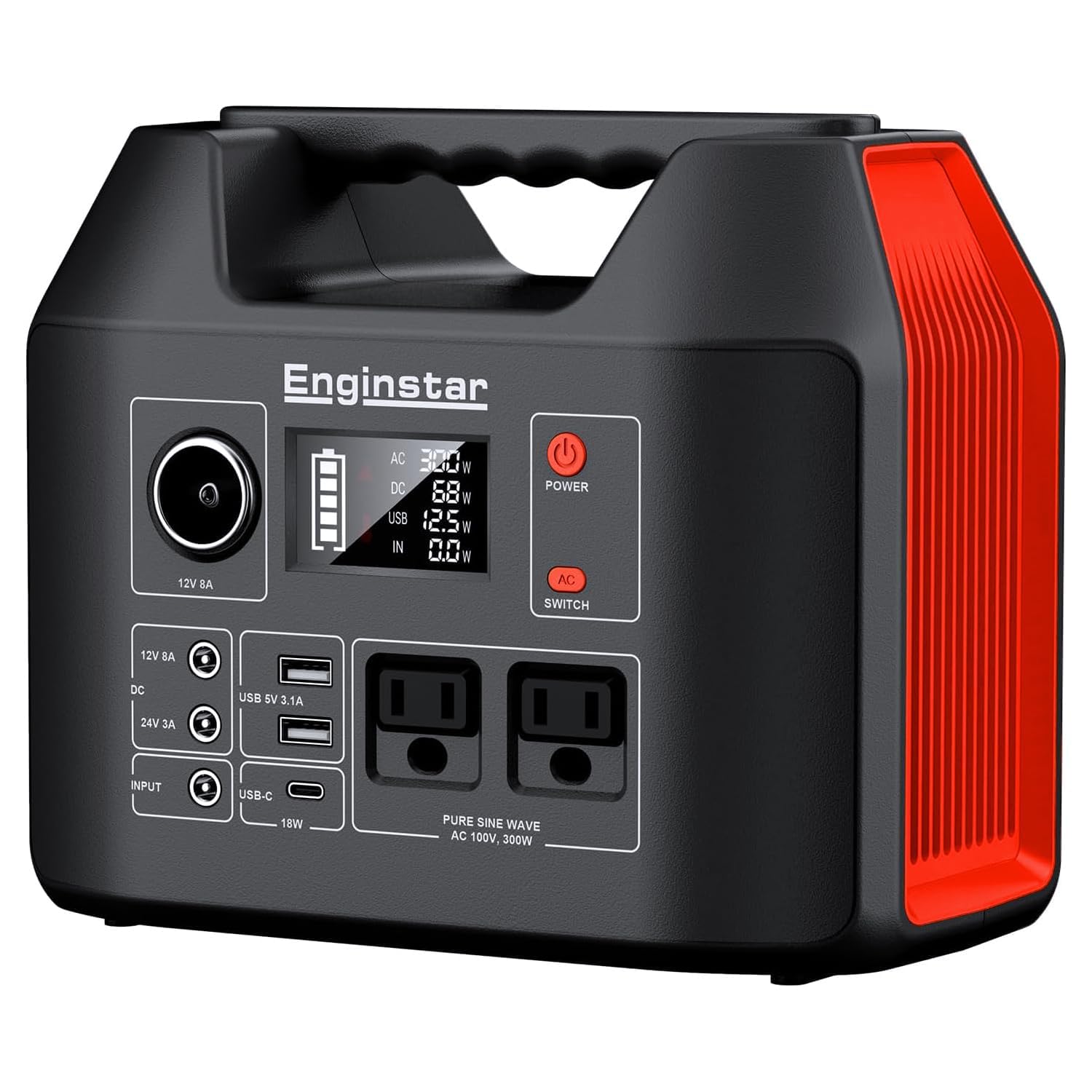
Features and Specifications
Type: Portable power station / solar generator
Rated AC Output: 300W
Battery Capacity: 296Wh (listed as 80000mAh)
AC Outlet Type: Pure sine wave
Intended Use: Outdoors, camping, travel, emergency blackout backup
Notable Load: CPAP machines and similar small medical devices
Charging Input: Solar panel compatible
Color: Black
The headline figure here is the pairing of a 300W AC inverter with a 296Wh battery. Those two numbers describe a small, portable unit rather than a home backup system: the inverter sets the ceiling on what can be plugged in at once, and the battery sets how long it can run before a recharge. The pure sine wave outlet is the detail that matters most for sensitive electronics, because it delivers the smooth AC waveform that CPAP machines, laptops and audio gear expect from a wall socket.
The 80000mAh figure in the product name is the same capacity expressed in a different unit, which is common in this category. Buyers comparing listings will see the same pack described both ways, and the watt-hour number is the more useful one for estimating runtime. The solar generator label signals that the unit accepts a panel input for off-grid recharging, which is what separates a power station from a sealed emergency battery.
Build and Portability
This is a carry-it-with-one-hand class of power station, not a wheeled unit. The form factor that 296Wh and a 300W inverter imply is a small rectangular box with a top handle, sized to sit in a car trunk, a tent corner or a closet shelf without a dedicated storage plan. Buyers who have handled similar units in this class will recognize the layout: outlets and ports on one face, a display or indicator panel on the front, and a charging input around the back.
The trade-off in a unit this size is that portability is bought with capacity. A pack that one person can lift comfortably cannot also run a space heater or a full-size refrigerator for long, and the housing on a budget-tier station is typically functional plastic rather than armored construction. Buyers planning to leave the unit in a truck bed or a damp campsite should treat it as a fair-weather tool and store it dry.
Capacity and Runtime Expectations
Runtime is where the watt-hour number earns its keep. A 296Wh battery running a load of roughly 100W delivers somewhere in the neighborhood of two and a half hours of use before inverter losses, and a load near the 300W ceiling cuts that to well under an hour. That math is what makes the unit a fit for small, intermittent loads — a CPAP machine through the night, a laptop and phone recharge, a fan or a lamp — rather than continuous high-draw appliances.
CPAP users are the clearest audience for this capacity tier, since a typical machine draws far less than the inverter’s ceiling and a single night’s sleep fits inside the pack. Buyers should check their own device’s draw against the 300W rating before assuming compatibility, and anyone with a heated humidifier running at full tilt sits closer to the limit than the headline number suggests. For camping, the realistic pattern is a day of small recharges followed by an evening of lighting, not air conditioning or an electric kettle.
Power Output and Pure Sine Wave AC
The pure sine wave outlet is the feature that justifies the unit’s place in a travel and emergency kit. Modified sine wave inverters, common on cheaper boxes, can cause sensitive electronics to buzz, run hot or refuse to charge; a pure sine wave output behaves like household power, which is why the product name leads with it. For a CPAP machine, a laptop brick or a camera battery charger, that compatibility removes a real source of doubt.
The 300W rating also defines the boundary of what the station is for. Small kitchen appliances, power tools and anything with a heating element draw more than this inverter will supply, and buyers who need to run those loads should be shopping in a higher wattage class entirely. Within its lane — electronics, lighting, medical devices and small fans — the output is well matched to the battery, so the pack and the inverter are not fighting each other.
Solar Recharging and Maintenance
The solar generator designation means the unit accepts a panel input, which is what makes multi-day off-grid use possible in principle. Panel output varies with sun, angle and cloud cover, so solar recharging on a station this size is a slow top-up rather than a fast refill, and buyers should plan on wall charging before a trip and solar as a supplement. The practical routine is to charge at home, use the pack down over a day or two, and top it back up at the next outlet.
Battery maintenance for a unit like this is mostly about storage discipline. Lithium packs in this class hold charge best when kept cool, dry and partially charged rather than drained flat for months, so a station that lives in a closet between blackouts should be topped up on a schedule. Buyers who plan to store it in a hot garage or a freezing shed should reconsider the location, since temperature extremes are the main thing that shortens the life of a pack like this.
Who It Suits and Who It Does Not
The EnginStar 300W fits three buyer profiles well: campers who want quiet power for lights, phones and a fan; travelers who need a portable outlet for laptops and cameras; and CPAP users who want a bedside backup that keeps running when the grid drops. It also works as a general emergency pack for apartment dwellers who need to keep phones and a router alive through a short outage. In each case the load is small, intermittent and sensitive enough to benefit from clean sine wave power.
It is a poor fit for buyers with bigger ambitions. Anyone hoping to run a refrigerator, a space heater, a microwave or power tools needs a station with a far higher wattage rating and a much larger battery. Buyers who want to power a whole home during a multi-day outage, or who need to run high-draw appliances continuously, will find this unit’s ceiling frustrating rather than convenient.
Trade-off: The compact, budget-friendly design trades capacity and ruggedness for portability, so the unit covers small electronics and CPAP use well but cannot carry high-draw appliances or shrug off rough outdoor storage.
Check the current price on Amazon
FAQ
-
What can the EnginStar 300W power station run?
It is built for small, sensitive loads: CPAP machines, laptops, phones, cameras, fans, lights and a router. The 300W AC ceiling rules out heaters, microwaves, kettles and power tools. -
Is a pure sine wave outlet important for a CPAP machine?
Yes. Pure sine wave AC matches the smooth waveform from a wall outlet, which is what sensitive medical and electronic devices are designed to accept. Modified sine wave output can cause buzzing or charging problems. -
How long does a 296Wh battery last?
Runtime depends on the load. A device drawing around 100W runs for roughly two and a half hours, while a load near the 300W limit lasts well under an hour. Small intermittent loads stretch much further. -
Can the EnginStar 300W be charged with a solar panel?
The unit is sold as a solar generator, which means it accepts a panel input for off-grid recharging. Solar is a slow top-up on a pack this size, so wall charging before a trip remains the practical starting point. -
Is 300W enough for camping?
For lights, phone and camera charging, a fan and a small speaker, yes. For a camp stove, an electric cooler or anything with a heating element, no — those loads exceed the inverter’s rating. -
Can it run a refrigerator during a blackout?
Not realistically. A full-size refrigerator draws more than this inverter supplies, and even a small unit would drain a 296Wh battery quickly. This station is for electronics and medical devices, not major appliances. -
How should the battery be stored between uses?
Keep it cool, dry and partially charged rather than fully drained. Topping it up on a regular schedule preserves the pack, and temperature extremes should be avoided. -
Does the 80000mAh figure mean a bigger battery than 296Wh?
No — they describe the same capacity in different units. Watt-hours are the more useful figure for estimating how long a given load will run. -
Who should not buy this power station?
Buyers who need to run power tools, kitchen appliances or a whole home during a long outage should look at a higher wattage, higher capacity unit instead.
Bottom Line
The EnginStar Portable Power Station 300W is a sensible buy for a narrow, well-defined job: keeping a CPAP machine, a laptop or a few small devices running through a night or a short blackout, with pure sine wave output that sensitive electronics accept without complaint. Its 296Wh battery and 300W inverter are honestly matched to that role, and the solar input adds off-grid flexibility for campers. Buyers who need to run appliances or weather a multi-day outage should step up to a larger class — everyone else can check the current price on Amazon and decide.