Why there are Amazon links here: Brave Review is paid a commission for qualifying Amazon purchases made through the links below. Your price does not change, and using our links is entirely optional. How this works
EnginStar Solar Generator vs ENOFLO 300W Portable Power Station: Capacity Against Carry Weight
Two compact power stations at the same output rating, split by one number: the EnginStar carries 296Wh of lithium capacity, the ENOFLO carries 228Wh. That gap is the whole decision.
The EnginStar suits buyers who need to run a device longer between charges and do not mind a heavier box. The ENOFLO suits buyers who want a lighter unit for short trips and single-device backup. Both are budget-tier 300W stations with pure sine wave AC outlets, so the choice comes down to capacity per pound rather than features.
EnginStar Solar Generator, 300W Portable Power Station
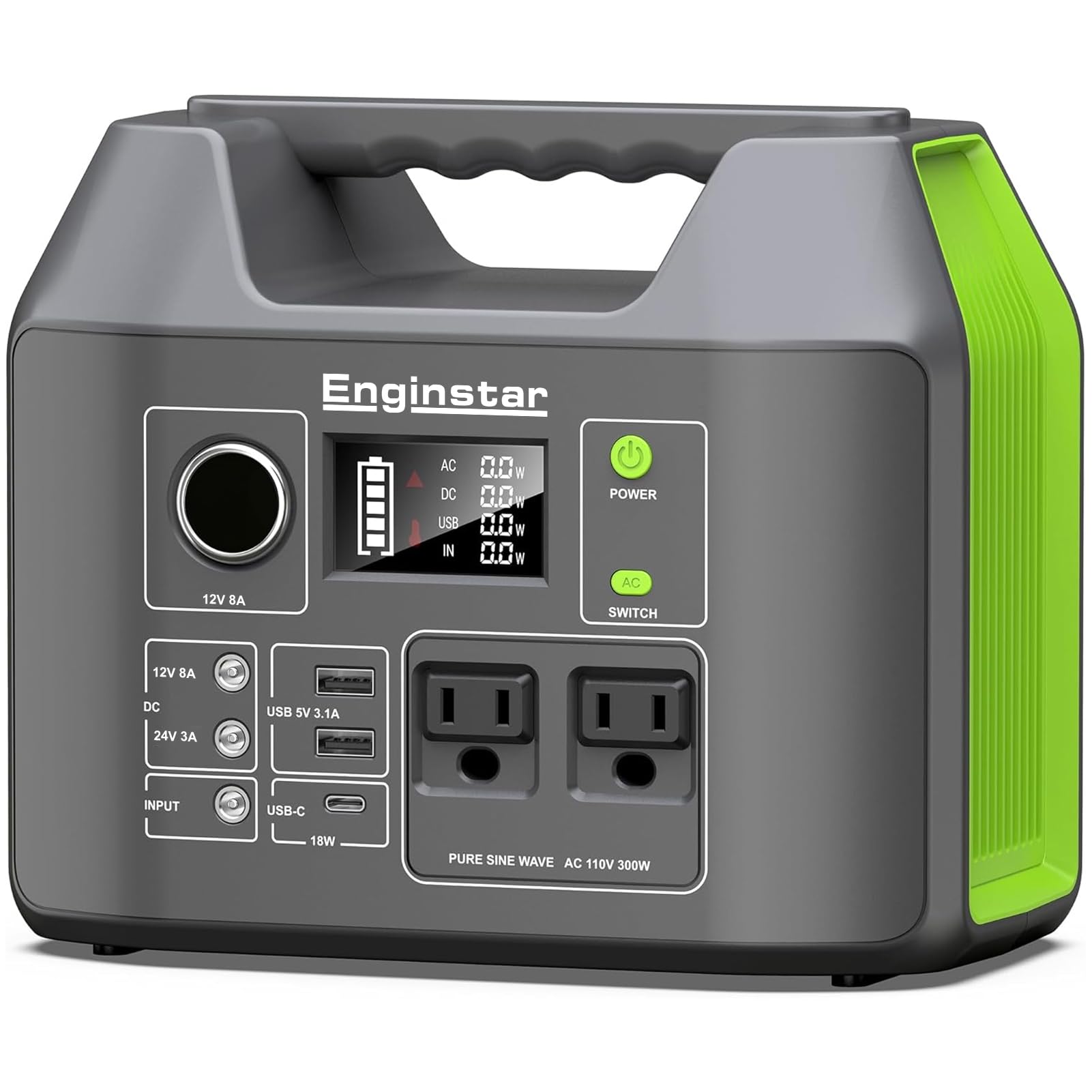
Rated Output: 300W
Battery Capacity: 296Wh (80,000mAh)
Battery Type: Lithium
AC Outlets: Two 110V pure sine wave
Intended Use: Camping, road trip, RV, blackout backup
Check the current price on Amazon
The EnginStar is the larger of the two on paper and in the hand. Its 296Wh pack and two AC outlets give it enough headroom to run a laptop and a phone charger together, or to keep a small fridge cycling through a short outage. Pure sine wave output matters here: it is the waveform that sensitive electronics, from laptop bricks to CPAP machines, are built to accept.
The capacity advantage cuts both ways. A pack this size is heavier and bulkier than a 228Wh unit, so it fits car camping, RV storage, and home emergency shelves better than it fits a daypack. Buyers who hike to a campsite and count ounces should look elsewhere in this category.
Trade-off: The extra 68Wh comes at the cost of weight and footprint, so the EnginStar rewards buyers who leave it in a vehicle or a closet rather than carrying it far.
ENOFLO 300W Portable Power Station

Rated Output: 300W
Battery Capacity: 228Wh (61,600mAh)
Battery Type: Lithium
AC Outlets: 110V pure sine wave
Intended Use: CPAP, camping, RV, home emergency
Check the current price on Amazon
The ENOFLO matches the EnginStar’s 300W rating with a smaller 228Wh pack, which makes it the more portable of the pair. The name points at CPAP use directly, and that is a sensible fit: a single medical device drawn overnight is exactly the load a pack this size is sized for. Pure sine wave output keeps that use safe for the device’s motor.
What the ENOFLO gives up is runtime. Fewer watt-hours means fewer hours before the pack needs a wall outlet or a solar panel, and heavy loads drain it faster. Buyers who want to run several devices at once or power something with a compressor should size up rather than settle here.
Trade-off: The lighter build and smaller reserve leave little margin for multi-device use, so the ENOFLO is a single-purpose pack rather than a whole-campsite power source.
Side-by-Side Specifications
| Specification | EnginStar | ENOFLO |
|---|---|---|
| Rated output | 300W | 300W |
| Battery capacity | 296Wh | 228Wh |
| Capacity in mAh | 80,000mAh | 61,600mAh |
| Battery type | Lithium | Lithium |
| AC outlets | Two 110V pure sine wave | 110V pure sine wave |
| Intended use | Camping, road trip, RV, blackout | CPAP, camping, RV, home emergency |
| Price tier | Budget | Budget |
Reading the Differences
Capacity is the first separator. The EnginStar holds roughly a third more energy than the ENOFLO, and that ratio carries straight through to runtime at any given load. A buyer comparing the two on hours-per-charge will find the EnginStar ahead on every device they own.
Outlet count is the second. Two AC outlets on the EnginStar allow two AC devices at once; the ENOFLO’s single AC outlet means buyers rotate devices or lean on USB ports for the rest. For a laptop plus a lamp, that difference is real. For a CPAP alone, it is not.
Portability is the third, and it favors the ENOFLO. A 228Wh pack is the smaller object, and smaller matters for buyers who move the station between a tent, a car, and a bedside table. Neither unit is a pocket device, but the ENOFLO is the easier one to carry one-handed up a trail.
Both share the same 300W ceiling, so neither will run a space heater, a microwave, or a full-size coffee maker. That limit is a category fact, not a flaw in either product, and buyers with those loads need a larger class of station entirely.
Which Should You Buy?
Choose the EnginStar if the priority is runtime and outlet count. It suits RV owners, car campers, and households building a blackout kit who want the most watt-hours per dollar and can live with the extra weight.
Choose the ENOFLO if the priority is a light, single-device pack. It suits CPAP users, short camping trips, and buyers who want emergency power for one essential device without hauling a bigger box.
Buyers who cannot decide should ask one question: does the station leave the house on foot? If yes, the ENOFLO. If it lives in a vehicle or a closet, the EnginStar’s capacity wins.
FAQ
-
Is the EnginStar or the ENOFLO better for CPAP use?
Both offer pure sine wave AC output, which is what a CPAP machine needs. The ENOFLO names CPAP in its intended use and is the lighter of the two, while the EnginStar’s larger capacity means more nights per charge. Buyers who travel with the machine should weigh carry weight against runtime. -
Can either station run a refrigerator?
Neither is suited to a full-size refrigerator. At a 300W rating, both are built for laptops, phones, lights, fans, routers, and medical devices. A compressor fridge that draws more than 300W at startup will trip the overload protection on either unit. -
Do these power stations work with solar panels?
Both are marketed as solar generators, which means they accept a solar panel input for recharging. Buyers should match the panel to the station’s input limits rather than assume any panel works. -
How long does the EnginStar’s 296Wh battery last?
Runtime depends on the load. A device drawing 100W would run for roughly under three hours on 296Wh, while a phone or a light draws far less and lasts much longer. The same math applies to the ENOFLO’s 228Wh pack at a lower total. -
Which one is easier to carry?
The ENOFLO, by virtue of its smaller battery. The EnginStar’s capacity advantage is paid for in weight and bulk, which matters for anyone carrying the station any distance. -
Are these good for home emergency backup?
Both can keep phones, lights, a router, and a medical device running through a short outage. Neither is a whole-home solution. The EnginStar’s extra capacity gives it more staying power for a multi-hour blackout. -
What is the difference between 80,000mAh and 61,600mAh here?
Those figures express the same battery capacity as the Wh ratings, at a different voltage reference. The EnginStar’s 80,000mAh corresponds to 296Wh and the ENOFLO’s 61,600mAh to 228Wh, so the EnginStar remains the larger pack either way it is stated.
Bottom Line
The EnginStar Solar Generator is the pick for most buyers: more capacity, two AC outlets, and the same 300W ceiling at a budget price. The ENOFLO is the right call only when lighter weight and single-device simplicity outweigh runtime.
