Why there are Amazon links here: Brave Review is paid a commission for qualifying Amazon purchases made through the links below. Your price does not change, and using our links is entirely optional. How this works
Feit Electric A19 Motion Sensor Light Bulb: Automatic Light for Porches and Hallways
The Feit Electric A19 motion sensor is a screw-in LED bulb that switches itself on when something moves and off again when the area goes quiet. It fits a standard E26 socket, so an ordinary porch light, hallway fixture, or closet lamp becomes a hands-free light without wiring, an app, or a hub. This review covers what the bulb does, how the adjustable white settings and motion sensing work in practice, and which households should skip it.
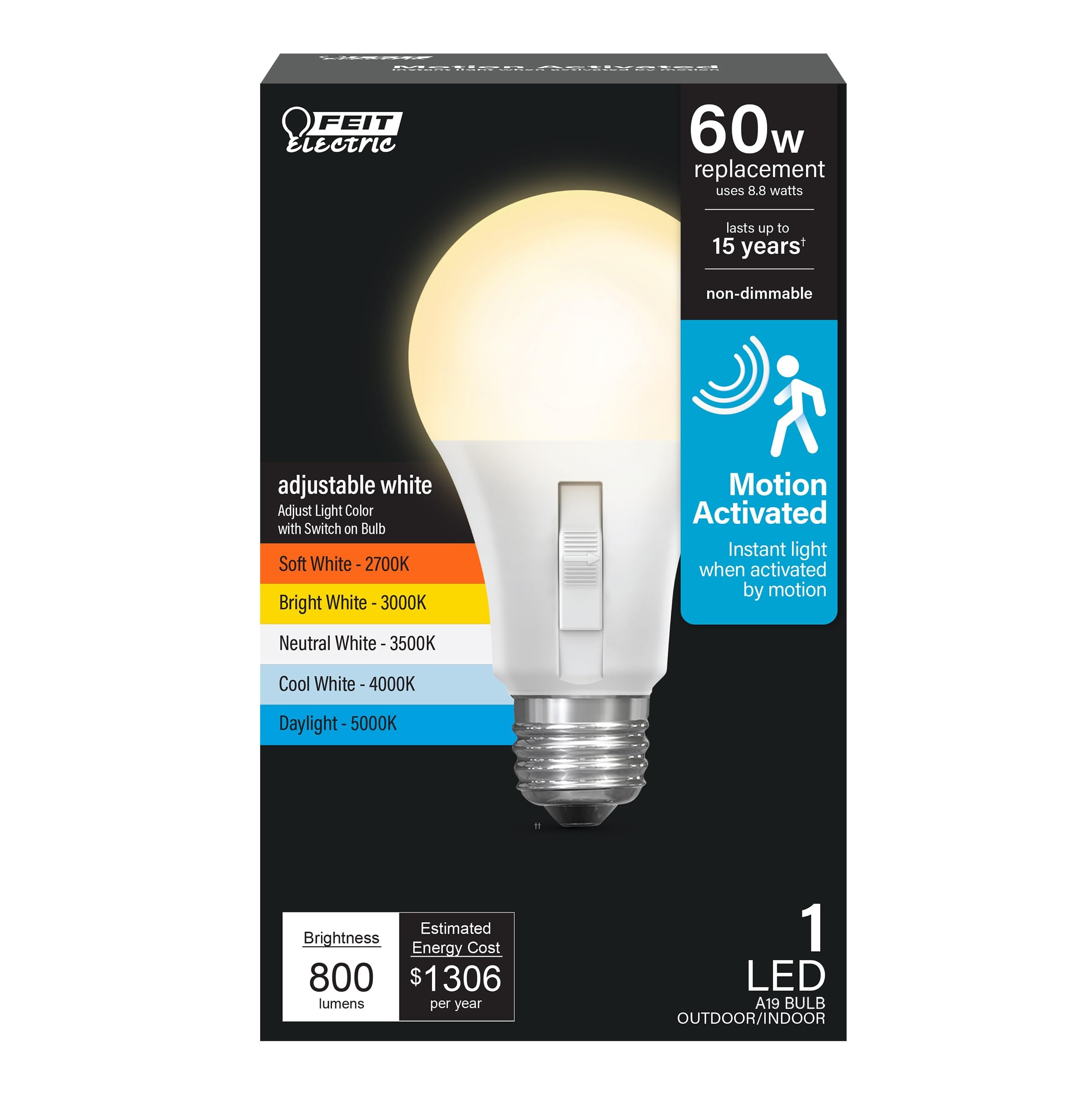
Features and Specifications
Type: A19 LED motion sensor light bulb
Base: E26 (standard screw-in)
Brightness: 800 lumens, 60W equivalent
Wattage: 8.8W
Color Rendering: 90+ CRI
Color Temperature: 5CCT adjustable white
Rated Life: 17,000 hours
Intended Use: Indoor/outdoor security and porch lighting
The headline figure is the 800-lumen output. That is roughly what a traditional 60W bulb produces, which is enough to light a small porch, a stairwell, or a laundry room but not enough to flood a driveway. Buyers should think of this as task and safety lighting rather than area lighting.
The 5CCT adjustment is the feature that separates this bulb from a plain motion sensor. Most fixed-temperature bulbs lock a buyer into one white tone, and the wrong tone on a porch reads either cold and clinical or oddly yellow. Here the color temperature can be matched to the fixture and the setting, which matters more than it sounds when the same bulb type goes into a hallway and an exterior lantern.
The 90+ CRI rating means colors render close to how they look under natural light. For a security bulb, that helps a face or a package look like itself rather than washed out, which is a small but real advantage over cheap high-output LEDs.
Build and Sensing
The bulb is built around an integrated motion sensor, so the sensing hardware lives inside the same glass-and-plastic envelope as the LED array. That is what allows it to drop into an existing fixture with no separate sensor box, no bracket, and no additional wiring. The trade-off is that the sensor sits where the bulb sits, so detection depends entirely on the fixture’s position and orientation.
Sensing works best when the fixture has a clear view of the approach. A porch light mounted beside a door and pointed outward sees arrivals well; a fixture tucked under a deep overhang or behind a decorative cage sees less. Buyers replacing a bulb in an enclosed or heavily shrouded fixture should expect shorter detection range and may see the light trigger late.
Because the sensor is part of the bulb, the bulb also has to be left in a fixture that stays powered. A wall switch that cuts power to the socket defeats the whole purpose, since the sensor has nothing to run on. The practical setup is a fixture on a circuit that stays live, with the bulb handling on and off by itself.
Brightness, Power, and Color
At 8.8W and 800 lumens, this is an efficient bulb by any measure. Running it in motion-only mode means it is lit for short bursts rather than hours, so the electricity cost is negligible even compared with other LEDs. The 17,000-hour rated life is the more relevant number for budgeting, since a bulb in a porch fixture cycles far less than one left on all evening.
The 60W-equivalent output sets expectations. A single bulb at this brightness covers a doorway, a short walkway, or a small utility space comfortably. A two-car garage apron or a long side yard needs more than one fixture, and buyers should plan accordingly rather than expect one bulb to do the work of a floodlight.
The adjustable white setting is where the bulb earns its place. A cooler white reads as security lighting and looks sharp on modern exteriors; a warmer white blends with older homes and feels less harsh in a hallway at night. The 90+ CRI keeps skin tones and packaging readable under either setting, which is a genuine plus for a light whose main job is letting someone identify what is at the door.
Trade-off: The motion sensor lives in the bulb, so detection range and reliability depend heavily on fixture placement, and a switched-off socket or a shrouded fixture can leave the bulb sensing poorly or not at all.
Check the current price on Amazon
Indoor and Outdoor Use
The name lists indoor and outdoor security and porch lighting, and the bulb suits both. Outdoors, it belongs in a protected fixture — under a porch roof, inside a lantern, or in a wall-mounted holder — rather than exposed directly to driving rain. Standard A19 bulbs of this type are built for damp locations in enclosed fixtures, not for full weather exposure, and buyers should check the fixture rather than the bulb.
Indoors, the most natural fits are hallways, stairwells, closets, laundry rooms, and basements, where a light that comes on with movement saves fumbling for a switch. The motion trigger is also useful in a garage entry or a mudroom where hands are full. In a bedroom or living room, the same behavior becomes a nuisance, since the light will cycle whenever someone walks through.
The bulb is a poor fit for anyone who wants scheduled lighting, dimming, or app control. There is no smart-home integration here, no dawn-to-dusk mode, and no way to tune sensitivity from a phone. Buyers who want a porch light that comes on at dusk and stays on should look at a fixture with a photocell instead.
Who It Suits and Who It Does Not
This bulb suits renters and homeowners who want automatic lighting without an electrician. It also suits anyone replacing a bulb in an existing motion fixture whose sensor has failed, or adding motion behavior to a fixture that never had it. The adjustable white setting makes it a reasonable one-bulb solution for mixed indoor and outdoor use.
It does not suit buyers who need broad coverage, dimming, or smart controls. It also is not the right pick for a fixture that is switched at the wall, since the sensor needs constant power to work. And anyone expecting a security-grade floodlight should recognize this as a convenience and safety light, not a deterrent-grade illuminator.
FAQ
-
Does the Feit Electric A19 motion sensor bulb need a special fixture?
No. It uses a standard E26 base and screws into ordinary fixtures. The fixture does need to stay powered so the sensor can operate. -
Can this bulb be used outdoors?
The name lists indoor and outdoor use, and it works well in protected outdoor fixtures such as porch lanterns and covered wall lights. Fully exposed locations are a different matter, and an enclosed or sheltered fixture is the safer choice. -
How bright is 800 lumens?
It is roughly the output of a 60W incandescent bulb. That is enough for a doorway, porch, hallway, or closet but not for lighting a large yard. -
Can the color temperature be changed?
Yes. The bulb is 5CCT adjustable, so the white tone can be set to match the space rather than fixed at the factory. -
Does it work with a dimmer switch?
There is no dimming capability described for this bulb. It is intended to switch on and off in response to motion, not to dim. -
Will it turn on during the day?
Motion sensing is the trigger, and the bulb does not list a daylight sensor. In a bright room or a sunlit porch it may still activate on movement. -
What happens if the wall switch is turned off?
The bulb loses power and the sensor stops working. It needs a live socket to detect motion and switch itself on. -
How long does the bulb last?
It carries a 17,000-hour rated life. In motion-only use, that translates to a long service interval for a porch or hallway fixture. -
Is it good for security lighting?
It is useful as a safety and convenience light that announces arrivals. Buyers wanting broad, bright coverage for a driveway should use a dedicated floodlight instead. -
Does it need Wi-Fi or a hub?
No. The sensor is built into the bulb, so there is no app, hub, or network setup involved.
Bottom Line
The Feit Electric A19 motion sensor is the simplest way to make an existing porch, hallway, or closet fixture turn itself on. The 800-lumen output, adjustable white settings, and high color rendering cover the practical bases, and the screw-in design means no wiring and no smart-home setup. Buyers should confirm the fixture stays powered and offers the sensor a clear view, and should not expect floodlight coverage or app control. For a single automatic light in a doorway or passage, it is a sensible, low-cost pick.
