Why there are Amazon links here: Brave Review is paid a commission for qualifying Amazon purchases made through the links below. Your price does not change, and using our links is entirely optional. How this works
Best Frost Protection Setting for an Empty House: 5 Picks That Guard Pipes While Away
A house left empty in cold weather needs a thermostat setting that never lets interior temperatures fall near freezing, and it needs a backup plan for the pipes that sit closest to the cold. This guide covers five devices that handle that backup: thermostatically controlled outlet adapters, a self-regulating heat cable, a freeze protection switch, and a faucet shield. It suits snowbirds leaving for weeks, landlords between tenants, and anyone who keeps a second home or cabin unoccupied through winter. The overview below ranks all five by role so a pick can be made in under a minute.
Overview of the Picks
| Product | Key Spec | Best Use | Price Tier |
|---|---|---|---|
| 37°F On 50°F Off Auto Control Extension Cord | 20-inch cord, 15A 120V | Plug-in control for a space heater or heat lamp | Budget |
| Frost King HC6A Heat Cable | 6 ft, automatic thermostatic | Wrapping a short exposed pipe run | Mid |
| 38°F On 50°F Off Thermostatic Outlet Switch | 120V heavy-duty plug | Converting any outlet into a freeze-protection outlet | Budget |
| SUPCO SFPC Freeze Protection Control | Opens 35°F / closes 50°F | Hard-wired or inline control on a heat source | Mid |
| Outdoor Faucet & Spigot Freeze Protection Shield | Activates below 37°F, 3 pack | Protecting exterior spigots without a cover | Premium |
1. 37°F On 50°F Auto Control Extension Cord
Type: Thermostatically controlled outlet extension cord
On/Off Setpoints: 37°F on, 50°F off
Cord Length: 20 inches
Electrical Rating: 15A, 120V
Intended Use: Covered outdoor plug
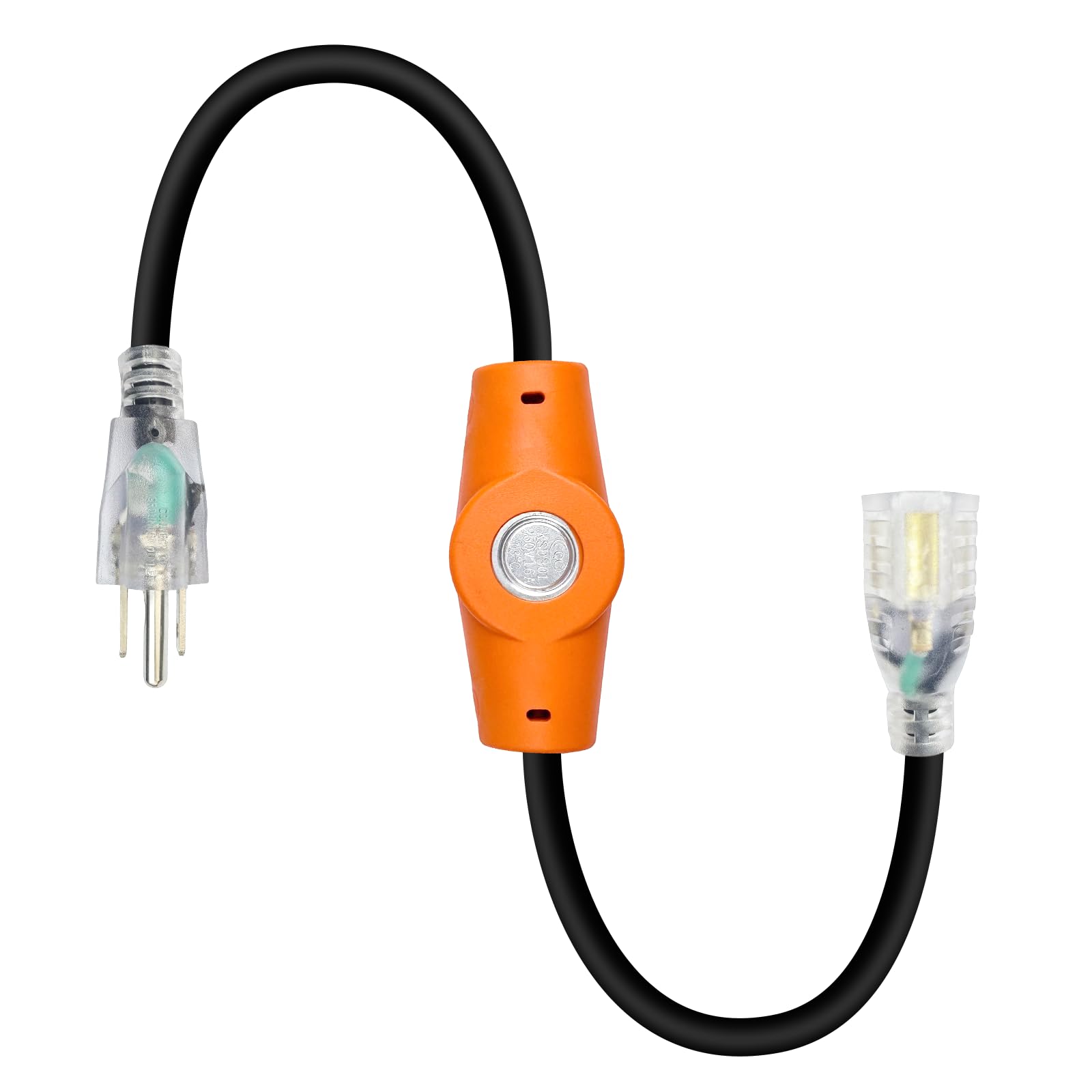
This is a short extension cord with a built-in thermostat, designed to sit between a covered outdoor receptacle and whatever is plugged into it. The 20-inch length means the thermostat housing stays off the ground and under cover, while the 15A 120V rating is enough for a small heater, a heat lamp, or a pipe heat cable. It switches on at 37°F and off at 50°F, so the connected device only runs when the air around the plug actually turns cold.
The appeal here is that it turns an ordinary outdoor outlet into a temperature-triggered one without any wiring. A homeowner leaving a house empty can plug a small heater into it inside a garage, crawlspace, or shed and let the thermostat do the switching. It is the least invasive way to add frost protection to a space that already has power.
Trade-off: The 15A ceiling limits it to light-duty loads, so it cannot carry a large space heater or any 240V appliance.
2. Frost King HC6A Automatic Electric Heat Cable
Type: Pipe heating cable
Length: 6 feet
Control: Automatic thermostatic
Intended Use: Pipe freeze protection

This is a 6-foot electric heat cable that wraps around a water pipe and warms it directly, with a built-in thermostatic control that handles the on and off cycle automatically. It is aimed at the short, vulnerable runs that a whole-house thermostat cannot reach: the stretch of pipe under a sink on an exterior wall, a line feeding an unheated garage, or a run in a crawlspace. The cable is the most direct answer to pipe freeze protection because it heats the pipe itself rather than the air around it.
For an empty house, the value is that it keeps working without anyone present. Once wrapped and plugged in, the thermostat decides when to energize the cable based on temperature, so the pipe stays above freezing through a cold snap. It is a good fit for a known problem pipe rather than whole-house coverage.
Trade-off: At 6 feet, the cable covers only one short run, and longer or branched pipe layouts need additional lengths or a different product.
3. 38°F On 50°F Off Thermostatic Outlet Switch
Type: Thermostatically controlled outlet switch
On/Off Setpoints: 38°F on, 50°F off
Electrical Rating: 120V heavy-duty plug
Intended Use: Freeze protection switching for plug-in devices

This is a plug-in thermostat that turns any standard outlet into a temperature-controlled one, switching on at 38°F and off at 50°F. The heavy-duty 120V plug is built to handle sustained loads, which makes it a natural partner for heat tape, a small fan heater, or a heat lamp in a utility room. It is the simplest of the plug-in controls in this group: no cord to route, just a switch that sits between the outlet and the device.
The 38°F trigger gives a slightly wider safety margin than a 37°F unit, which matters in poorly insulated spaces where the air near the outlet can lag behind the rest of the room. For an empty house, it is the piece that makes an existing heater automatic, so nothing needs to be switched on by hand before a trip.
Trade-off: It controls only what is plugged into it, and the thermostat reads the air at the device rather than the pipe, so placement near the vulnerable spot matters.
4. SUPCO SFPC Freeze Protection Control
Type: Freeze protection control
Setpoints: Opens 35°F, closes 50°F
Brand: Sealed Unit Parts Company (SUPCO)
Intended Use: Inline freeze protection switching

Sealed Unit Parts Company, Inc. (SUPCO) SFPC Freeze Protection Control Opens 35F/Close 50F Supco
The SUPCO SFPC is a freeze protection control that opens its circuit at 35°F and closes it at 50°F, which makes it a switching device rather than a heater. It is built for inline use on a heat source, so it can sit in the circuit of a heater, a heat lamp, or a heat cable and decide when power should flow. The 35°F trigger is the earliest of the group, giving the widest buffer before pipe temperatures become a concern.
This is the pick for a homeowner who already has a heat source wired in and wants automatic control without adding a smart thermostat. It is a straightforward, brand-name component that does one job: turn the heat on before the pipe gets cold and turn it off once the space has recovered.
Trade-off: It is a control only and produces no heat itself, so it is useless without a heater, cable, or lamp already in place.
5. Outdoor Faucet & Spigot Freeze Protection Shield
Type: Faucet and spigot freeze protection shield
Activation: Below 37°F / 3°C water temperature
Quantity: 3 pack
Intended Use: Exterior faucet protection

This is a patented valve shield that fits over an outdoor faucet or spigot and activates when the water temperature drops below 37°F. It is positioned as a durable alternative to the foam winter covers that get lost or cracked, and it installs quickly without tools. The three-pack covers multiple exterior spigots on a single property, which is the typical count on a house with a yard and a garage.
For an empty house, exterior spigots are the easiest freeze point to overlook, and a shield is a passive layer that does not depend on power or a thermostat setting. It is the pick for a homeowner who wants the outside taps handled while the indoor system runs on its own schedule.
Trade-off: At the top of the price range, the shield costs more than a set of foam covers, and it protects the faucet only — not the pipe behind the wall.
Before You Buy
- Setpoint: A control that switches on at 37°F or 38°F leaves a working margin above freezing; a 35°F trigger is earlier still but relies on a heat source being present.
- Load rating: Check the amperage and voltage the control can carry against the heater or cable it will switch, since a 15A plug-in unit will not run a large heater.
- Coverage: A 6-foot heat cable handles one short pipe run; longer or branched layouts need more cable or a different approach.
- Placement: Thermostats read the air or water at the device, so mount them near the pipe or spigot that needs protection rather than across the room.
- Power source: Plug-in controls need a live, covered outlet; hard-wired or inline controls need an existing circuit and heat source.
- Exterior vs. interior: Faucet shields protect spigots outside the envelope; indoor pipes still need a thermostat setting and, where vulnerable, a heat cable.
- Quantity: Count the spigots and vulnerable pipe runs before ordering, since most of these products cover one point each.
Frequently Asked Questions
- What temperature should a thermostat be set to in an empty house? The furnace should be left on and set well above freezing, typically in the mid-50s°F, so interior temperatures never approach the point where pipes on exterior walls can freeze. The devices here are a backup layer, not a replacement for that setting.
- Is a plug-in thermostat enough on its own? No. A plug-in control only switches whatever is plugged into it, so it needs a heater, heat lamp, or heat cable to do any actual warming.
- Can a heat cable be used on any pipe? A 6-foot cable is sized for a short, straight run; plastic and metal pipes have different requirements, so the pipe material should be checked before wrapping.
- Do exterior faucet shields replace draining the spigot? They add a layer of protection but do not remove water from the line, so shutting off and draining an exterior spigot before a long absence is still the safer step.
- How many controls are needed for a whole house? One per heat source or vulnerable zone is the practical rule, since each thermostat reads only its own location.
- Does a freeze protection control use much power? The control itself draws very little; the operating cost comes from the heater or cable it switches on.
Bottom Line
The fastest way to protect an empty house is to pair a reliable thermostat setting with one automatic control at the most vulnerable point. The 37°F On 50°F Off Auto Control Extension Cord is the top pick for most homes because it converts a covered outdoor outlet into a temperature-triggered one with no wiring and no tools, and it pairs with a small heater or heat cable to keep a garage, crawlspace, or utility room above freezing. Buyers with a known problem pipe should add the Frost King HC6A cable, and anyone with exposed spigots should cover them with the faucet shield before leaving.
