Why there are Amazon links here: Brave Review is paid a commission for qualifying Amazon purchases made through the links below. Your price does not change, and using our links is entirely optional. How this works
Geeni Prisma 1050 Wi-Fi LED Bulb: Color Control Without a Hub
The Geeni Prisma 1050 is a single smart bulb that connects straight to a home Wi-Fi network, with no hub or bridge in the middle. It covers the basics most people actually want from a color bulb: dimming, multicolor scenes, and voice control through Alexa or Google Home. This review walks through what the bulb is built to do, where its limits show up, and which households will get the most out of a bulb at this price.
Features and Specifications
Type: Wi-Fi LED light bulb, A21 shape
Brightness: 75-watt equivalent output
Light Color: Multicolor, with a 2700K warm white setting
Dimming: Dimmable through the companion app and voice assistants
Voice Control: Works with Alexa and Google Home
Connectivity: Direct Wi-Fi, no hub required
The A21 shape is the larger, wider bulb format, so it fills a lamp shade more completely than a standard bulb and puts out a broader spread of light. Buyers should check the fixture before ordering — an A21 will not fit inside every enclosed shade or tight socket housing. The 75-watt equivalent rating puts it in the range of a bright household bulb rather than a dim accent light.
Multicolor plus a 2700K warm white setting covers two different jobs. The warm white is the everyday setting for living rooms and bedrooms, while the color modes are for accent lighting, movie nights, holiday decor, or a kids’ room. Dimming runs through the app rather than a wall dimmer switch, which matters for how the bulb gets installed.
Build and Setup
The bulb is a Wi-Fi device first, so setup runs through the Geeni app rather than a separate hub. That is the main architectural decision here, and it cuts both ways. A hub-free bulb is cheaper to start with and simpler to explain to a household, but every bulb in the house becomes its own network device.
The trade-off with direct Wi-Fi bulbs is network load. A handful is fine on most home routers; a whole-house installation of a dozen or more can start to crowd a weaker network. Buyers planning to light several rooms should think about that before committing to a Wi-Fi-only approach.
The A21 size also affects placement. It suits table lamps, floor lamps, and open fixtures well. Enclosed ceiling domes and small sconces are a harder fit, and the bulb needs to sit somewhere the Wi-Fi signal actually reaches — a lamp in a basement corner is a worse candidate than one in an open living room.
Brightness, Color, and Dimming
The 75-watt equivalent output is the headline number. It is bright enough to serve as primary light in a bedroom or a small living area, not just as decoration. That separates it from cheaper color bulbs that only work as accent pieces.
Color control is the reason most buyers pick this model over a plain white smart bulb. Multicolor scenes, scheduled color changes, and grouping bulbs together in the app are the features that justify the extra cost. The 2700K warm white gives a familiar, slightly yellow household tone for evenings, which is what most people will use day to day.
Dimming is app-driven. That means no wiring changes and no dimmer switch to install, but it also means the wall switch still needs to stay on for the bulb to respond. Households used to flipping a switch on the wall will need a small habit change, and anyone else in the house needs to know the app exists.
Voice Control and the App
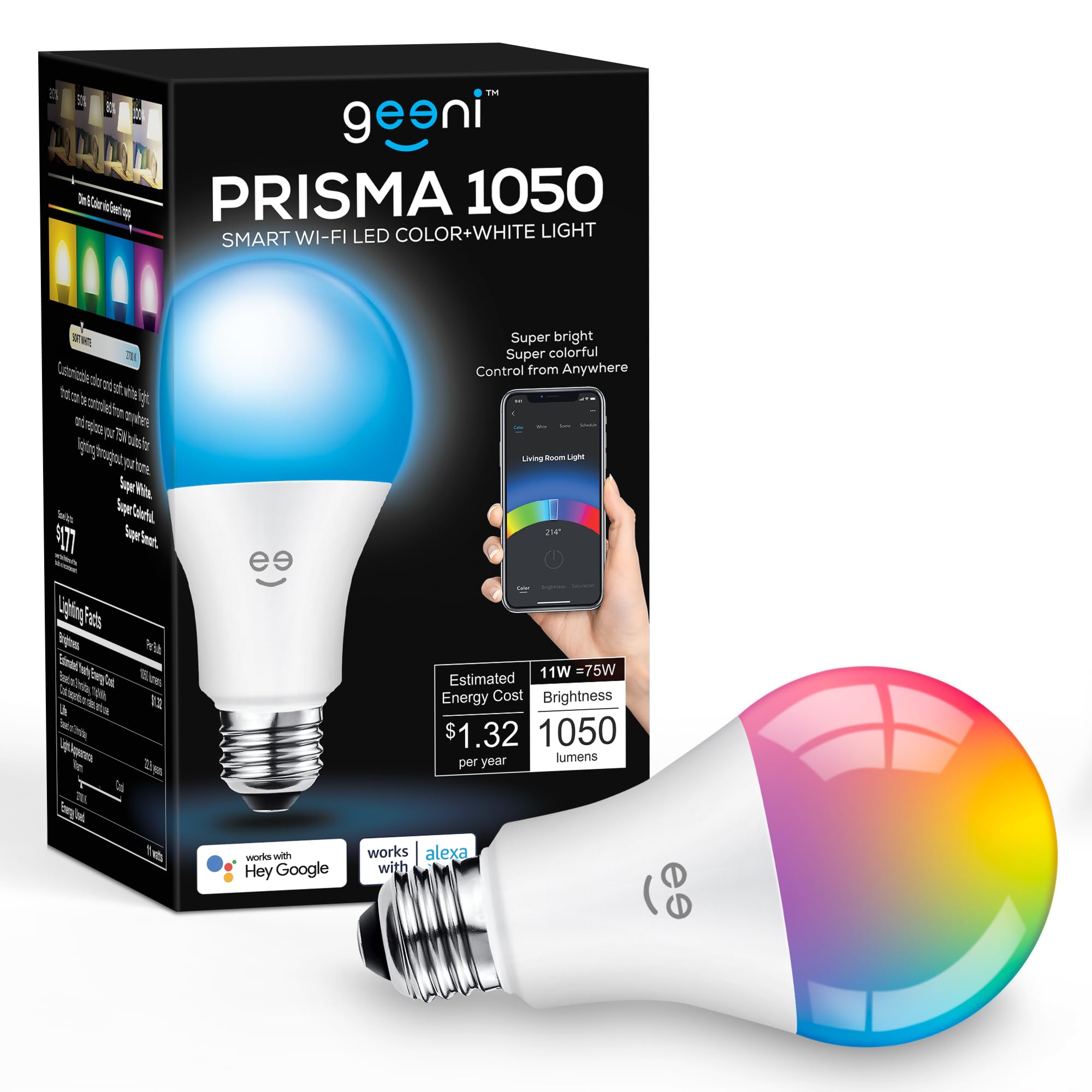
Alexa and Google Home support means the bulb can be controlled by voice once it is linked to the assistant. That is the feature that makes a smart bulb feel worth having — turning lights off from the couch or dimming them without reaching for a phone.
The app is where scheduling, grouping, and color scenes live. Most of the day-to-day value of the Prisma 1050 sits in those automations rather than in the bulb itself. Buyers who only ever want to switch a light on and off will find a plain LED bulb does the same job for less.
Trade-off: A hub-free Wi-Fi bulb puts every light on the home network and depends on the app and cloud service staying supported, so it is a poor fit for anyone who wants lighting that works entirely offline.
Check the price of the Geeni Prisma 1050 on Amazon
Who It Suits and Who Should Skip It
The Prisma 1050 fits renters and first-time smart-home buyers best. There is no hub to buy, no wiring to change, and one bulb is enough to test whether color lighting is actually useful in a given home. It also suits anyone already using Alexa or Google Home who wants a cheap way to add a voice-controlled lamp.
It is a weaker choice for large installations. A buyer planning to light an entire house with color bulbs will hit network and app-management limits faster than someone buying two or three. The same goes for anyone who wants lighting to keep working when the internet is down.
Buyers who mainly want dimmable white light should also pause. A standard dimmable LED plus a wall dimmer costs less and never needs an app. The multicolor features are the reason to pay for this bulb, and skipping them means paying for capability that goes unused.
FAQ
-
Does the Geeni Prisma 1050 need a hub?
No. It connects directly to a home Wi-Fi network, so no separate bridge or hub is required. -
Does it work with Alexa and Google Home?
Yes. The bulb is listed as compatible with both, so it can be controlled by voice once linked to either assistant. -
Is the Geeni Prisma 1050 dimmable?
Yes, it is dimmable, with dimming handled through the app and voice assistants rather than a wall dimmer. -
What does 75-watt equivalent mean?
It is a brightness comparison to an old incandescent bulb. This bulb produces light comparable to a 75-watt incandescent while using far less power. -
What color light does it produce?
It is a multicolor bulb with a 2700K warm white setting for everyday lighting plus a range of colors for scenes and accents. -
Will it fit a standard lamp?
It is an A21 bulb, which is wider than a standard A19. It fits most table and floor lamps but should be checked against small or enclosed fixtures. -
Can several bulbs be controlled together?
Yes. Bulbs can be grouped in the app so they respond as one, which is the usual way to run a room or a whole floor. -
What happens if the Wi-Fi goes down?
App and voice control depend on the network. A bulb that loses its connection cannot be controlled remotely until it reconnects. -
Is it suitable for a whole house?
It can be, but each bulb is its own Wi-Fi device. Large installations put more demand on the router and on app management than a few bulbs do. -
Who should not buy it?
Buyers who only want dimmable white light, who need lighting to work without internet, or who have no interest in using an app.
Bottom Line
The Geeni Prisma 1050 is a sensible entry point into color smart lighting: bright enough to be the main light in a room, hub-free, and controlled by voice through Alexa or Google Home. It makes the most sense for renters and small setups where two or three bulbs are enough. Buyers planning a whole-house install, or who want lighting that never depends on an app, should look at a hub-based system instead.
