Why there are Amazon links here: Brave Review is paid a commission for qualifying Amazon purchases made through the links below. Your price does not change, and using our links is entirely optional. How this works
GoveeLife Smart Water Leak Detector 1s: Whole-Home Leak Coverage for Less
The GoveeLife Smart Water Leak Detector 1s is a three-pack of WiFi water sensors built for homeowners who want early warning before a drip becomes a flooded basement. This review covers what the hardware actually does, where it fits in a house, and which buyers should look elsewhere. The short version: it suits anyone who wants several rooms covered at once without paying per-sensor prices.
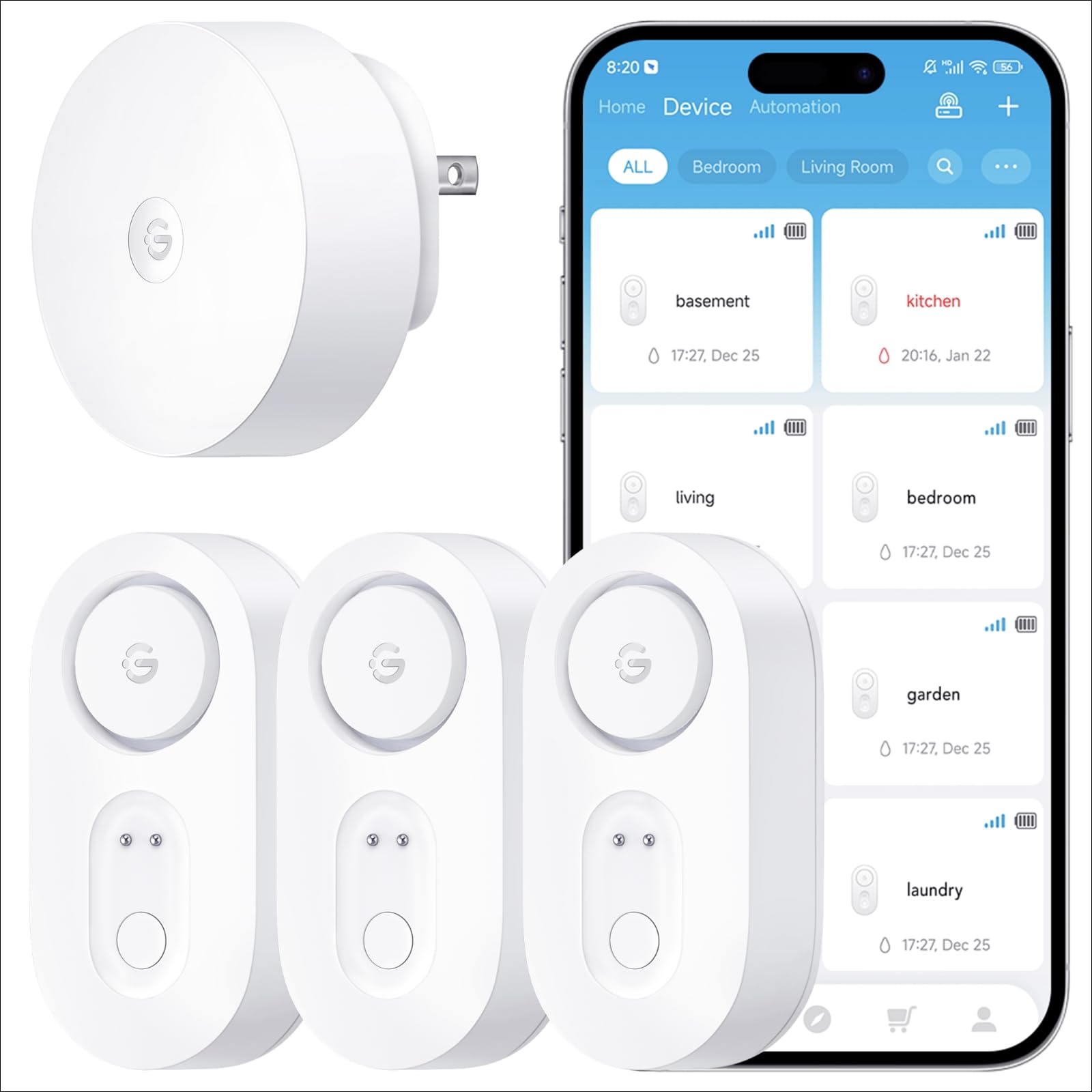
Features and Specifications
Type: WiFi water leak detector, three-pack
Connectivity: WiFi with SMS, email and app push notifications
Range: Rated up to 1804 ft
Battery Life: Rated at 5 years
Ingress Protection: IP67
Alarm: High-volume audible alarm plus remote alerts
Intended Use: Home, basement, kitchen
The headline figure here is the range. A claimed 1804 ft is far more than most home WiFi leak sensors advertise, and it matters in the places leaks actually happen: basements, crawlspaces, laundry rooms and garages that sit far from the router. Buyers who have tried cheaper sensors and lost the signal two rooms away will understand why this number is the one to check first.
The second figure worth pausing on is the five-year battery rating. Leak sensors are useless if they die quietly in a cabinet, so a long service interval is a real feature rather than a spec-sheet flourish. Combined with IP67 sealing, the unit is built to sit in damp, dusty or splash-prone spots without the enclosure itself becoming the failure point.
Build and Sealing
IP67 means the sensor is sealed against dust and can survive temporary immersion. That is the right rating for a device whose entire job is to sit in a puddle and still work. The enclosure is compact enough to tuck behind a washing machine, under a sink or beside a water heater without blocking access.
The caution with any sealed battery-powered sensor is that the seal is only as good as the housing around it. A unit dropped on a hard basement floor or wedged under a pipe can crack, and a cracked IP67 shell is no longer IP67. Placement matters more than the rating suggests.
Alerts and App Behavior
The 1s name refers to the alarm response, and the alert path runs three ways: a loud local siren, plus SMS, email and app push through WiFi. That combination is the sensible design for a leak detector, because a siren only helps someone who is home to hear it. Remote push alerts are what catch a burst supply line while the household is at work.
WiFi also means no separate hub to buy or power. The trade-off is dependence on the home network and on the Govee app for setup and notification routing. Buyers who already run other Govee devices will find the app familiar; buyers who dislike another account and another app should weigh that before committing.
Coverage Across Three Zones
Three sensors is the practical number for a first deployment. The obvious trio is a basement or utility room, a kitchen sink or dishwasher area, and a laundry room or water heater closet. That covers the three most common domestic leak sources without buying a second pack.
The limitation is that three is also easy to outgrow. A larger house with two bathrooms, a second kitchen zone and a sump pump will want more units, and the per-sensor cost of adding them individually is usually less attractive than the bundle price. Buyers should map the risk spots in the house before deciding the pack size is enough.
Power and Maintenance
Five years of battery life is a long window, which makes maintenance close to zero for most of the unit’s working life. The realistic task is a periodic check rather than a routine chore: confirm the sensor is still reporting in the app, and confirm the battery indicator has not moved.
The maintenance risk is complacency. A sensor that has been silent for three years is easy to forget, and a forgotten sensor in a basement is exactly the one that fails during a leak. A calendar reminder to test the alarm once or twice a year costs nothing and preserves the whole point of the purchase.
Trade-off: The three-pack locks buyers into a fixed sensor count, and expanding coverage later costs more per sensor than the bundle price suggests.
Check the current price on Amazon
Who Should Buy the GoveeLife Smart Water Leak Detector 1s
This pack suits homeowners who want several rooms monitored at once and who already have solid WiFi coverage through the house. It also suits anyone replacing a single old sensor who would rather cover three risk zones in one purchase. The SMS and email alerts make it a reasonable fit for people who travel or leave the house empty during the day.
It is not for buyers who need leak detection in a building with no WiFi, such as a detached shed, a remote cabin or a rental property with no network. Those cases call for a hub-based or cellular system. Buyers who want water shutoff automation rather than alerts should also look at a valve controller instead, since this device warns but does not stop the flow.
FAQ
-
How does the GoveeLife Smart Water Leak Detector 1s send alerts?
It pushes notifications through WiFi to the app and can also send SMS and email alerts, alongside a loud local alarm at the sensor itself. -
Does the GoveeLife Smart Water Leak Detector 1s need a hub?
No. The sensors connect directly over WiFi, so there is no separate bridge or hub to buy and power. -
What does the 1804 ft range actually mean?
It is the rated wireless range under ideal conditions. Interior walls, floors and appliances reduce real-world reach, so a basement sensor still benefits from being reasonably close to the router. -
Can the sensor survive being submerged?
The IP67 rating covers dust and temporary immersion, which is what a leak sensor needs. It is not designed for permanent underwater placement. -
How long do the batteries last?
The rated life is five years. Actual life depends on how often the sensor reports and how many alerts it fires. -
Where should the three sensors go first?
The highest-value spots are the basement or utility area, under the kitchen sink or beside the dishwasher, and near the washing machine or water heater. -
Does it work with Alexa or Google Home?
The product is built around the Govee app for setup and alerts. Buyers who want voice-assistant integration should confirm current compatibility on the listing before buying. -
Can it shut off the water when a leak is detected?
No. It detects and alerts only. Stopping the flow requires a separate smart valve controller. -
Is it suitable for a rental property?
It works well in a rental with WiFi, but the app account and alert routing belong to whoever sets it up, which complicates handover between tenants. -
How often should the alarm be tested?
Once or twice a year is a sensible interval, ideally at the same time as checking the app still shows the sensor as online.
Bottom Line
The GoveeLife Smart Water Leak Detector 1s is the straightforward pick for a homeowner who wants three rooms covered, long battery life and remote alerts without buying a hub. The range and IP67 sealing are the specs that justify it over cheaper single sensors, and the five-year battery rating keeps maintenance minimal. Buyers who need more than three zones, no-WiFi coverage or automatic shutoff should look at a different class of system entirely.