Why there are Amazon links here: Brave Review is paid a commission for qualifying Amazon purchases made through the links below. Your price does not change, and using our links is entirely optional. How this works
Growatt Infinity 2000 Pro: Home Backup Power That Travels
The Growatt Infinity 2000 Pro is a 2048Wh LiFePO4 portable power station with 2400W AC output, sold with a 200W folding solar panel. It is aimed at households that want an emergency backup battery on hand and campers or RV owners who want the same unit to leave the house. This review covers what the capacity and output figures mean in practice, where the bundled panel fits, and the compromises that come with a unit at this price.
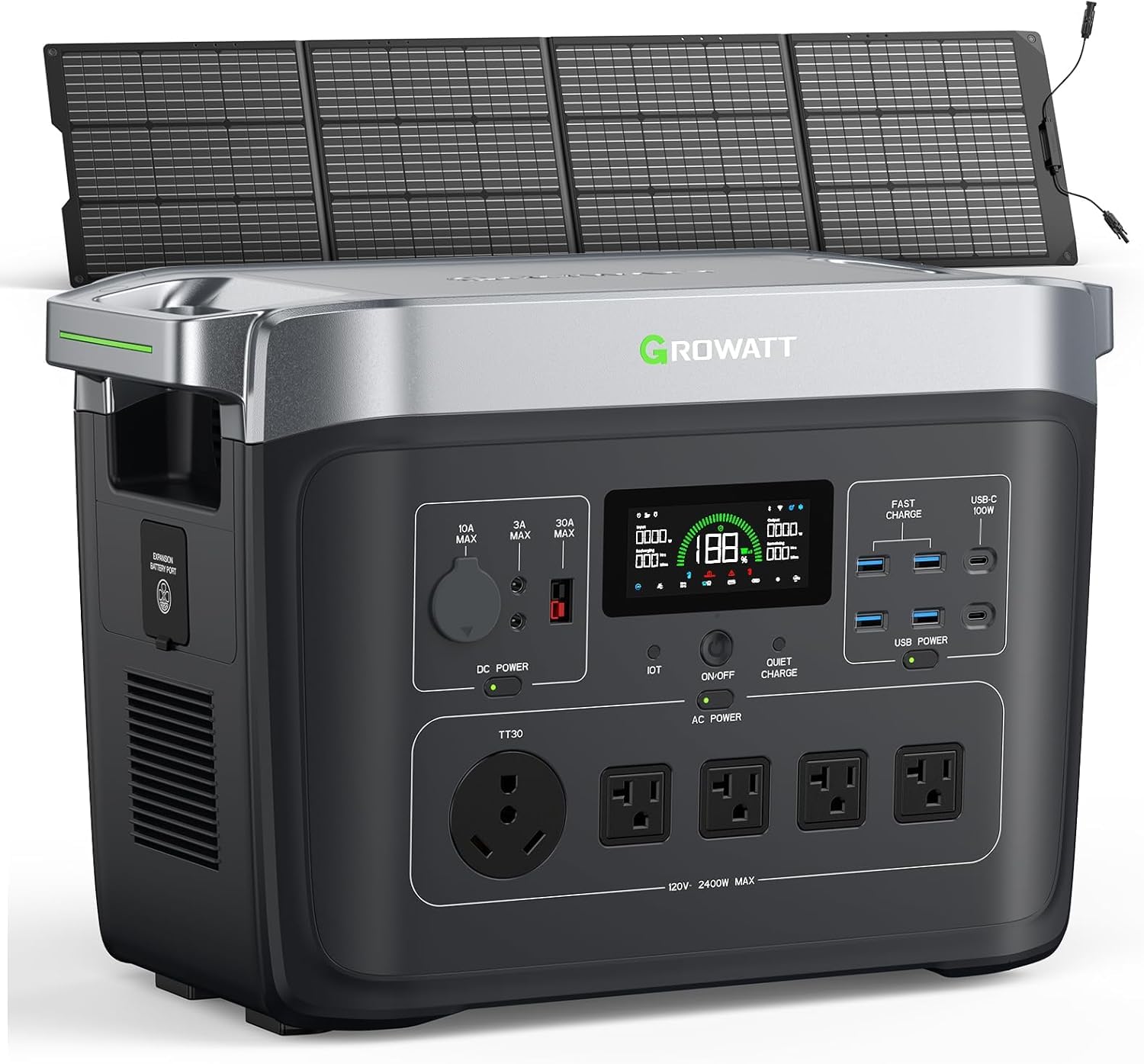
Features and Specifications
Battery Chemistry: LiFePO4
Battery Capacity: 2048Wh
AC Output: 2400W
Included Solar Panel: 200W
Intended Use: Home backup, camping, RVs
Emergency Feature: EPS (Emergency Power Supply)
Type: Portable power station / solar generator
The headline figure is the 2048Wh capacity. In plain terms, that is a battery large enough to run a fridge through a multi-hour outage, keep phones and laptops charged for days, or carry a campsite’s worth of lighting and small appliances without rationing. The LiFePO4 chemistry matters as much as the number: it is the battery type associated with long service life and stable behavior under repeated charge cycles, which is why it dominates this product category.
The 2400W AC output is the second number that decides whether this unit suits a given buyer. It sets the ceiling on what can be plugged in at once — resistive loads like heaters and kettles draw heavily, while motor-driven appliances pull a surge on startup that sits well above their running wattage. Buyers should add up the running watts of everything they intend to power simultaneously and leave headroom for those surges.
The bundled 200W solar panel is the detail that separates this listing from a bare power station. A panel of that size will not refill a 2048Wh battery in an afternoon, but it turns the unit into a genuine off-grid power source for camping and RV use, where a slow top-up over a sunny day is the normal pattern. For home backup, the panel is a supplement rather than the main charging route.
Build and Design
A 2048Wh LiFePO4 station is a substantial object, and buyers should expect to move it in two hands or on a cart rather than carry it like a lunchbox. The capacity has to live somewhere. That weight is the direct cost of the storage, and it is the reason this class of unit tends to stay in one place — a garage shelf, an RV compartment, a closet by the breaker panel — rather than travel on every trip.
The practical question is where it lives. Buyers who picture hauling it to a campsite, back home, and out again each weekend are describing a job better suited to a smaller station. Buyers who want one unit that covers the house in an outage and comes along on a few trips a year are the ones this design fits.
Trade-off: At this capacity the unit is heavy and bulky enough that it is a semi-permanent fixture rather than a grab-and-go battery, so buyers who need something to carry daily should look smaller.
Capacity and Runtime
Capacity is where buyers most often misjudge a power station. A 2048Wh battery does not deliver 2048Wh of usable output to every appliance — conversion losses and the nature of the load eat into the figure. The honest way to plan is to list the essentials, note their running watts, and work out how many hours the total can run before the battery is drained.
For home backup, the sensible target is a small set of critical loads: a refrigerator, a few lights, a router, and phone charging. That combination draws far less than the AC output ceiling and can be sustained far longer than a house full of appliances. Buyers who intend to run space heaters, air conditioners, or an electric stove should understand that those loads will flatten a battery of this size quickly, whatever the output rating says.
For camping and RV use, the same capacity covers lighting, device charging, a fan, and a small appliance or two with room to spare. The 200W panel then extends the stay by topping the battery up during daylight. The pairing is coherent: capacity sized for a day or two of modest use, solar input sized to stretch it.
Power Output and What It Runs
The 2400W AC output puts this unit in the class that can run most household plug-in devices one or two at a time. Laptops, routers, lights, fans, televisions, and a fridge are all comfortably within range. Higher-draw appliances need checking against both the running wattage and the startup surge.
The EPS feature is the part aimed squarely at home backup. It lets the station sit between the wall outlet and a device, passing power through while charged and switching to battery when the grid drops. That makes it useful for keeping a specific appliance — a fridge, a medical device, a network setup — alive through short outages without anyone being home to plug anything in. Buyers should treat it as protection for selected devices, not as a whole-house solution.
Trade-off: The 2400W ceiling and 2048Wh reserve flatter the unit against small loads but will not carry high-draw appliances like space heaters or air conditioners for long, so buyers with heavy loads need a larger system.
Solar Charging and the Bundled Panel
The included 200W panel is the reason this listing reads as a solar generator rather than a plain battery. Its job is steady replenishment in off-grid settings, and that is how it should be judged. A day of good sun returns a meaningful share of the battery’s capacity — enough to keep a campsite or RV running indefinitely on a modest daily budget of power, but not enough to refill a fully drained 2048Wh battery in a single sitting.
For home backup, the panel has a different role. It is a fallback for extended outages when the grid is gone for days, letting the station recover some charge each day rather than relying solely on a generator or a wall outlet. Buyers should not expect the bundled panel to replace grid charging in normal use; it supplements it.
The practical caution here is solar conditions. Panel output depends on direct sun, angle, and shade, and a 200W rating describes ideal conditions rather than a cloudy afternoon. Buyers planning to rely on solar should treat the panel as one input among several and keep wall charging as the primary route.
Maintenance and Long-Term Ownership
LiFePO4 is the chemistry buyers should want in a station at this price, and the maintenance routine around it is simple. The unit should be kept charged rather than stored flat for long periods, kept out of extreme heat, and cycled occasionally so the battery stays healthy. There is no fuel, no oil, and no engine to service — the ownership burden is mostly about storage conditions and keeping it topped up.
The EPS role adds a small ongoing consideration: a unit wired in for pass-through power is doing continuous work, and buyers should be comfortable with where it sits and how it is ventilated. Beyond that, the long-term cost of ownership is low compared with a gas generator, which needs fuel, oil changes, and periodic running to stay reliable.
Trade-off: The unit is priced as a premium-capacity station, and buyers who only need occasional phone charging or a laptop top-up are paying for storage and output they will never use.
FAQ
-
What can the Growatt Infinity 2000 Pro power?
With 2400W AC output and 2048Wh of storage, it runs typical household plug-in devices — fridges, lights, routers, fans, laptops, and TVs — one or two at a time, and covers modest camping and RV loads with capacity to spare. -
How long will the 2048Wh battery last during an outage?
Runtime depends entirely on the load. A small set of critical devices like a fridge, router, and lights will run far longer than high-draw appliances such as heaters or air conditioners, which drain the battery quickly. -
Is the included 200W solar panel enough to recharge it?
The panel provides meaningful daily top-up in good sun, which suits camping and RV use and extended outages, but it will not refill a fully drained 2048Wh battery in a single day. Wall charging remains the primary route. -
What is EPS and why does it matter for home backup?
EPS passes grid power through the station and switches to battery when the grid fails, keeping selected devices running through short outages without anyone plugging anything in. -
Is LiFePO4 better than other battery types?
LiFePO4 is the chemistry associated with long service life and stable performance over many charge cycles, which is why it is the standard for stations in this class and price bracket. -
Can it run a space heater or air conditioner?
Those are high-draw appliances that will drain a 2048Wh battery quickly, even though the 2400W output may cover their running wattage. Buyers with heavy loads should plan on a larger system or a fuel generator. -
Who is this power station not for?
Buyers who need something light enough to carry daily, or who only charge phones and a laptop, will find the capacity, weight, and price more than their use justifies. -
Does it work for RV and camping trips?
Yes — the capacity covers lighting, device charging, fans, and small appliances, and the bundled 200W panel extends off-grid stays with daily solar top-up. -
How should the battery be stored?
Keep it charged rather than flat, store it away from extreme heat, and cycle it occasionally. There is no fuel or engine maintenance to worry about. -
Is the Growatt Infinity 2000 Pro a whole-house backup solution?
No. It is a portable station for selected critical devices, not a replacement for a home battery system or a standby generator sized for a whole house.
Bottom Line
The Growatt Infinity 2000 Pro is the right buy for households that want a serious emergency battery on the shelf and a capable off-grid power source for RV and camping trips, with the bundled 200W panel making the solar side usable out of the box. The 2048Wh LiFePO4 capacity and 2400W output cover the loads most buyers actually need in an outage. Buyers who need something light enough to carry every day, or who only charge small devices, should look at a smaller and cheaper station instead.
