Why there are Amazon links here: Brave Review is paid a commission for qualifying Amazon purchases made through the links below. Your price does not change, and using our links is entirely optional. How this works
iRobot Roomba Y0140 vs iRobot Roomba 104: Which Robot Vacuum Fits Your Home
The iRobot Roomba Y0140 and the iRobot Roomba 104 both promise to vacuum and mop in one pass, but they split on one big question: whether the robot should empty itself or the owner should handle that job. The Y0140 is the simpler, lower-cost combo unit. The Roomba 104 adds a self-emptying base and LiDAR mapping for a modest step up in price. This comparison breaks down where the two diverge so a buyer can settle on one quickly.
iRobot Roomba Y0140

Type: Robot vacuum and mop combo
Cleaning: Vacuums and mops, multi-surface floors
Suction: Power-lifting suction
Navigation: Smart navigation, cleans in neat rows
Charging: Self-charging
Waste handling: Bagless
Form factor: Space-saving
The Y0140 is a two-in-one floor cleaner that handles vacuuming and damp mopping without a separate machine. Its power-lifting suction is aimed at pulling debris up off hard floors and low-pile carpet, while the neat-row cleaning pattern keeps coverage orderly rather than random. The bagless bin means no consumable bags to buy, and the compact, space-saving body suits apartments and tighter floor plans.
This is the pick for buyers who want mopping and vacuuming from one robot at the lowest entry point. The self-charging behavior means it returns to its dock on its own after a run, so daily upkeep stays minimal. It is not the right fit for anyone who expects the dock to hold days of debris or who wants a live map of the home.
Trade-off: The bin is small and the owner empties it after most runs, so a large home with pets will need frequent hands-on maintenance.
Check the current price on Amazon
iRobot Roomba 104
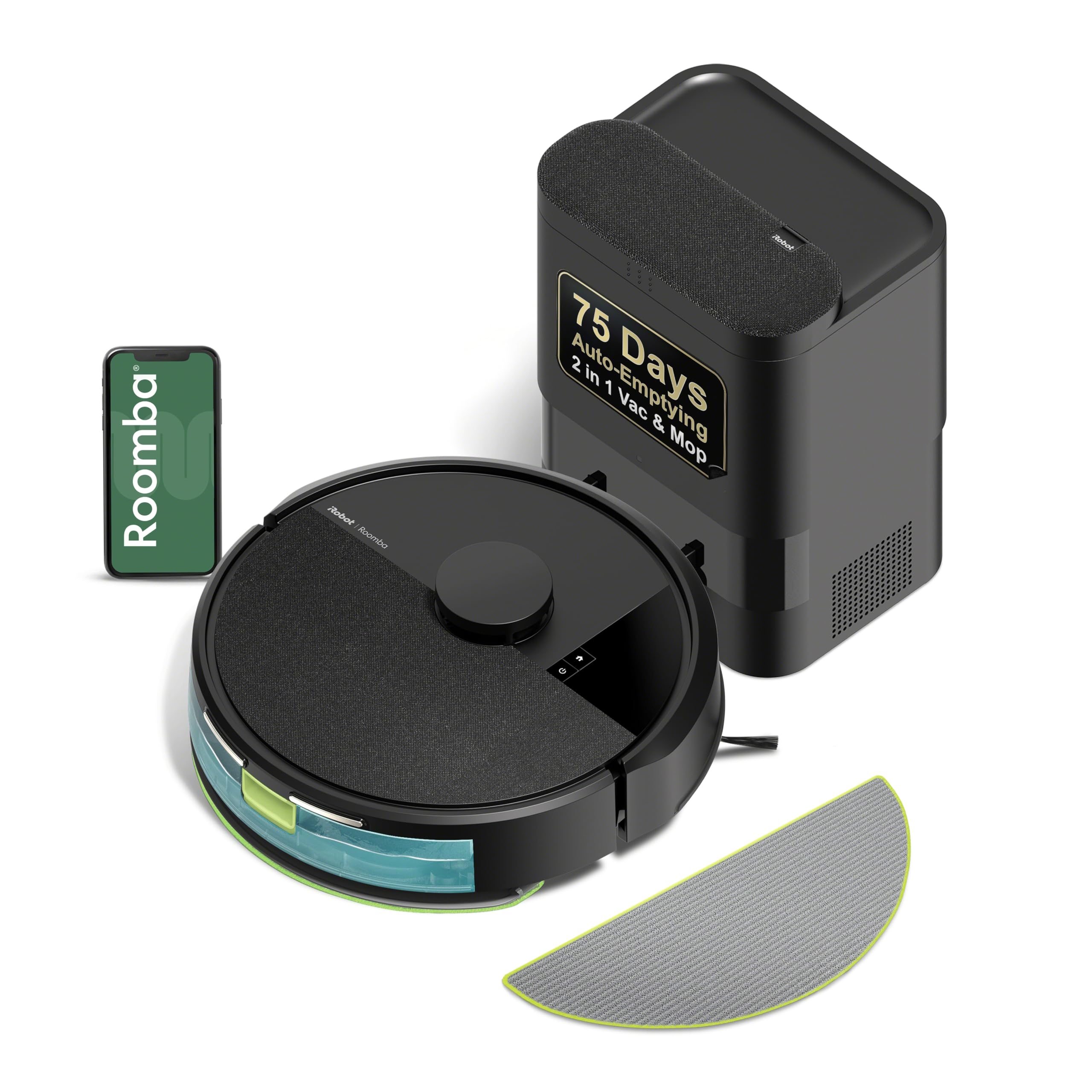
Type: 2-in-1 robot vacuum and mop
Waste handling: Self-empties for 75 days
Suction: Intense power-lifting suction
Floor coverage: Vacuums all floors, mops hard floors
Best for: Pet hair
Navigation: LiDAR smart navigation mapping
The Roomba 104 takes the same combo formula and adds a self-emptying base that holds debris for up to 75 days, which removes the after-every-run bin duty that defines the Y0140. Its suction is tuned for pet hair across all floor types, and the LiDAR navigation builds a map of the home rather than relying on row-by-row wandering. It still mops hard floors, so the two-in-one job stays intact.
This is the pick for pet owners and busier households where emptying a small bin every day would wear thin. LiDAR mapping also makes coverage more predictable in multi-room layouts, since the robot knows the floor plan instead of rediscovering it each time. Buyers who only have hard floors and a small apartment may find the extra hardware hard to justify.
Trade-off: The self-emptying base adds bulk and cost, and the dock still needs its own bag or bin service, so the 75-day figure assumes normal debris loads rather than heavy shedding season.
Check the current price on Amazon
Side-by-Side Comparison
| Feature | Roomba Y0140 | Roomba 104 |
|---|---|---|
| Type | Vacuum and mop combo | 2-in-1 vacuum and mop |
| Suction | Power-lifting suction | Intense power-lifting suction |
| Navigation | Smart navigation, neat rows | LiDAR smart navigation mapping |
| Self-emptying | No | Yes, up to 75 days |
| Waste handling | Bagless bin | Self-emptying base |
| Floor coverage | Multi-surface | All floors, mops hard floors |
| Pet hair focus | General | Ideal for pet hair |
| Charging | Self-charging | Returns to self-emptying base |
Where the Two Roomba Models Diverge
The clearest split is waste handling. The Y0140 carries a bagless bin the owner empties by hand, while the Roomba 104 docks onto a base that vacuums the bin out and stores debris for up to 75 days. That single difference changes the daily routine more than any other spec on the sheet, and it is the reason the 104 costs more.
Navigation is the second divider. The Y0140 cleans in neat rows using smart navigation, which is orderly but does not build a stored map. The Roomba 104 uses LiDAR mapping, so it learns the layout and can cover a multi-room home more consistently. Buyers with open-plan or many-room floors get more value from the mapping than buyers in a studio or one-bedroom.
Suction wording favors the 104 as well, with "intense" power-lifting suction and an explicit pet-hair focus against the Y0140’s general multi-surface claim. Both self-charge, both mop hard floors, and both are bagless in the sense that no traditional vacuum bags are required for the robot itself.
Which Should You Buy?
Choose the Roomba Y0140 if the budget is the deciding factor, the home is small to mid-sized, and emptying a bin after each run is acceptable. It delivers vacuuming and mopping in one compact unit at the lower price tier and suits renters and first-time robot owners.
Choose the Roomba 104 if pets share the home, the floor plan has several rooms, and the idea of touching a bin every day is a dealbreaker. The self-emptying base and LiDAR mapping are the two features that justify the step up, and the pet-hair focus fits shedding households.
FAQ
-
What is the main difference between the Roomba Y0140 and Roomba 104?
The Roomba 104 self-empties into a base for up to 75 days and uses LiDAR mapping. The Y0140 uses a bagless bin the owner empties manually and relies on smart navigation with neat-row cleaning. -
Do both robots vacuum and mop?
Yes. Both are combo units that vacuum floors and mop hard surfaces, so neither requires a separate mopping machine. -
Which one is better for pet hair?
The Roomba 104 names pet hair as an intended use and pairs intense power-lifting suction with a self-emptying base, which suits shedding households better than the Y0140’s general multi-surface design. -
Does the Y0140 empty itself?
No. The Y0140 has a bagless bin that the owner empties by hand, while the Roomba 104 docks and transfers debris into its base automatically. -
Is LiDAR mapping worth it?
For multi-room homes, yes. LiDAR mapping lets the Roomba 104 learn the layout and cover it consistently. In a small apartment, the Y0140’s neat-row navigation is usually enough. -
Which is cheaper?
The Roomba Y0140 sits at the lower price tier, and the Roomba 104 costs more because of the self-emptying base and mapping hardware. -
Do either of these need vacuum bags?
The robots themselves are bagless. The Roomba 104’s self-emptying base is the part that handles stored debris, so buyers should check what that base requires before purchase.
Bottom Line
The iRobot Roomba 104 is the better buy for most households with pets or multiple rooms, because self-emptying and LiDAR mapping remove the two chores that make robot vacuums feel like work. The Y0140 remains the sensible budget choice for small homes where a daily bin empty is a fair trade for a lower price.
