Why there are Amazon links here: Brave Review is paid a commission for qualifying Amazon purchases made through the links below. Your price does not change, and using our links is entirely optional. How this works
Jackery Explorer 1000 v2 vs Anker SOLIX C1000 Gen 2: Power Against Output
The Jackery Explorer 1000 v2 and the Anker SOLIX C1000 Gen 2 are both mid-size LiFePO4 power stations aimed at the same buyer, and the decision between them comes down to what that buyer needs to run. The Jackery leans on fast charging and a lighter, camping-first build; the Anker leans on raw output for high-draw appliances at home. The sections below compare capacity, power, charging, ports and price tier, then name the buyer each one fits.
The Picks at a Glance
| Product | Key Spec | Best Use | Price Tier |
|---|---|---|---|
| Jackery Explorer 1000 v2 | 1070Wh, 1500W | Camping, RV trips, fast top-ups | Mid |
| Anker SOLIX C1000 Gen 2 | 1,024Wh, 2,000W with up to 3,000W output | Home backup, high-draw appliances | Upper-mid |
Both units sit in the same capacity class, so the table already shows where the split falls: the Jackery carries slightly more stored energy, while the Anker carries meaningfully more usable output. That single difference drives most of the buying decision.
Jackery Explorer 1000 v2

Capacity: 1070Wh
Battery Type: LiFePO4
Rated Output: 1500W
USB-C Output: 100W
Charging: 1 Hr Fast Charge
Intended Use: Camping, emergency, RV
The Explorer 1000 v2 is built around the idea that a power station should be ready when the trip starts, not the morning after. Its headline feature is the one-hour fast charge, which means a wall outlet can bring the pack back to full in about the time it takes to pack a car. The LiFePO4 chemistry is the same long-life battery type used across the modern power station market, and it is the reason this class of unit can be cycled regularly without the early capacity loss that older lithium packs suffered.
The 1070Wh capacity is the largest figure in this comparison, and it is paired with a 1500W rated output. That output covers the camping and RV workload well: a portable fridge, lights, phones, laptops, a camera kit and a small appliance or two. The 100W USB-C port is the other practical detail worth noting, because it lets the unit charge a modern laptop at full speed without a power brick in the chain.
Trade-off: The 1500W ceiling rules out the heavy household loads — space heaters, large microwaves, full-size kettles — that buyers with whole-home backup in mind tend to reach for first.
Check the current price on Amazon
Anker SOLIX C1000 Gen 2
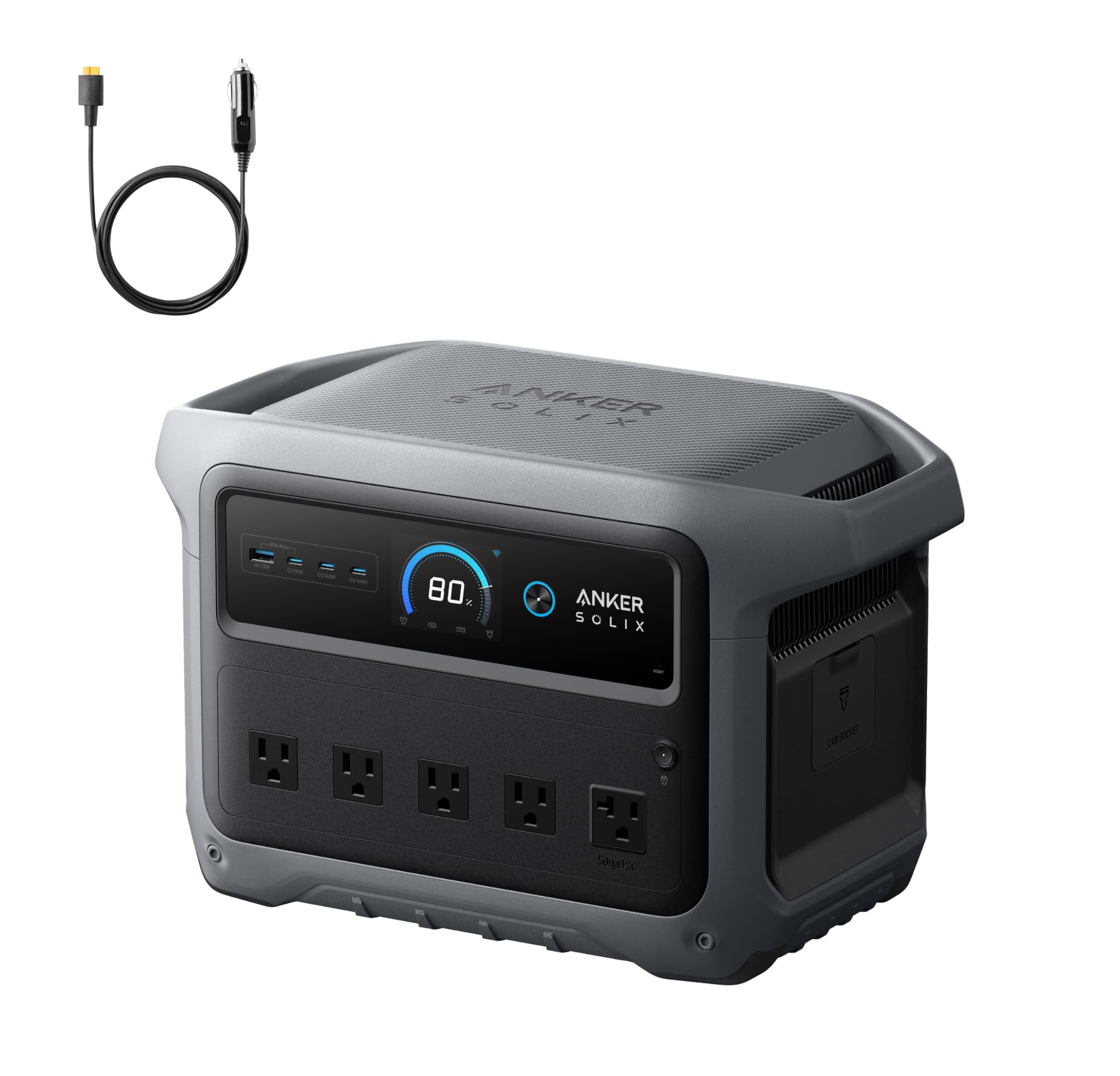
Capacity: 1,024Wh
Battery Type: LiFePO4
Rated Output: 2,000W
Peak Output: Up to 3,000W
Charging: Car charging cable included
Intended Use: Home, outdoor, emergency
The SOLIX C1000 Gen 2 is the higher-output option, and that is the whole point of the unit. A 2,000W rated output with up to 3,000W available pushes it into a class of appliance the Jackery cannot touch: microwaves, coffee makers, hair dryers and similar resistive loads that spike hard on startup. For a buyer whose backup plan involves keeping a normal kitchen running through an outage, that headroom matters more than a few dozen watt-hours of extra storage.
Capacity lands at 1,024Wh, which is close enough to the Jackery’s figure that the difference will not decide anything for most users. The LiFePO4 battery is the same chemistry, so cycle life and safety behaviour are broadly comparable. Anker includes a car charging cable in the box, which suits buyers who top the unit up while driving between sites rather than from a wall outlet at home.
Trade-off: The higher output tier comes with a higher price, and a buyer who only ever runs camping loads will pay for wattage that never gets used.
Check the current price on Amazon
Side-by-Side Comparison
| Spec | Jackery Explorer 1000 v2 | Anker SOLIX C1000 Gen 2 |
|---|---|---|
| Capacity | 1070Wh | 1,024Wh |
| Battery chemistry | LiFePO4 | LiFePO4 |
| Rated output | 1500W | 2,000W |
| Peak output | Not stated in name | Up to 3,000W |
| USB-C output | 100W | Not stated in name |
| Fast charge | 1 Hr Fast Charge | Car charging cable included |
| Intended use | Camping, emergency, RV | Home, outdoor, emergency |
| Price tier | Mid | Upper-mid |
Capacity and Output: Where the Two Diverge
On paper the capacity gap is tiny — 1070Wh against 1,024Wh — and in practice it is close to noise. Neither unit will run a full-size refrigerator for days, and both will comfortably cover a weekend of camping electronics or a short outage running lights, routers and phones. A buyer choosing on capacity alone is effectively choosing on nothing.
Output is a different story. The Jackery’s 1500W rating covers the load types that camping and RV travel actually produce. The Anker’s 2,000W rating, with up to 3,000W available, opens the door to kitchen appliances that would trip the Jackery’s limit. That gap is the single most consequential difference in this comparison, and it points in one direction only: the Anker wins on power, the Jackery wins on nothing in this dimension except a marginal capacity edge.
The 100W USB-C output on the Jackery is a genuine practical advantage for laptop users, and it is the kind of detail that gets overlooked in spec-sheet comparisons. The Anker’s name does not advertise a comparable USB-C figure, so buyers who plan to run a laptop directly from the station should weigh that carefully.
Charging Speed and Portability
The Jackery’s one-hour fast charge is the standout convenience feature here. For a camper or overlander, the ability to recharge from a wall outlet in roughly the time it takes to sort gear is worth real money, and it removes the overnight wait that older power stations imposed. The unit is marketed as a solar generator with the panel sold separately, so solar top-ups remain an option for off-grid trips.
The Anker ships with a car charging cable, which fits a different pattern: topping up during the drive between campsites or job sites rather than at a wall socket. That is a slower route in most cases, but it suits buyers who are rarely near mains power during the day.
Portability is the quieter factor. A 1000-class power station is a carry-with-help item rather than a backpack item, and buyers who move the unit between a car trunk and a campsite will notice weight and handle design more than any spec on this page. Neither unit is a grab-and-go size.
Which Should You Buy?
Choose the Jackery Explorer 1000 v2 if the unit’s life will be spent in a tent, a trailer or an RV, the loads are laptops, fridges, lights and cameras, and fast wall charging before departure is the feature that matters most. It is also the better fit for buyers who want the lower price tier of the two.
Choose the Anker SOLIX C1000 Gen 2 if the unit is meant to keep a house running during an outage, the appliance list includes a microwave, a coffee maker or anything with a heavy startup draw, and the extra output is worth the higher price. Buyers who charge from a vehicle rather than a wall outlet will also prefer the included car cable.
Neither unit suits a buyer who needs to run large appliances for days at a time; that job belongs to a bigger, heavier class of power station or a fixed home battery.
FAQ
-
Is the Jackery Explorer 1000 v2 or the Anker SOLIX C1000 Gen 2 better for camping?
The Jackery is the better camping fit. It carries slightly more capacity, offers a 100W USB-C output for laptops, and its one-hour fast charge means it can be refilled from a wall outlet right before a trip. -
Which one has more output for home backup?
The Anker. Its 2,000W rated output with up to 3,000W available handles high-draw kitchen appliances that the Jackery’s 1500W rating cannot. -
Do both use LiFePO4 batteries?
Yes. Both product names specify LiFePO4 chemistry, which is the long-life battery type standard in this class of power station. -
Does the Jackery include a solar panel?
No. The Explorer 1000 v2 is sold as a solar generator with the panel optional, so a panel is a separate purchase. -
Does the Anker come with a charging cable?
Yes. The SOLIX C1000 Gen 2 ships with a car charging cable, which suits topping up while driving. -
Can either unit run a microwave?
The Anker can, within its output limits. The Jackery’s 1500W rating puts most microwaves out of reach. -
Which is cheaper?
The Jackery sits in the lower price tier of the two. Current pricing shifts, so the live Amazon listing is the figure to check. -
Which one is better for RV use?
The Jackery, for the same reasons it suits camping: fast wall charging, a laptop-friendly USB-C port and slightly more stored energy.
Bottom Line
The Anker SOLIX C1000 Gen 2 is the stronger pick for anyone whose backup plan involves real household appliances, because its output advantage is decisive and its capacity deficit is negligible. The Jackery Explorer 1000 v2 remains the better buy for camping and RV buyers who value fast charging and a lower price over raw wattage. Match the unit to the load list, and the choice makes itself.