Why there are Amazon links here: Brave Review is paid a commission for qualifying Amazon purchases made through the links below. Your price does not change, and using our links is entirely optional. How this works
Jackery Explorer 500 v2 vs AFERIY P210: Capacity or Portability
The Jackery Explorer 500 v2 and the AFERIY P210 are two portable power stations built for very different jobs. The Jackery is the compact, carry-it-anywhere option for camping and short outages. The AFERIY P210 is a large-capacity home backup unit that can run serious appliances. This comparison lays out capacity, output, charging speed, and UPS behavior so a buyer can pick one in under a minute.
The short version: campers and weekend travelers should look at the Jackery, while households preparing for long outages or running heavy loads should look at the AFERIY. Both are legitimate LiFePO4 units at different price tiers, and neither is a mistake — the decision comes down to how much power is needed and how far it has to travel.
Jackery Explorer 500 v2 Portable Power Station
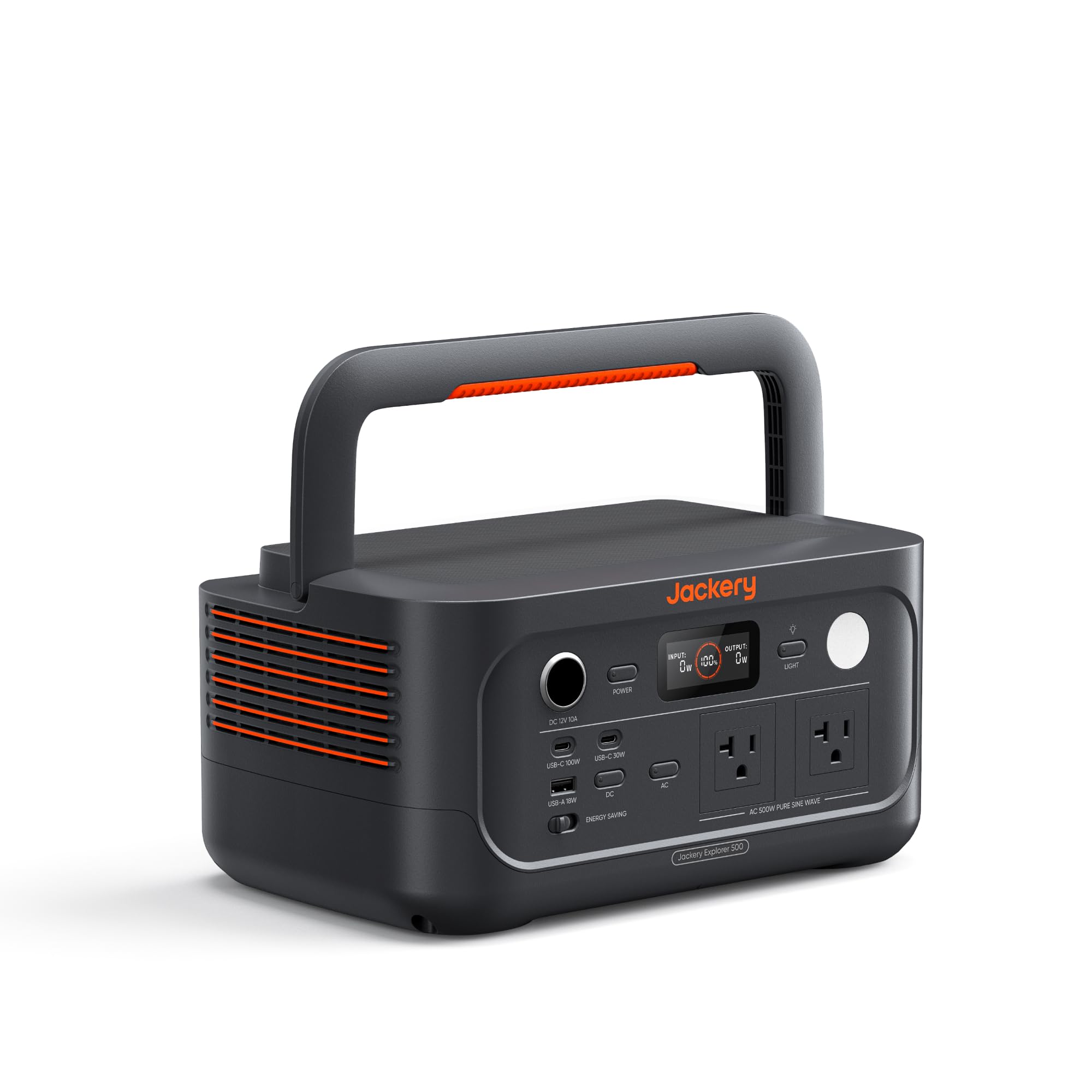
Battery Chemistry: LiFePO4
Capacity: 512Wh
AC Output: 500W continuous
Peak Output: 1000W
Intended Use: Camping, outdoors, power outages
Solar Input: Supported (solar generator design)
The Explorer 500 v2 is built around a LiFePO4 battery, which is the chemistry buyers now expect at this price tier because it holds up over many charge cycles and tolerates heat better than older lithium formulations. At 512Wh, it sits in the middle of the compact class — enough to top up phones, laptops, cameras, and a small fan or light through a weekend, but not enough to run a fridge for long.
The 500W continuous AC output with a 1000W peak is the tell for what this unit is for. It handles small electronics and modest appliances, and the peak rating covers brief startup surges from things like a small cooler or a blender. Buyers who need to run a space heater, a full-size fridge, or power tools should look elsewhere — that is not what this class of station does.
Trade-off: The compact, travel-friendly build means the capacity ceiling is low, so buyers planning multi-day outages or heavy appliance loads will outgrow it quickly.
Check the current price on Amazon
AFERIY P210 Portable Power Station

Battery Chemistry: LiFePO4
Capacity: 2048Wh
AC Output: 2400W continuous
Peak Output: 4800W
DC Output: 12V/25A XT60
UPS Switchover: 10ms
Intended Use: Home backup, power outages, camping
Solar Input: Optional
The AFERIY P210 is a different class of machine. At 2048Wh it carries four times the capacity of the Jackery, and its 2400W continuous output with a 4800W peak puts it in territory where a fridge, a microwave, or a space heater becomes realistic. The LiFePO4 battery is rated for a long cycle life, and AC fast charging means the unit can be topped up from a wall outlet without an overnight wait.
The 10ms UPS switchover is the feature that separates this from a pure camping box. Plugged into a wall, it can pass power through to connected devices and take over almost instantly when the grid drops — the kind of behavior buyers want for a router, a desktop, or medical equipment during an outage. The 12V/25A XT60 DC output also makes it useful for vehicle and off-grid DC setups, and solar charging is supported as an add-on.
Trade-off: The capacity and output come with real bulk and a much higher price, so this is a poor fit for buyers who need something light enough to carry to a campsite or stash in a car trunk.
Check the current price on Amazon
Jackery Explorer 500 v2 vs AFERIY P210 Side by Side
| Feature | Jackery Explorer 500 v2 | AFERIY P210 |
|---|---|---|
| Battery chemistry | LiFePO4 | LiFePO4 |
| Capacity | 512Wh | 2048Wh |
| AC output (continuous) | 500W | 2400W |
| Peak output | 1000W | 4800W |
| DC output | Standard DC ports | 12V/25A XT60 |
| UPS switchover | Not a UPS unit | 10ms |
| AC fast charging | Standard | Yes |
| Solar charging | Supported | Optional add-on |
| Best use | Camping, travel, small devices | Home backup, heavy loads |
| Price tier | Budget | Premium |
How the Two Compare
The capacity gap is the headline. The AFERIY P210 holds roughly four times the energy of the Jackery Explorer 500 v2, which changes what each unit can actually do. The Jackery is a device charger with a small AC outlet attached — phones, laptops, lights, a fan. The AFERIY is a household backup that can carry a fridge or a microwave through an evening. Buyers should match capacity to the load list, not to the spec sheet.
Output tells the same story. The Jackery’s 500W continuous rating limits it to small appliances, while the AFERIY’s 2400W opens up major ones. The peak ratings widen that gap further: 1000W versus 4800W is the difference between starting a small cooler and starting something with a real motor. Anyone whose outage plan includes a sump pump or a full kitchen should treat the Jackery as out of scope.
The UPS behavior is the feature that most cleanly splits the two. The AFERIY’s 10ms switchover makes it a genuine uninterruptible power supply when plugged in, which matters for routers, NAS boxes, and anything that dislikes a hard shutdown. The Jackery is a standalone power station, not a pass-through UPS, so it is the wrong tool for always-on protection.
Charging and portability pull in opposite directions. The AFERIY’s AC fast charging refills a much larger battery quickly, and its XT60 DC output suits vehicle and off-grid setups, but the unit is heavy and stays close to home. The Jackery is the one that goes in the trunk, gets carried to a tent, and charges from a solar panel on a sunny afternoon. Buyers who value mobility over capacity should weight that heavily.
Which Should You Buy?
Choose the Jackery Explorer 500 v2 if the priority is portability. It suits campers, road-trippers, tailgaters, and anyone who wants a light backup for phones, laptops, and small devices. It is also the lower-cost entry into LiFePO4 power stations, which makes it a sensible first unit for buyers who are not yet sure how much capacity they need.
Choose the AFERIY P210 if the priority is capacity and home protection. It suits households in outage-prone areas, buyers who want a UPS for networking gear, and anyone who needs to run a fridge, a microwave, or power tools off a battery. The higher price buys four times the capacity, far more output, and true pass-through backup.
FAQ
-
Is the Jackery Explorer 500 v2 enough to run a fridge?
No. At 500W continuous, the Jackery is built for small electronics and modest appliances. A full-size fridge needs more output and far more capacity than 512Wh provides. -
Can the AFERIY P210 run a whole house?
No. At 2400W continuous it can carry selected appliances — a fridge, a microwave, lights, a router — but not a whole-home load. It is a targeted backup unit, not a whole-house generator. -
What does the 10ms UPS switchover on the AFERIY P210 mean?
It means the unit can pass wall power through to connected devices and take over almost instantly when the grid fails, keeping routers and computers running without a hard shutdown. -
Do both units use LiFePO4 batteries?
Yes. Both the Jackery Explorer 500 v2 and the AFERIY P210 use LiFePO4 chemistry, which is the durable, long-cycle option buyers should look for at these price tiers. -
Can both be charged with solar panels?
Yes, though the approach differs. The Jackery is designed as a solar generator with supported solar input, while the AFERIY lists solar as an optional add-on. -
Which one is easier to carry?
The Jackery Explorer 500 v2. Its 512Wh capacity keeps the unit compact and travel-friendly, while the AFERIY P210’s much larger battery makes it a stay-at-home unit. -
Is the AFERIY P210 worth the higher price?
For buyers who need home backup, UPS behavior, and enough output to run major appliances, yes. For campers and light users, the Jackery covers the job at a lower cost.
Bottom Line
The Jackery Explorer 500 v2 and the AFERIY P210 are not really competitors — they serve different buyers. Portability and a low entry price point to the Jackery Explorer 500 v2 for camping and small-device backup. Capacity, output, and true UPS protection point to the AFERIY P210 for home outages and heavy loads. Match the unit to the load list, and the decision makes itself.
