Why there are Amazon links here: Brave Review is paid a commission for qualifying Amazon purchases made through the links below. Your price does not change, and using our links is entirely optional. How this works
Linkind Matter Smart Light Bulbs: One Pack, Full Smart Home
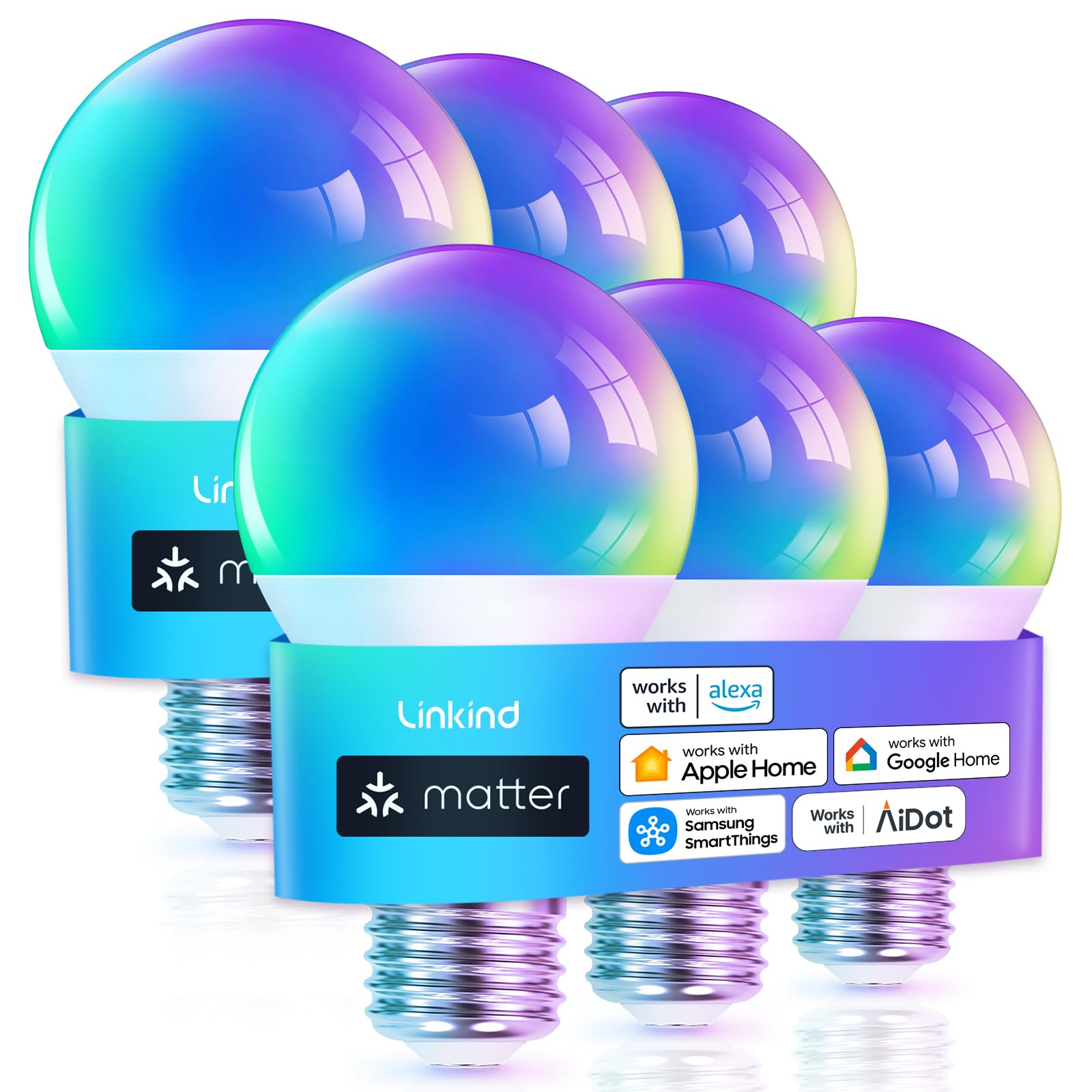
The Linkind Matter smart light bulbs are a six-pack of color-changing A19 bulbs that connect straight to Apple Home, Alexa and Google Home over WiFi — no hub, no bridge, no proprietary app gymnastics. This review covers what the bulbs are built for, how the Matter connection changes the setup, and where a budget six-pack like this one asks for patience. Buyers who want mood lighting across several rooms without paying per-bulb premium prices will find the decision below made quickly.
Check the current price on Amazon
Features and Specifications
Type: LED color-changing light bulbs, A19 shape
Base: E26 (standard US medium screw base)
Brightness: 60W equivalent, 800 lumens
Connectivity: 2.4 GHz WiFi, Matter-enabled direct connect
Compatibility: Apple Home, Alexa, Google Home
Pack Size: 6 bulbs
The numbers here describe a standard household bulb that happens to be smart. A19 is the everyday bulb shape, E26 is the fitting found in most US lamps, ceiling fixtures and fans, and 800 lumens is roughly what a 60W incandescent used to put out. That means the pack can go into existing fixtures without adapters or new hardware.
The Matter label is the part that matters most for the buying decision. Matter is a shared smart-home standard, so the bulbs pair with whichever major platform the household already uses rather than locking into one brand’s app. The 2.4 GHz WiFi requirement is the one detail worth checking before ordering — it is the standard band for smart bulbs, but it does mean the bulbs want a 2.4 GHz network rather than a 5 GHz-only one.
Build and Everyday Use
These are LED bulbs, so the practical expectations are the ones that come with the category: low running cost, little heat, and a long service life compared with incandescent. The A19 form factor keeps them unobtrusive in table lamps and open fixtures. Color changing adds the mood-lighting job — warm whites for evenings, saturated colors for accents, and adjustable white tones for working light.
The six-pack sizing is deliberate. Smart bulbs are usually bought one at a time and cost accordingly; a six-pack spread across a living room, two bedrooms and a hallway gets a household to whole-home coverage in a single purchase. For buyers who want every lamp in a room to change together, buying in bulk is the only sane way to do it.
Power and Connectivity
Direct connect is the headline capability. The bulbs join a WiFi network and talk to Apple Home, Alexa or Google Home without a separate hub or bridge device. That removes a piece of hardware, an extra power outlet and a setup step that trips up a lot of first-time smart-home buyers.
Matter adds forward compatibility. Because it is a cross-platform standard, the bulbs are not tied to one ecosystem, and a household that later switches from Alexa to Apple Home is not starting over with new hardware. The 2.4 GHz band is the trade-off built into the design: it reaches further through walls than 5 GHz, which suits bulbs scattered around a home, but it is also the more crowded band in dense neighborhoods.
Color, Mood Lighting and Control
Color changing is where these bulbs earn their place beyond plain white lighting. The practical uses are the familiar ones: dimmed warm light for evenings, cooler white for tasks, and colored scenes for movie nights or ambient corners. Control runs through the platform app — Apple Home, Alexa or Google Home — rather than a single manufacturer app, which keeps the household’s smart devices in one place.
The honest limit of any color bulb is that saturated colors read dimmer than white light at the same setting, and that is true across the category rather than specific to this pack. Buyers who mainly want bright, clean white light should treat the color features as a bonus rather than the reason to buy.
Maintenance and Reliability
LED bulbs need essentially no maintenance beyond occasional dusting, and the long rated life of the category means replacement is a rare event. The maintenance question with smart bulbs is really a network question: firmware updates arrive through the platform, and a stable 2.4 GHz WiFi signal is what keeps schedules and voice control responsive.
The realistic caution for a budget six-pack is consistency. Inexpensive smart bulbs can occasionally drop off the network or need re-pairing after a router restart, and six bulbs means six devices to check when something misbehaves. Buyers with a mesh WiFi system or a router that handles many connected devices will have an easier time than those on an older single-router setup.
Trade-off: At this price tier the bulbs trade premium build and per-bulb polish for volume, so a buyer should expect occasional re-pairing and accept that the six-pack value comes with a little setup patience.
Who These Bulbs Suit — and Who They Don’t
These bulbs suit renters and first-time smart-home buyers who want multi-room color lighting without a hub, and households already running Apple Home, Alexa or Google Home that want devices to appear in the app they already use. The six-pack also suits anyone lighting a whole room or a small apartment in one order.
They are a poor fit for buyers who need a single bulb, for homes with a 5 GHz-only network, and for anyone who wants per-bulb premium features like dedicated scene hardware or a proprietary app with deep customization. Buyers chasing the brightest possible white light should look at dedicated high-lumen bulbs instead.
FAQ
-
Do these bulbs need a hub or bridge?
No. They are Matter-enabled direct-connect bulbs that join a 2.4 GHz WiFi network and pair with Apple Home, Alexa or Google Home without extra hardware. -
Will they work with Apple Home, Alexa and Google Home at the same time?
Matter is a cross-platform standard, so the bulbs are built to pair with the major platforms. A household can use the platform it prefers, and multiple platforms can generally share Matter devices. -
What fitting do these bulbs use?
They are A19 bulbs with an E26 base, the standard medium screw fitting found in most US lamps and ceiling fixtures. -
How bright are they?
They are rated at 800 lumens, the equivalent of a 60W incandescent bulb, which suits lamps and general room lighting. -
Do they work on 5 GHz WiFi?
No. They connect over 2.4 GHz WiFi, which is the standard band for smart bulbs and reaches further through walls. -
Can the color and brightness be controlled by voice?
Yes. Because they pair with Alexa, Google Home and Apple Home, color, brightness and on/off can be controlled through those platforms’ voice assistants. -
Are these bulbs suitable for outdoor fixtures?
They are standard indoor A19 bulbs. Buyers should check the fixture’s rating before using any bulb outdoors. -
How many bulbs come in the pack?
Six. That is enough to cover several lamps or a small apartment in one purchase. -
Do the bulbs remember their settings after a power cut?
Smart bulbs typically restore their last state or a default when power returns, depending on platform settings. The behavior is configured in the app rather than on the bulb. -
Are they a good choice for someone who only needs one smart bulb?
Not really. The value is in the six-pack, so a buyer who needs a single bulb is paying for extras.
Bottom Line
The Linkind Matter smart light bulbs are the practical pick for a household that wants color-changing smart lighting across several rooms without a hub or a premium per-bulb price. Matter support keeps the pack usable across Apple Home, Alexa and Google Home, and the A19/E26 format drops straight into existing fixtures. Buyers with a stable 2.4 GHz network and more than one lamp to fill get the most out of it; anyone needing a single bulb or a 5 GHz-only setup should look elsewhere.
