Why there are Amazon links here: Brave Review is paid a commission for qualifying Amazon purchases made through the links below. Your price does not change, and using our links is entirely optional. How this works
Minetom E26 Rechargeable Light Bulbs: One Bulb, Twelve Colors, No Outlet Needed
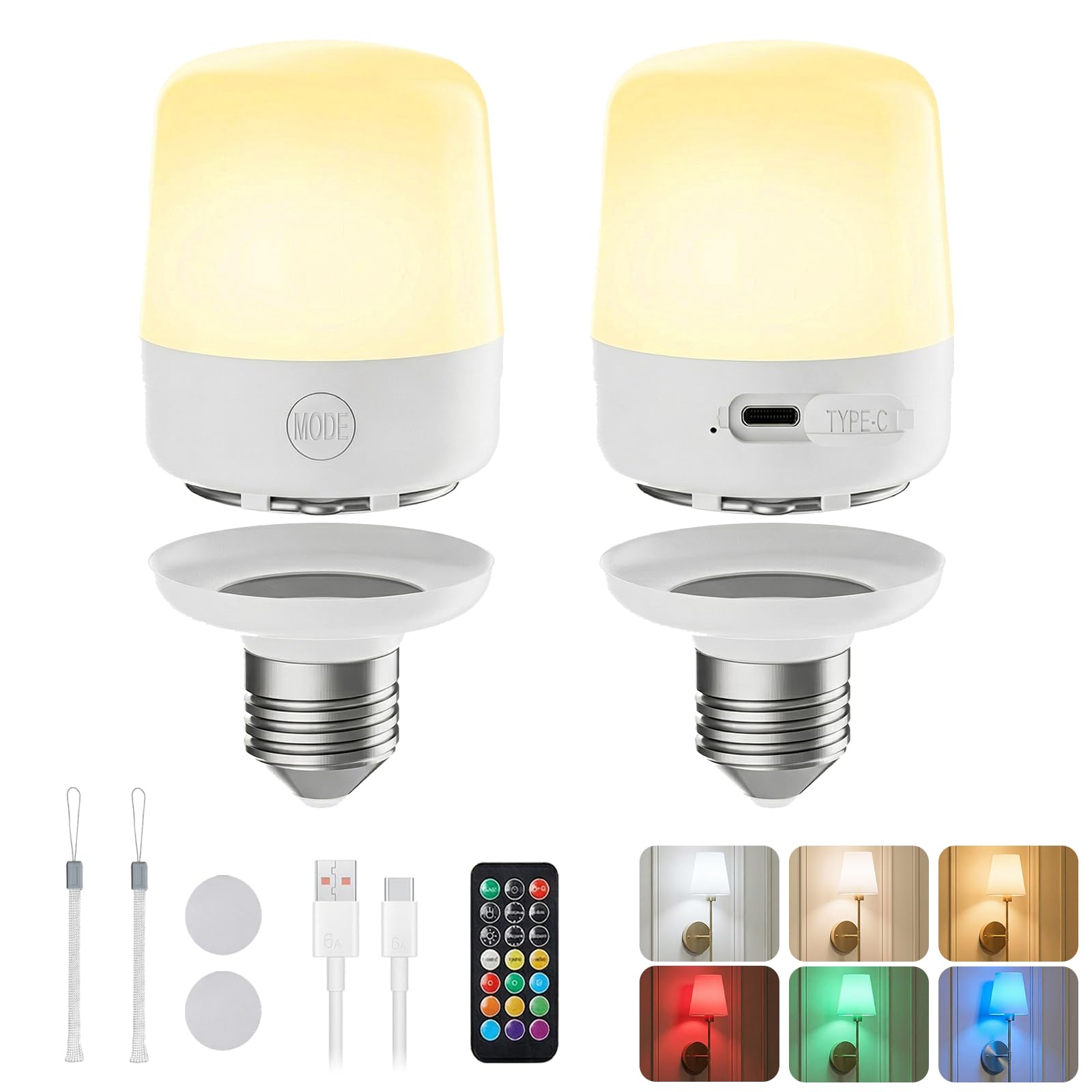
The Minetom E26 rechargeable light bulbs are a two-pack of battery-powered LED bulbs built for sockets where a cord is inconvenient or impossible — lamps, sconces, closets, campsites and storm kits. This review covers what the bulbs actually do, where the 2300mAh battery and 12-color range make sense, and the situations where a standard bulb is still the better buy. It is written for the buyer deciding between a rechargeable bulb and a corded fixture, not for someone shopping on color alone.
Check the current price on Amazon
Features and Specifications
Type: Rechargeable LED light bulb, E26 base
Pack Size: 2 bulbs
Color Range: 12 colors
Brightness: Dimmable
Output Equivalence: 40W incandescent equivalent
Battery: 2300mAh rechargeable
Controls: Remote control with timer
Intended Use: Lamps, sconces, camping, emergency lighting
The Minetom bulbs are standard-shaped LED bulbs with an E26 screw base, which is the ordinary medium base found on most table lamps, wall sconces and ceiling fixtures in US homes. The difference is that each bulb carries its own rechargeable battery instead of drawing power from the socket. That means the bulb works in a lamp that is nowhere near an outlet, in a fixture on a wall with no wiring behind it, or hanging in a tent.
The remote is the part that turns this from a novelty into a usable product. It handles power, brightness and color selection, and it carries a timer function, so a bulb can be set to shut off after a period rather than left running. Buyers who plan to use the bulbs in a bedroom or a hallway will get more out of the remote than buyers who only want a light for a closet.
The trade-off is that everything the bulb does comes out of one 2300mAh battery. Brightness, color and runtime all compete for the same charge, and the 40W-equivalent rating is the ceiling, not the everyday setting.
Build and Materials
The bulbs follow the shape and footprint of a conventional LED bulb, which is deliberate: they are meant to disappear into existing fixtures rather than announce themselves as a specialty product. The E26 base screws into the same sockets as any household bulb, so installation is a matter of charging the battery and screwing the bulb in.
Because the battery sits inside the bulb, weight is the main physical difference from a standard LED. A heavier bulb is fine in a table lamp or a wall sconce with a firm mount, but it is worth checking the fixture before committing — a loose or angled socket that holds a lightweight bulb may not hold one with a battery inside it.
The two-pack format suits the way these bulbs actually get used. Buyers rarely need one; they need a pair for matching sconces, or one for the lamp and one kept charged as a spare for a power cut. Minetom selling them as a pair rather than singly is a small but sensible choice for the category.
Battery, Power and Brightness
The 2300mAh battery is the number that governs the whole experience. Capacity in this range is enough for an evening of use at moderate brightness, but it is not enough to leave a bulb running at full output for days. Buyers should think of these as task and accent lights that get charged periodically, not as a replacement for a wired bulb that stays on all night.
The 40W-equivalent rating puts output in the same territory as a modest reading lamp or a dim hallway light. That is appropriate for the jobs listed on the box — camping, emergency lighting, sconces — but it is not a bulb for lighting a living room for a family. The dimming function softens the ceiling further, so the practical range runs from a soft accent glow up to a working light, not from dim to bright room-filling illumination.
The 12-color range is the feature that separates this bulb from a plain rechargeable white LED. Color-changing bulbs get used in two ways: practical (a warm tone for the evening, a cooler tone for a task) and decorative (a colored wash behind a TV or across a patio table). Both are covered here, and the remote makes switching between them quick rather than a matter of cycling through a menu on the bulb itself.
The timer deserves separate mention because it solves the main weakness of any battery bulb — forgetting to turn it off. Setting a shutoff removes the most common way these batteries get drained.
Charging and Maintenance
Rechargeable bulbs live or die on charging routine, and this is where buyers should be honest with themselves about how disciplined they are. A bulb that is charged on a schedule works reliably for years of casual use. A bulb that is only remembered when it dies will spend a lot of time dark.
The practical approach is to treat the two-pack as a rotation: one bulb in the fixture, one on the charger, swap when needed. That pattern removes the dead-battery surprise entirely and is the reason a two-pack makes more sense than a single bulb for anyone relying on these for emergency lighting.
Beyond charging, maintenance is minimal. There is no wiring, no fixture to install and nothing to replace but the bulb itself when the battery eventually stops holding a useful charge. Rechargeable batteries degrade over time, and a built-in battery means the whole bulb reaches end of life together — a normal limitation of the category rather than a fault specific to Minetom.
Trade-off: The battery that makes these bulbs useful also caps them — output, color and runtime all draw from one 2300mAh cell, so they suit lamps, sconces and emergency kits rather than all-night primary lighting.
Who These Bulbs Suit — And Who They Don’t
These bulbs are a strong fit for renters who cannot add wiring, for anyone with a lamp or sconce in a spot with no nearby outlet, for campers who want real light in a tent without a lantern, and for households building a storm or outage kit. The remote and timer make them more usable than a basic battery puck light, and the E26 base means they fit fixtures buyers already own.
They are a poor fit for anyone wanting to replace the main lighting in a room. A 40W-equivalent output on a battery is not a ceiling light, and no amount of dimming changes that. Buyers who want permanent smart lighting in a fixed fixture should look at a wired bulb instead.
They are also a questionable buy for someone who wants a set-and-forget bulb. These require charging, and a buyer who resents that routine will end up with two dead bulbs in a drawer.
FAQ
-
Do Minetom E26 rechargeable light bulbs need to be plugged in to work?
No. Each bulb runs on its own built-in 2300mAh rechargeable battery, so it works in a socket with no power connected. The bulb is charged separately and then screwed into the fixture. -
What does 40W equivalent mean on a rechargeable bulb?
It means the bulb’s light output is comparable to a 40W incandescent bulb. That is a modest, lamp-level brightness rather than room-filling light, which matches the camping, sconce and emergency uses the bulb is sold for. -
How do the 12 colors get changed?
Through the included remote, which also handles brightness and the timer. The remote is the primary control, so keeping it somewhere findable matters more with this bulb than with a standard one. -
Can these bulbs be dimmed?
Yes. Brightness is dimmable, and the dimming is controlled from the remote. The range runs from a soft glow up to the bulb’s full 40W-equivalent output. -
What is the timer for?
The timer shuts the bulb off automatically after a set period. It is the simplest way to avoid draining the battery by leaving a light on, and it is useful for a hallway or bedside lamp used at the same time each night. -
Will these fit a normal lamp?
They use a standard E26 medium base, the same base as most US table lamps, sconces and ceiling fixtures. The bulbs are heavier than standard LEDs because of the battery, so a firm socket is worth confirming before use in a loose fixture. -
How long does the battery last on a charge?
Runtime depends on brightness and color setting, since both draw from the same battery. Expect shorter runs at full brightness and longer runs at dim settings. Keeping the second bulb charged in rotation avoids surprises. -
Are these good for power outages?
Yes, this is one of their best uses. A charged pair gives light during an outage without candles or a flashlight, and the two-pack format means one can be in use while the other charges. -
Do they work outdoors?
The product is marketed for camping and sconce use, so they suit sheltered outdoor spots and tents. They are not sold as a weatherproof fixture, so exposed outdoor mounting in rain is not their job. -
Why buy a two-pack instead of one bulb?
The rotation is the reason. One bulb in the fixture and one on the charger means a light is always ready, which matters most for emergency and sconce use where a dead bulb is discovered at the worst moment.
Bottom Line
The Minetom E26 rechargeable light bulbs solve a specific problem well: light where there is no wiring, with enough control — 12 colors, dimming, a remote and a timer — to be genuinely useful rather than a gadget. The 2300mAh battery and 40W-equivalent output set clear limits, so these are the right buy for lamps, sconces, camping and outage kits, and the wrong buy for anyone replacing primary room lighting. Buyers who accept the charging routine will get a versatile pair of bulbs; buyers who want set-and-forget should stay with a wired LED.
