Why there are Amazon links here: Brave Review is paid a commission for qualifying Amazon purchases made through the links below. Your price does not change, and using our links is entirely optional. How this works
Moen Flo Detector: Wi-Fi Water Leak Sensors for the Whole House
The Moen Flo Detector is a three-pack of Wi-Fi water and moisture sensors built to catch leaks before they turn into a flooded basement or a swollen ceiling. It suits homeowners who already run a smart-home setup and want early warning at the water heater, under the kitchen sink, and beside the washing machine. This review covers what the sensors do, how they fit into a Moen Flo system, what the trade-offs are, and who should skip them. The short answer for most people: it is a sensible add-on for leak-prone rooms, but it is not a standalone shutoff system.
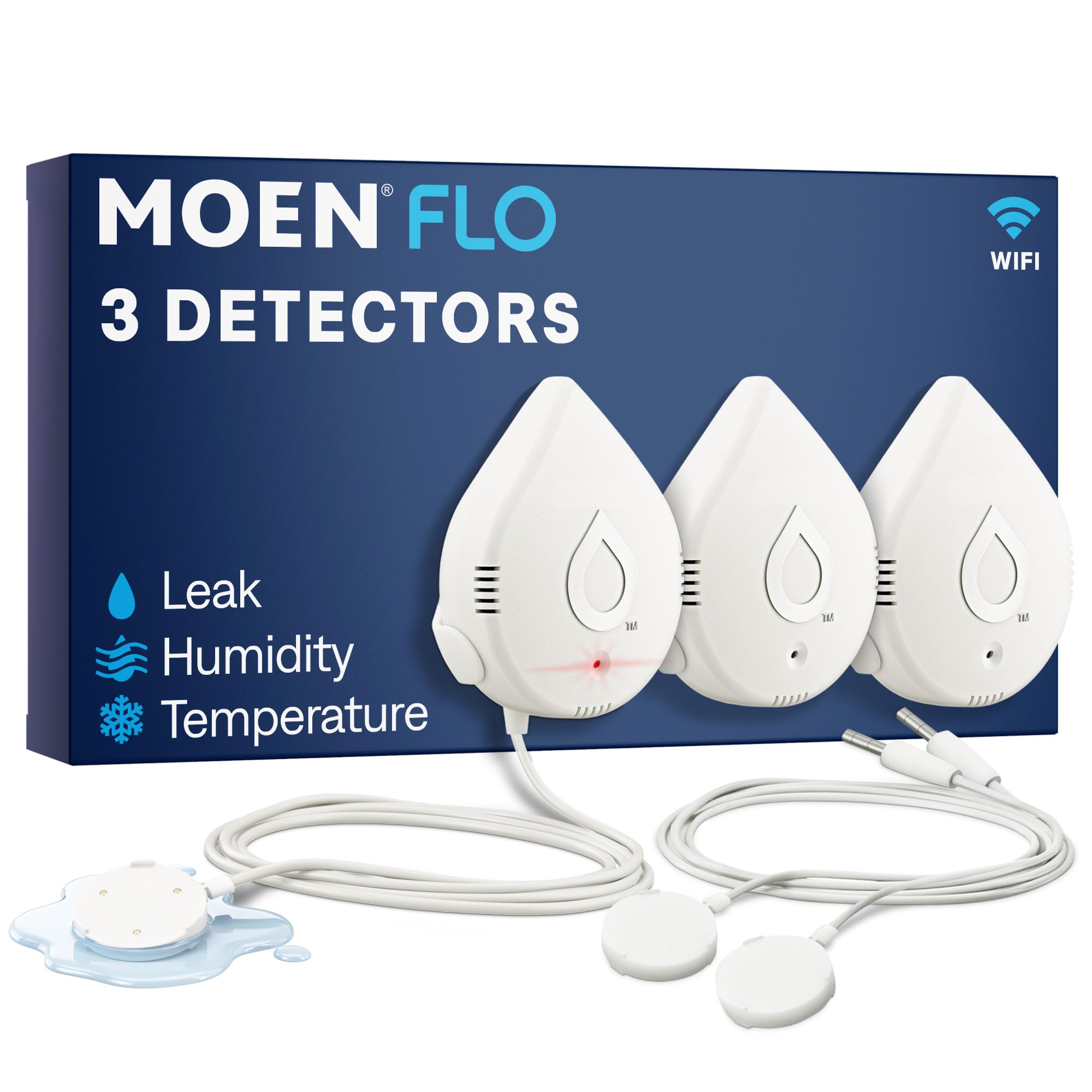
Features and Specifications
Product: Moen Flo Detector, WiFi Enabled Water & Moisture Sensors, 3 pcs, 920-005
Type: Water and moisture leak sensors
Quantity: Three sensors per pack
Connectivity: Wi-Fi enabled
Intended Use: Spot leak detection at fixtures and appliances
ASIN: B08559ZTDK
The headline here is the count. Three sensors in one box means a buyer can cover the three classic leak locations without buying three separate devices, which is where most single-sensor kits fall short.
Wi-Fi is the other defining feature. These detectors talk to a network rather than a proprietary hub, so they fit into a connected home rather than demanding their own bridge. That matters for anyone who has already invested in a smart-home ecosystem and does not want another app and another dongle.
What the name does not promise is a shutoff valve. The Flo Detector is a sensing product; it reports moisture, it does not stop water. Buyers who want automatic shutoff need to pair it with a valve controller or a full Flo system. That distinction is the single most important thing to understand before buying.
Trade-off: The pack is priced as a premium accessory, so buyers paying for three sensors are paying for the Moen name and ecosystem fit rather than for hardware that undercuts generic leak pucks.
Check the current price on Amazon
How the Detector Fits a Leak-Protection Setup
Build and Placement
These are spot sensors, the kind that sit flat on a floor or in a cabinet and wait. They are designed for the places water actually pools: the pan under a water heater, the cabinet beneath a sink, the floor behind a washing machine, the base of a toilet.
Because they are small and self-contained, placement is flexible. A buyer can tuck one behind a toilet tank without rearranging plumbing, and the three-pack format means no agonizing over which single location matters most. The practical approach is to put them where a slow drip would go unnoticed for days.
The limitation is coverage area. A spot sensor catches water that reaches it, not water across the room. A finished basement with a slab floor needs several units or a different approach.
Connectivity and Alerts
Wi-Fi connectivity is the feature that separates this from a dumb leak alarm that only beeps in an empty house. A connected sensor can push an alert to a phone, which is the difference between learning about a leak while at work and learning about it when the ceiling stains.
The trade-off with any Wi-Fi sensor is dependence on the home network and on power. A detector that loses its connection is a silent detector, and a buyer should confirm the network reaches the basement or the crawlspace before relying on it.
The Shutoff Question
This is the decision that defines the purchase. Sensors warn; valves stop. A buyer who wants the water cut off automatically while on vacation is shopping for the wrong product and will be disappointed.
The Detector’s value is as a layer in a larger system: sensing plus a shutoff device plus a phone alert covers detection, action, and notification. Bought alone, it covers only the first and third.
Maintenance and Longevity
Leak sensors are low-maintenance devices by nature. They sit, they wait, and occasionally they need a battery or a connectivity check. The realistic upkeep is periodic testing, because a sensor that has never been triggered is a sensor nobody knows works.
Buyers should plan to test each unit a couple of times a year, confirm the app still sees all three, and keep the batteries fresh. Skipping that routine quietly converts a safety device into decoration.
Strengths and Weaknesses
The clearest strength is the three-pack format paired with Wi-Fi. Buyers get multi-location coverage and phone alerts without buying a hub or three separate kits, and the Moen branding means it plays well with the wider Flo ecosystem.
The second strength is simplicity. There is no plumbing work, no wiring, and no professional install. A homeowner can have all three sensors placed and connected in an afternoon.
The weakness is scope. These detect and report; they do not stop water. A buyer expecting automatic shutoff will find the product underwhelming, and a buyer with a large or spread-out property will find three sensors thin.
The second weakness is ecosystem gravity. The Detector is most compelling for households already invested in Moen’s water-management products. A buyer starting from scratch may find cheaper ways to get leak alerts, even if the integration is less tidy.
Trade-off: Three sensors cover three rooms well, but a whole-house leak strategy needs more units or a shutoff valve, and the pack price makes expansion a real budget line.
See the Moen Flo Detector on Amazon
Who Should Buy It — and Who Should Not
Buyers who should consider it: homeowners with a water heater, a laundry room, and a kitchen sink worth protecting; anyone already running Moen Flo gear who wants sensing at the fixtures; and households that travel and want a phone alert when something drips.
Buyers who should skip it: anyone expecting automatic water shutoff, renters who cannot mount or place sensors freely, and large properties where three units cannot plausibly cover the risk. Those buyers need a valve-based system first.
FAQ
-
What does the Moen Flo Detector actually do?
It senses water and moisture at the spot where it sits and, through Wi-Fi, alerts the homeowner. It does not shut off the water supply. -
Does the Moen Flo Detector need a hub?
It is Wi-Fi enabled, so it connects to the home network rather than a dedicated bridge. Buyers should confirm their network reaches the intended locations. -
How many sensors come in the box?
Three. The pack is listed as 3 pcs, which covers three separate leak-prone locations. -
Will it stop a leak automatically?
No. Detection and shutoff are separate jobs. Stopping water requires a valve controller or a full Flo system. -
Where should the three sensors go?
The usual priority spots are under the kitchen sink, beside the water heater, and behind or beside the washing machine — anywhere a slow leak would go unseen. -
Does it work without Wi-Fi?
The product is built around Wi-Fi connectivity, so the alerting features depend on a working network. A buyer with dead zones should address coverage first. -
Is it hard to install?
No plumbing or wiring is involved. Placement and app setup are the whole job. -
Can it be expanded later?
Yes. Additional detectors can extend coverage to more rooms, which is the natural path for a larger home. -
Is it a replacement for a water alarm?
It is a smarter version of one. A basic alarm beeps locally; this one adds remote notification, which matters when nobody is home. -
Who is this pack not for?
Buyers who want automatic shutoff, or who need broad coverage across a large property, will be better served by a valve-based system.
Bottom Line
The Moen Flo Detector is a well-targeted three-pack for homeowners who want Wi-Fi leak alerts at the fixtures that fail most often, and it makes the most sense for households already inside the Moen Flo ecosystem. It detects and reports rather than stopping water, so it belongs alongside a shutoff solution, not instead of one. Buyers who understand that division of labor will find it a clean, no-plumbing way to add early warning to three vulnerable spots.
Check the price and availability of the Moen Flo Detector on Amazon
