Why there are Amazon links here: Brave Review is paid a commission for qualifying Amazon purchases made through the links below. Your price does not change, and using our links is entirely optional. How this works
Mysa Smart Thermostat Lite for Electric Baseboard Heaters: Smart Control for a Forgotten Heater Type
Electric baseboard heaters are common, cheap to install and almost impossible to automate — most smart thermostats are built for central HVAC and simply will not work with them. The Mysa Smart Thermostat Lite is one of the few mainstream options aimed squarely at line-voltage baseboard heat, adding WiFi programming, a seven-day schedule and voice control through HomeKit, Alexa and Google. This review covers what the Lite version actually does, where it fits in a home, and the limits a buyer should weigh before ordering. The short version: it suits anyone with 120V or 240V baseboard heat who wants app and voice control, and it is a poor fit for central forced-air systems or for anyone expecting a full-featured flagship thermostat.
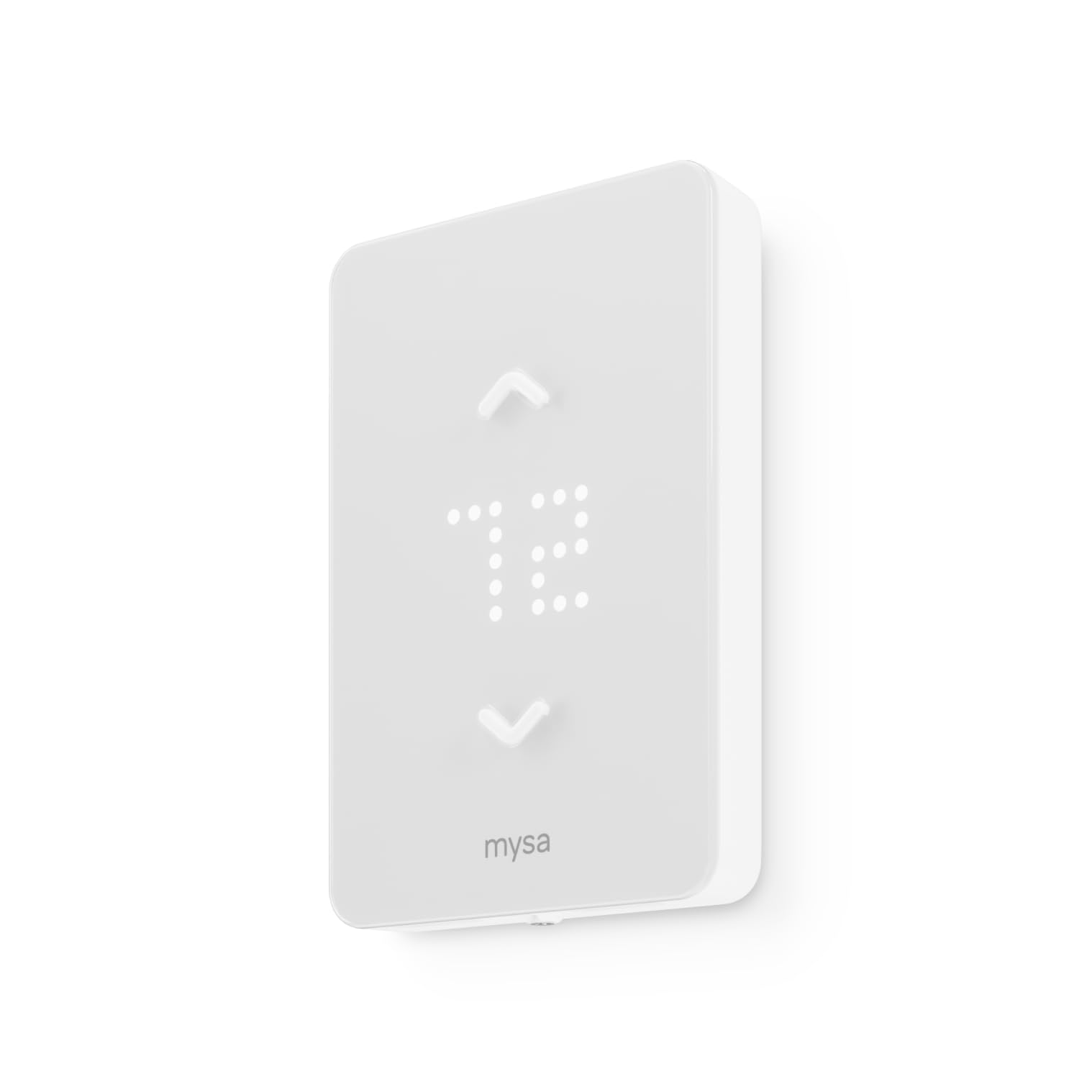
Check the current price on Amazon
Features and Specifications
Type: Smart thermostat for electric baseboard heaters
Power Compatibility: 120V–240V line voltage
Connectivity: WiFi
Scheduling: 7-day programmable
Voice and Platform Support: Apple HomeKit, Amazon Alexa, Google
Claimed Savings: Up to 26% on heating
Brand: Mysa
The name carries most of the useful detail. This is a line-voltage thermostat, meaning it switches mains power directly to the heater rather than sending a low-voltage signal to a furnace or boiler. That single fact is why the Lite exists: standard smart thermostats run on low-voltage wiring and are not compatible with baseboard circuits.
The 120V–240V range covers the two voltages residential baseboard heaters typically use, so the same unit serves both a small bathroom heater and a larger living-room run. WiFi is built in, and the platform list — HomeKit, Alexa and Google — means the thermostat can join whichever smart-home ecosystem is already in the house rather than forcing a new one.
The seven-day scheduling is the practical core of the product. Each day can run its own program, which matters in households where the weekday routine and the weekend routine look nothing alike. The claimed savings of up to 26% on heating come from the manufacturer and rest on the usual logic of setback scheduling: heat less when rooms are empty or occupants are asleep.
Build and Installation
The Lite is the pared-down member of the Mysa line, and the physical design reflects that. It is a wall-mounted unit that replaces the existing baseboard thermostat in the same electrical box, which keeps installation familiar for anyone who has swapped a thermostat before.
Because the unit sits on a line-voltage circuit, installation involves mains wiring rather than the low-voltage wiring most homeowners handle themselves. A buyer who is not comfortable shutting off a breaker and working with 120V or 240V conductors should budget for an electrician, and that labor cost belongs in the total price of the project.
The trade-off here is straightforward. A line-voltage thermostat has to be built around relays and heavier terminal blocks than a low-voltage unit, and the Lite keeps costs down by trimming features rather than safety hardware. Buyers who want the leanest capable option for baseboard heat get exactly that; buyers who want extras should look at the full Mysa range instead.
Capacity and Coverage
One Lite controls one heating circuit. In a home with several baseboard heaters on separate circuits, that means one thermostat per zone, and the cost multiplies accordingly. A single large open-plan room on one circuit is the ideal case; a house with six independently wired heaters is a much bigger purchase than the unit price suggests.
The 120V–240V rating means the thermostat is not the limiting factor for typical residential baseboard loads — the circuit and the heater are. Buyers should confirm what voltage and amperage their existing thermostat is switching before ordering, since the Lite replaces that device in place.
The trade-off is scale. This is a per-zone device, not a whole-home controller, and anyone expecting a single purchase to manage every heater in the house will be disappointed by the arithmetic.
Power and Efficiency
The efficiency story rests on scheduling rather than on any exotic hardware. A seven-day program lets a household drop the setpoint during work hours and overnight, then bring rooms back up to temperature before anyone needs them. On resistive baseboard heat, where every kilowatt-hour becomes heat directly, that setback is the main lever available.
The claimed savings of up to 26% should be read as a manufacturer figure tied to specific usage patterns, not a guarantee. Households that already keep rooms cool and only heat occupied spaces will see less; households that currently leave baseboard heat running on a dumb dial all day will see more.
The trade-off is that scheduling only pays off if the schedule matches real life. A program that fights the household’s routine gets overridden, and an overridden schedule saves nothing.
Smart Home and Maintenance
WiFi plus HomeKit, Alexa and Google puts the Lite in the same control layer as the rest of a smart home. Voice commands handle setpoint changes, app control handles scheduling from elsewhere, and HomeKit support means Apple households can fold the thermostat into automations alongside other accessories.
Maintenance is minimal. There are no filters or moving parts to service, and the device’s job is switching and sensing. Firmware updates arrive over WiFi, so the practical upkeep is keeping the thermostat on the network.
The trade-off is dependence on the app and the cloud. A buyer who wants a thermostat that works entirely without a phone or an internet connection is buying the wrong category of product, and the Lite’s feature set lives largely in software.
Trade-off: The Lite is a per-circuit, app-dependent device, so multi-zone homes face multiplying costs and offline control is limited compared with a plain dial thermostat.
FAQ
-
Will the Mysa Smart Thermostat Lite work with electric baseboard heaters?
Yes — that is precisely what it is built for. It is a line-voltage thermostat rated for 120V–240V, which matches typical residential baseboard circuits. -
Does it work with central heating or a heat pump?
No. The Lite is designed for electric baseboard heat and similar line-voltage resistive heating, not for low-voltage central HVAC systems. -
Does it support Apple HomeKit, Alexa and Google?
Yes. The product name lists all three, so it can join whichever ecosystem the household already uses. -
Can the schedule differ by day?
Yes. It offers seven-day scheduling, so weekdays and weekends can run separate programs. -
Is a neutral wire required?
The product name does not state wiring requirements beyond the 120V–240V rating. Buyers should check the existing thermostat’s wiring and the installation guide before ordering. -
Can one thermostat control multiple baseboard heaters?
One unit controls one heating circuit. Heaters wired together on the same circuit can share a thermostat; heaters on separate circuits each need their own. -
Is professional installation necessary?
It is not strictly required, but the unit connects to mains voltage. Anyone not confident working with 120V or 240V wiring should hire an electrician. -
How much can it save on heating?
The manufacturer claims up to 26%. Actual results depend on the household’s schedule, current habits and how much unoccupied space is being heated. -
Does it need WiFi to run?
WiFi is central to its scheduling and voice-control features. Buyers who want fully offline operation should expect reduced functionality. -
How does the Lite differ from the standard Mysa?
The Lite is the pared-down version of the Mysa line. It keeps the core line-voltage compatibility, WiFi and platform support while trimming features to reach a lower price tier.
Bottom Line
The Mysa Smart Thermostat Lite solves a real problem for a specific buyer: someone with electric baseboard heat who wants app scheduling and HomeKit, Alexa or Google control without rewiring the house for a conventional smart thermostat. It is the right pick for a single well-used zone, and the wrong pick for central HVAC, for whole-home coverage on a budget, or for anyone who wants a thermostat that works without an app. Buyers with one or two baseboard circuits and a predictable weekly routine will get the most out of it.
