Why there are Amazon links here: Brave Review is paid a commission for qualifying Amazon purchases made through the links below. Your price does not change, and using our links is entirely optional. How this works
Best Offline Operation and Privacy Books for a Self-Reliant Digital Life
Offline operation and privacy come down to a simple shift: keeping the important parts of digital life working without a live internet connection and without handing data to someone else’s server. The five books here cover that ground from different angles — private local AI, DIY portable machines, anonymous browsing, full-scale identity removal, and keeping a household running when the network drops. Readers who want to build rather than just read should start with the private-server guide; those protecting an existing life should start with Extreme Privacy. The overview table below sorts all five by what they actually deliver.
The Picks at a Glance
| Product | Key Spec | Best Use | Price Tier |
|---|---|---|---|
| Personal AI Servers | Local LLM self-hosting guide | Running private AI offline | Mid |
| Why Build a Cyberdeck | DIY portable computer guide | Hands-on offline hardware | Mid |
| Dark Web for Beginners | Step-by-step OSINT and anonymity guide | Safe, structured anonymity practice | Budget |
| Extreme Privacy | Full identity-removal playbook | Deep personal privacy overhaul | Mid |
| The Offline Household | Household continuity handbook | Grid-down and outage planning | Budget |
Personal AI Servers: A Guide to Building Private AI Infrastructure for Secure, Offline and Self-Hosted Local LLMs for Data Privacy

Format: Book
Topic: Self-hosted local LLMs
Focus: Private AI infrastructure
Level: Builder-oriented
Key Benefit: Offline AI operation
Best For: Privacy-minded tinkerers
Personal AI Servers: A Guide to Building Private AI Infrastructure for Secure, Offline and Self-Hosted Local LLMs for Data Privacy is the most technical pick on the list. It walks through standing up a local model that runs on owned hardware, so prompts and documents never leave the machine. The book frames the work around secure, self-hosted infrastructure rather than a quick install, which suits readers who want to understand the whole stack.
This one earns its place because local AI is where privacy and offline operation intersect most directly — a model that runs on the desk keeps working when the connection does not. It suits hobbyists, small-office operators, and anyone who already owns capable hardware. The trade-off is that a book on local model hosting dates quickly as tooling changes, so readers should expect to supplement it with current setup notes.
Check the current price on Amazon
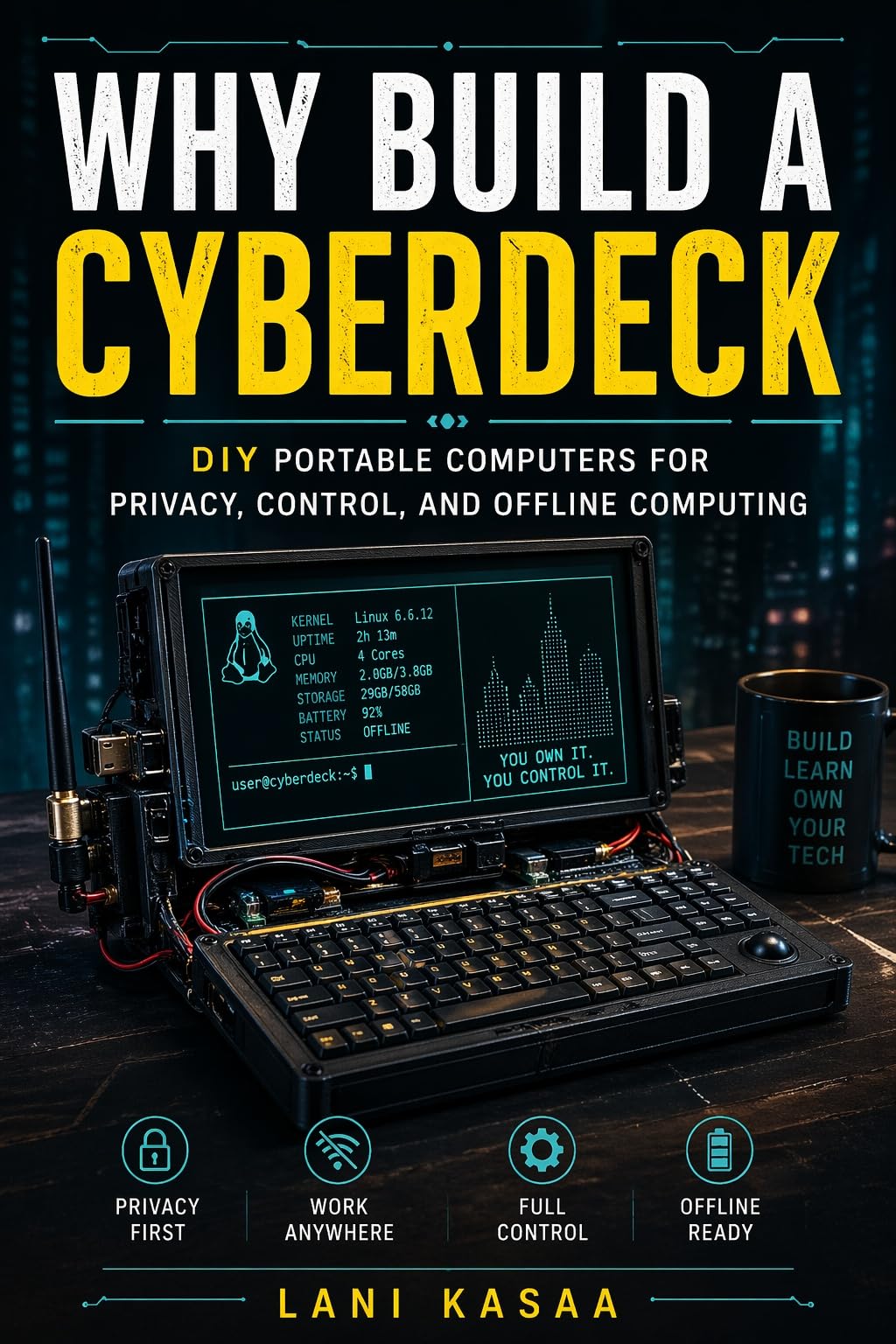
Why Build a Cyberdeck: DIY Portable Computers for Privacy, Control, and Offline Computing
Format: Book
Topic: DIY portable computing
Focus: Privacy and offline use
Approach: Build-focused
Key Benefit: Hardware control
Best For: Makers and hardware hobbyists
Why Build a Cyberdeck: DIY Portable Computers for Privacy, Control, and Offline Computing treats the machine itself as the privacy boundary. A cyberdeck is a home-built portable computer, and the book argues the case for assembling one rather than buying sealed hardware that phones home by default. It covers the reasoning first — control, repairability, offline capability — before the build side.
The pick suits people who are comfortable with a screwdriver and a soldering iron and who want a computer whose behavior they fully understand. It is the most hands-on title here, and the payoff is a device that works with no account and no cloud dependency. The trade-off is that a build guide assumes parts availability and basic electronics skill, so complete beginners will find the project side steep.
Check the current price on Amazon
Dark Web for Beginners: The Complete Step-by-Step Guide to OSINT, Anonymous Browsing, Digital Privacy, and Protecting Your Identity Online

Format: Book
Topic: Anonymity and OSINT
Focus: Digital privacy basics
Approach: Step-by-step
Key Benefit: Structured beginner path
Best For: Newcomers to anonymous browsing
Dark Web for Beginners: The Complete Step-by-Step Guide to OSINT, Anonymous Browsing, Digital Privacy, and Protecting Your Identity Online is the entry-level option and the cheapest of the five. It sequences the fundamentals — anonymous browsing, open-source intelligence gathering, and identity protection — into a step-by-step format rather than assuming prior knowledge. The framing keeps the emphasis on privacy practice, not on the sensational side of the topic.
It earns a slot because most privacy failures start with a missing basic step, and a structured walkthrough fixes that faster than scattered tutorials. The pick suits readers who are new to anonymization tools and want a single ordered path through them. The trade-off is that a beginner guide cannot go deep on any one tool, so readers planning serious operational security will outgrow it quickly.
Check the current price on Amazon
Extreme Privacy: What It Takes to Disappear

Format: Book
Topic: Identity removal
Focus: Deep personal privacy
Approach: Comprehensive playbook
Key Benefit: End-to-end identity control
Best For: Readers with a privacy mandate
Extreme Privacy: What It Takes to Disappear is the heaviest commitment on the list, and the title is literal. It addresses what full separation from data brokers, public records, and routine digital trails actually requires, layer by layer. The scope runs well past app settings into legal identity, property, and communications.
This is the pick for someone whose threat model justifies real disruption — a journalist, a public figure, or a person leaving a dangerous situation. It earns its place as the reference the other books point toward once basic hygiene is done. The trade-off is that the methods demand ongoing effort and money, and readers who only want better browser habits will find it far more than they need.
Check the current price on Amazon
THE OFFLINE HOUSEHOLD: How to Keep Your Money, Maps, Messages, Records, Work, and Home Running When the Internet Does Not (The Intelligence Frontier)

Format: Book
Topic: Household continuity
Focus: Outage and offline planning
Approach: Practical reference
Key Benefit: Everyday offline resilience
Best For: Families and householders
THE OFFLINE HOUSEHOLD: How to Keep Your Money, Maps, Messages, Records, Work, and Home Running When the Internet Does Not (The Intelligence Frontier) applies offline operation to the most ordinary setting: the home. It organizes planning around the systems a household depends on — money, navigation, communication, records, work, and the house itself — and covers how each keeps functioning without a connection.
The book suits families and anyone who wants resilience without a technical project, and it complements the privacy titles by covering the practical side of disconnection. It earns its slot as the most immediately useful pick for the average reader. The trade-off is that household continuity guidance is broad by design, so readers wanting deep technical detail on any single system will need a dedicated source.
Check the current price on Amazon
Before You Buy
- Skill level: The cyberdeck and AI-server titles assume hands-on comfort with hardware and configuration; the beginner and household books do not.
- Threat model: A reader protecting routine data needs different guidance than one attempting full identity removal, and the picks are not interchangeable.
- Currency: Titles covering local AI tooling and anonymous browsing age fastest; check publication dates before committing.
- Scope: Some books teach a project, others teach a practice; decide whether the goal is a build, a habit, or a plan.
- Format: All five are text references, so readers who learn from video walkthroughs will want supplementary material.
- Commitment: Extreme Privacy and the cyberdeck guide both imply sustained time and expense beyond the cover price.
- Starting point: Readers unsure where to begin should take the household book first and the technical titles second.
Frequently Asked Questions
-
Which book is best for someone completely new to privacy?
Dark Web for Beginners offers the most structured entry, and The Offline Household covers the practical side without technical prerequisites. -
Can these books actually keep a person offline?
They teach offline operation as a practice — local AI, home-built hardware, and household planning — rather than promising total disconnection. -
Is the local AI book useful without a powerful computer?
It is written for readers building on owned hardware, so a machine capable of running a local model is a reasonable prerequisite. -
Does Extreme Privacy require legal help?
The scope reaches into legal identity and records, so readers pursuing the full method should expect to consult qualified professionals. -
Which pick gives the fastest return?
The Offline Household, because its checklists apply to ordinary outages rather than long-term overhauls. -
Are these titles suitable as a set?
Yes — the beginner and household books build habits, while the AI, cyberdeck, and extreme-privacy titles go deeper as needs grow.
Bottom Line
For most readers, THE OFFLINE HOUSEHOLD is the best first purchase: it turns offline operation and privacy into concrete household steps instead of abstract principles. Readers ready to go technical should move to Personal AI Servers for local model hosting, while anyone with a serious threat model should go straight to Extreme Privacy.