Why there are Amazon links here: Brave Review is paid a commission for qualifying Amazon purchases made through the links below. Your price does not change, and using our links is entirely optional. How this works
Philips Hue A19 vs ANWIO BR30 Smart Bulbs: Which One Fits the Room
The Philips Hue A19 and the ANWIO BR30 are both four-packs of color-changing smart bulbs, but they are built for different sockets, different rooms and different budgets. This comparison separates them on shape, hub requirements, brightness, color range and cost so the reader can pick in a minute. The short version: Hue suits anyone building a proper smart home around a hub, and ANWIO suits anyone who wants cheap color in recessed ceiling cans.
Philips Hue A19: The Hub-Based Standard
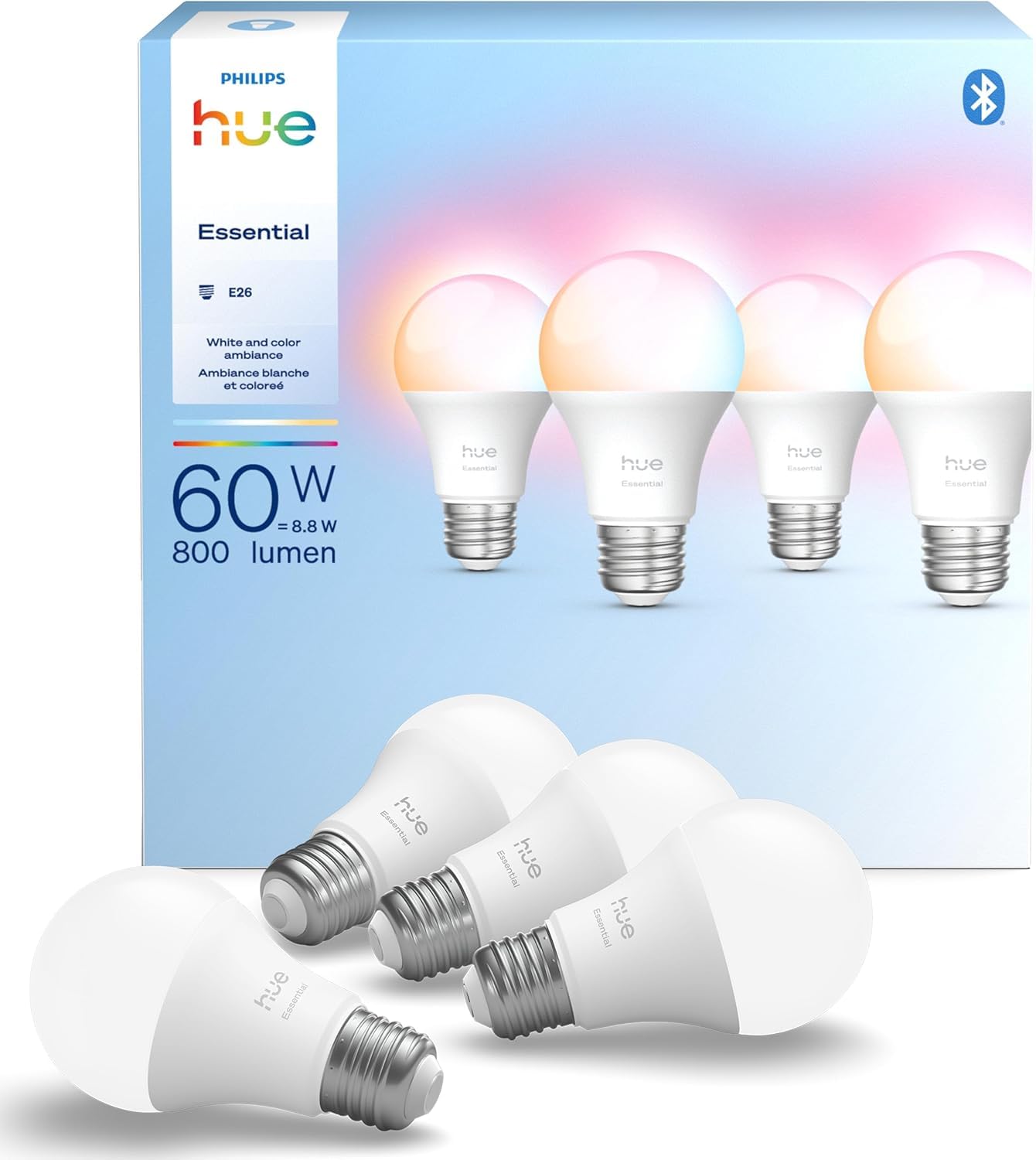
Base: E26
Shape: A19
Wattage: 7.2W
Color Temperature: 2200K-6500K
Brightness: 800 Lumens
Dimmable: Yes
Voice Assistants: Alexa, Google Assistant, Apple Home
Pack Size: 4
The Hue bulb is a standard A19 shape on an E26 base, which is the bulb that fits most table lamps, floor lamps, open ceiling fixtures and bedside lights in a US home. Its headline figure is the 2200K-6500K color temperature range: warm candlelight at one end, crisp daylight at the other, with full color ambience in between. At 800 lumens it lands in the same brightness territory as a conventional 60W bulb, so it is a straight swap rather than a downgrade.
The reason to pay more for Hue is the ecosystem behind it. The bulb lists Alexa, Google Assistant and Apple Home support, which points to a product designed to sit inside a coordinated smart home rather than stand alone. That usually means a Hue Bridge for the full feature set, including reliable schedules, scenes and multi-room control, and it means the bulbs hold their resale and expansion value better than no-name alternatives.
Trade-off: The premium price buys ecosystem polish, not raw output, and the brightest features and most dependable automation generally assume a separate hub purchase on top of the bulb cost.
Check the current price on Amazon
ANWIO BR30: Budget Color for Recessed Cans

Base: E26
Shape: BR30
Wattage: 8.5W
Equivalent: 60W
Brightness: 650 Lumens
Color: RGB multicolor
Hub Required: No
Voice Assistants: Alexa, Google Assistant
Pack Size: 4
The ANWIO bulb is a BR30, the wide flood shape that drops into recessed ceiling cans in kitchens, hallways and basements. That shape is the whole point: an A19 in a recessed can throws light in the wrong pattern, while a BR30 spreads it across the room. The bulb pairs over Wi-Fi with Alexa and Google Assistant without a hub, which keeps setup to a phone app and a voice device.
At 8.5W and 650 lumens it is a 60W-equivalent flood, so it lights a hallway or a covered porch comfortably without matching the output of a brighter living-room fixture. The RGB color changing is the draw here — party scenes, holiday colors, movie-night reds — at roughly half the cost per bulb of the Hue option. Amazon also certifies it to work with Alexa, which takes some of the guesswork out of pairing.
Trade-off: The no-hub design trades reliability and integration depth for price, and 650 lumens of flood light is dimmer than the Hue bulb, so it suits accent and ambient use better than task lighting.
Check the current price on Amazon
Side-by-Side Specs
| Specification | Philips Hue A19 | ANWIO BR30 |
|---|---|---|
| Base | E26 | E26 |
| Shape | A19 | BR30 |
| Wattage | 7.2W | 8.5W |
| Brightness | 800 Lumens | 650 Lumens |
| Color Temperature | 2200K-6500K | RGB multicolor |
| Dimmable | Yes | Yes |
| Hub Required | Bridge for full features | No |
| Voice Assistants | Alexa, Google Assistant, Apple Home | Alexa, Google Assistant |
| Pack Size | 4 | 4 |
| Price Tier | Premium | Budget |
The Differences That Decide It
The table above reads out in three places. The first is brightness: 800 lumens against 650. That gap is small on paper but noticeable in practice, because the Hue bulb can serve as primary light in a lamp while the ANWIO flood is better as accent or ambient light in a can. Buyers who want a bulb to read by should weight this heavily.
The second is color control. Hue’s 2200K-6500K range means the bulb can shift from warm to daylight white as well as produce color, which matters for anyone who wants a lamp to feel like a reading lamp at night and a workspace light by day. ANWIO’s RGB multicolor is about hue, not white quality — it is a fun bulb, not a tunable-white one.
The third is ecosystem. Hue lists Apple Home alongside Alexa and Google, which is the tell that it belongs in a broader setup with a bridge and scenes. ANWIO’s no-hub Wi-Fi design is the opposite bet: fewer moving parts, quicker setup, less integration. Neither is wrong; they answer different questions.
Shape is the quiet fourth difference. A BR30 only makes sense in a recessed can or a wide-shade fixture. An A19 fits almost everything. Buyers with standard lamps should not buy the flood, and buyers with ceiling cans should not buy the A19.
Which Should You Buy?
Choose the Philips Hue A19 if: the bulbs are going into table lamps, floor lamps or open fixtures; the household already uses Apple Home or plans a hub-based setup; tunable white light matters as much as color; and the budget stretches to a premium per-bulb price for better long-term integration.
Choose the ANWIO BR30 if: the target fixtures are recessed ceiling cans in a kitchen, hallway or basement; the goal is cheap color and voice control without a hub; Alexa or Google is the only smart assistant in the house; and 650 lumens of flood light is enough for the room.
Buyers who want both — a hub ecosystem in the living room and cheap color in the ceiling cans — are not forced to choose. The two products coexist fine in one home on separate apps.
FAQ
-
Do both bulbs fit the same socket?
Yes. Both use an E26 base, the standard US screw fitting. The difference is the bulb shape, not the socket: the A19 is a standard round bulb and the BR30 is a wide flood. -
Does the Philips Hue A19 need a hub?
The bulb works with Alexa, Google Assistant and Apple Home, but the full Hue feature set — scenes, schedules and multi-room control — generally assumes a Hue Bridge. Buyers should budget for that separately. -
Does the ANWIO BR30 really work without a hub?
The product name states no hub required, and it pairs directly over Wi-Fi with Alexa and Google Assistant. That makes setup simpler but ties control to the home network. -
Which bulb is brighter?
The Hue A19 at 800 lumens is brighter than the ANWIO BR30 at 650 lumens. The gap is modest but real in a lamp used for reading or tasks. -
Can the Hue bulb change white color temperature?
Yes. Its 2200K-6500K range covers warm white through daylight white, in addition to full color. The ANWIO bulb is RGB multicolor, which is a different kind of control. -
Which is better for recessed ceiling lights?
The ANWIO BR30, without question. A BR30 flood is shaped for recessed cans; an A19 in the same can throws light in a narrower pattern. -
Are both dimmable?
Yes, both are listed as dimmable. Dimming behavior depends on the switch or app used, so buyers with wall dimmers should confirm compatibility before installing. -
Which pack is the better value?
The ANWIO four-pack sits in a budget tier and the Hue four-pack in a premium one. Value depends on whether the buyer needs hub integration and tunable white light or just cheap color in ceiling cans.
Bottom Line
The decision comes down to fixtures and ecosystem. For lamps, tunable white light and a hub-based smart home, the Philips Hue A19 is the pick worth the premium. For recessed ceiling cans and budget color without a hub, the ANWIO BR30 does the job for far less.
