Why there are Amazon links here: Brave Review is paid a commission for qualifying Amazon purchases made through the links below. Your price does not change, and using our links is entirely optional. How this works
Best Planning for a Power Cut with Essential Equipment for a Calm, Prepared Home
Planning for a power cut with essential equipment is mostly a paperwork problem before it is a hardware problem: the household that knows what to buy, what to store and what to switch off first rides out an outage far better than the one that improvises in the dark. The five guides below cover that ground from different angles — one is a short conceptual primer, two are full survival playbooks, and two are free practical handbooks aimed squarely at homeowners. Beginners and renters should start near the top of the list; preppers planning for a long grid-down scenario will get more from the middle picks; households with medical devices or a generator should go straight to the last entry. The overview table below sorts all five by what each does best.
Overview of the Picks
| Product | Key Spec | Best Use | Price Tier |
|---|---|---|---|
| Small Power Planning | Paperback guide on blackout and off-grid power concepts | First book for a household new to outage prep | Budget |
| When The Lights Go Out | Survival guide for a long-term grid-down scenario | Readers planning for an extended collapse | Budget |
| How to Survive When the Grid Goes Down | Self-sufficient living guide, grid-down focus | Self-sufficiency readers wanting depth | Mid |
| When the Power Goes Out | Practical guide to blackouts and essential utilities | Quick, free grounding in the basics | Free |
| Power Outage Preparedness for Homeowners | Complete blackout and emergency power plan for a home | Homeowners with generators, batteries or medical needs | Free |
1. Small Power Planning: Blackout, Brownout, and Emergency Power Concepts
Format: Paperback
Subject: Blackout, brownout and emergency power concepts
Angle: Small-scale and off-grid power solutions
Best For: Beginners building a first plan
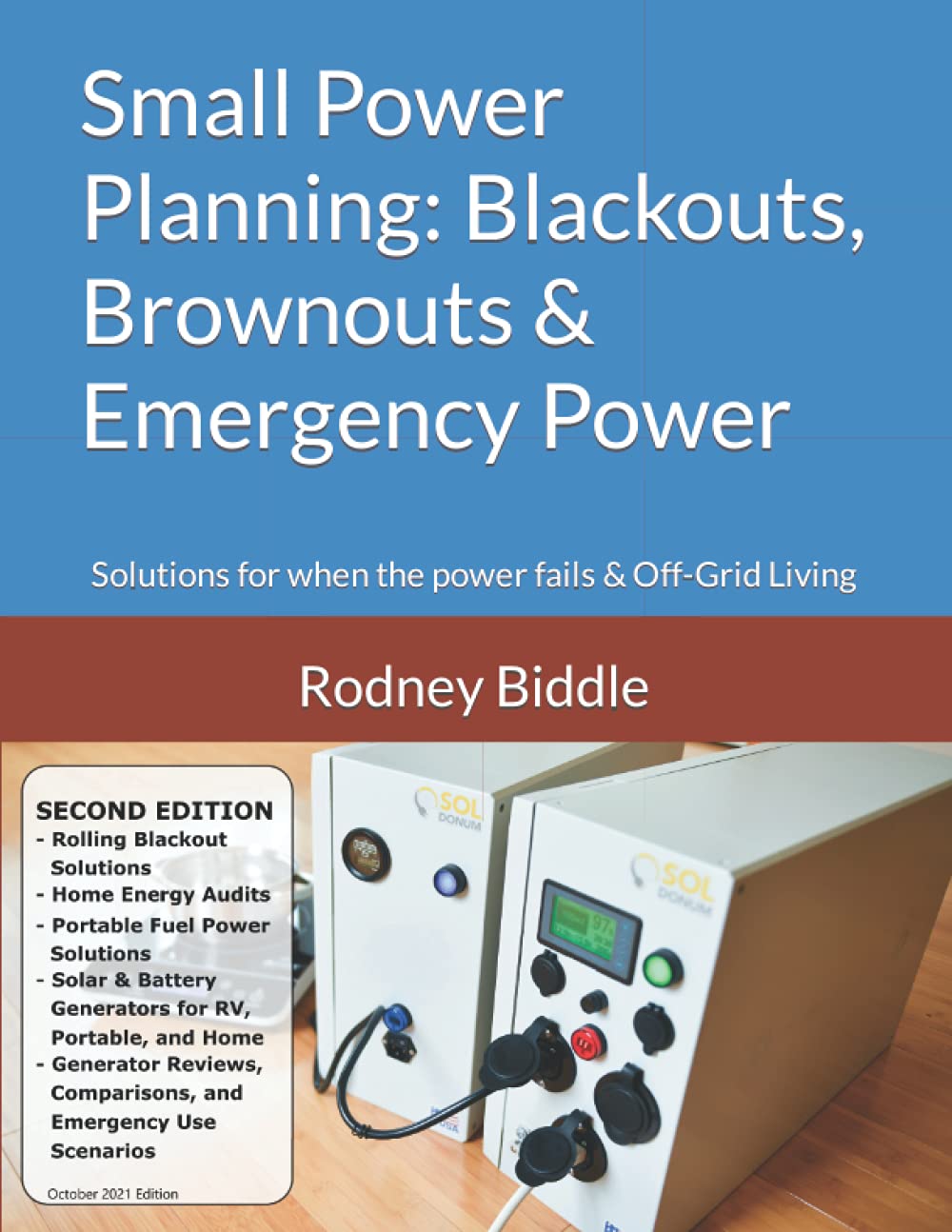
Small Power Planning: Blackout, Brownout, and Emergency Power Concepts: Small Power Solutions for when the power goes out and Off-Grid Living is the shortest on-ramp in this group. It treats a power cut as a set of concepts to understand — what a brownout does to appliances, how much power a household actually needs, where small-scale generation fits — rather than a shopping list. The paperback format suits a reader who wants to read once, annotate, and keep the book on a shelf with the emergency kit.
This is the pick for a renter or a first-time homeowner who has never thought seriously about outage prep and wants the vocabulary before the purchases. Its limitation is depth: a short conceptual primer will not walk a household through generator sizing, food safety timelines or medical-device contingency planning, so anyone past the beginner stage will outgrow it quickly.
Trade-off: The conceptual, small-power focus keeps it approachable but leaves readers with serious equipment needs looking elsewhere for specifics.
2. When The Lights Go Out: The Ultimate Survival Guide For When The Power Grid Goes Down…For Good

Format: Survival guide
Subject: Long-term grid-down scenario
Angle: Preparedness for an outage that does not end
Best For: Preppers planning beyond a few days
When The Lights Go Out: The Ultimate Survival Guide For When The Power Grid Goes Down…For Good takes the opposite stance to the first pick: its premise is that the grid does not come back. That framing pushes the content toward extended self-reliance — water, food storage, security, sanitation and community — rather than the two-day outage most households actually face. Readers who want to think through worst-case planning will find the scope useful.
The book earns its place for preppers and for anyone who has already handled the basics and wants a longer horizon. The caution is one of fit rather than quality: a guide built around a permanent grid-down scenario spends its pages on problems a typical suburban family will never encounter, and it offers little on the practical equipment questions — what to buy, how to store fuel, how to keep a freezer cold — that a short outage actually raises.
Trade-off: The permanent-collapse premise is compelling for preppers but overkill for households preparing for weather-driven outages.
3. How to Survive When the Grid Goes Down: The Ultimate Grid-Down Survival Guide For Thriving in a World Without Power (Self-Sufficient Living)

Format: Book, self-sufficient living series
Subject: Grid-down survival and thriving without power
Angle: Long-term self-sufficiency
Best For: Readers who want a deeper, series-backed treatment
How to Survive When the Grid Goes Down: The Ultimate Grid-Down Survival Guide For Thriving in a World Without Power (Self-Sufficient Living) sits in the middle of the list on price and at the deeper end on content. The self-sufficient living framing suggests a guide that connects power loss to the wider systems a household depends on — water, heat, food, light — and treats thriving, not just surviving, as the goal. It is the most substantial single volume here for a reader who wants one book to work through over weeks.
It suits the household that has decided preparedness is a hobby as much as a precaution, and it pairs well with a short practical handbook for the equipment specifics. The drawback is the flip side of that depth: a long, ambitious guide is slower to consult mid-outage, and a reader who only wants to know which battery to buy will find it heavier going than the free options below.
Trade-off: The broader self-sufficiency scope rewards committed readers but makes it a poor quick-reference book when the lights are already out.
4. When the Power Goes Out: A Practical Guide to Power Blackouts and Essential Utilities

Format: Practical guide
Subject: Blackouts and essential utilities
Angle: Everyday household practicality
Best For: Households wanting a free, fast grounding
When the Power Goes Out: A Practical Guide to Power Blackouts and Essential Utilities is the most utilitarian title in the group, and it is the one to read first if the goal is a working plan by the weekend. The focus on essential utilities — the systems a home cannot run without — maps directly onto the questions a household asks during an outage: what still works, what needs shutting off, and what to restore first. Being free to download makes it an easy starting point with no commitment.
This suits renters, apartment dwellers and busy families who want the practical core without the survivalist framing. The caution is that a free, utility-focused guide tends to stay at the level of principles and checklists; it will not replace a full equipment plan for a home with a generator, a sump pump or a chest freezer full of food.
Trade-off: Free and fast to read, but a utility-focused handbook leaves the equipment-selection work to the reader.
5. Power Outage Preparedness for Homeowners: The Complete Blackout & Emergency Power Plan for Home: Generators, Batteries, Food Safety, Heating, Cooling, Medical Devices & Family Safety
Format: Homeowner planning guide
Subject: Complete blackout and emergency power plan
Angle: Generators, batteries, food safety, heating, cooling, medical devices, family safety
Best For: Homeowners with equipment or medical needs
Power Outage Preparedness for Homeowners: The Complete Blackout & Emergency Power Plan for Home: Generators, Batteries, Food Safety, Heating, Cooling, Medical Devices & Family Safety is the most specific title here, and that specificity is the point. It addresses the equipment side — generators and batteries — alongside the household side: keeping food safe, staying warm or cool, protecting medical devices and keeping the family safe through an outage. For a homeowner assembling an actual plan, that combination is hard to beat, and it costs nothing to obtain.
This is the pick for the household with a generator to size, a freezer to protect or a medical device that cannot lose power, and it is the natural companion to one of the shorter conceptual books. Its limitation is the flip side of its completeness: a title covering this many systems can only go so deep on each, so a reader buying a generator will still want the manufacturer’s guidance on installation and venting.
Trade-off: The broad homeowner scope covers every system at a planning level but not at installation-level detail.
Before You Buy
- Format: A paperback suits annotating and shelf storage; a digital guide is searchable mid-outage and easier to keep on a phone.
- Scope: A short conceptual primer, a long-term survival playbook and a homeowner equipment plan solve different problems — match the book to the outage being planned for.
- Household type: Renters get little from generator-focused titles; homeowners with medical devices or a chest freezer need the equipment-level coverage.
- Depth vs. speed: Long guides reward study but are slow to consult during an actual blackout; keep a short practical reference alongside them.
- Currency: Power equipment and food-safety guidance change; check that a guide’s approach still matches the gear a household owns.
- Storage: Keep the chosen guide with the emergency kit, not on a shelf in another room, so it is findable without lighting.
- Companions: Pair one planning book with one practical handbook rather than buying several titles that repeat the same basics.
Frequently Asked Questions
-
What should a household read first when planning for a power cut?
A short practical guide on essential utilities is the fastest grounding, followed by a homeowner-focused plan if the house has a generator, freezer or medical equipment. -
Is a survival guide useful for a normal two-day outage?
Partly. Long-term grid-down guides cover far more than a weather outage requires, but the food, water and lighting chapters still apply. -
Do these guides cover generators and batteries?
The homeowner-focused title addresses generators and batteries directly; the shorter and survival-oriented books tend to stay at the level of concepts and general planning. -
Are free guides worth downloading?
Yes, for the basics. A free practical handbook covers utilities, safety and checklists well; paid titles add depth on self-sufficiency or long-term scenarios. -
How many books does a household actually need?
Two is usually enough: one practical handbook for quick reference and one deeper guide matched to the household’s equipment and risk level. -
Where should the guide be kept?
With the emergency kit and any printed contact list, so it can be found without a working light or phone.
Bottom Line
For most households, the strongest single starting point is Power Outage Preparedness for Homeowners: The Complete Blackout & Emergency Power Plan for Home: Generators, Batteries, Food Safety, Heating, Cooling, Medical Devices & Family Safety — it covers the equipment and the family-safety side in one place and costs nothing to obtain, which makes it the easiest recommendation to act on today. Pair it with a short practical handbook for quick reference, and add a survival-oriented guide only if the plan needs to stretch well beyond a typical outage.
