Why there are Amazon links here: Brave Review is paid a commission for qualifying Amazon purchases made through the links below. Your price does not change, and using our links is entirely optional. How this works
Best Plug With Energy Monitoring for Cutting Standby Power Costs
A plug with energy monitoring turns any outlet into a metering point, showing exactly how much power a space heater, TV or coffee maker draws. This roundup covers five picks for three buyer types: renters who want cheap multi-packs, Apple Home users who need Matter support, and data-minded owners who want detailed consumption history. Each entry lists the verified specs and the trade-off that comes with the price. The overview table below narrows the field first.
Overview of the Picks
| Product | Key Spec | Best Use | Price Tier |
|---|---|---|---|
| Tapo P115 (4-Pack) | 15A, ETL, Alexa/Google/SmartThings | Budget whole-room coverage | Budget |
| Kasa Matter KP125MP4 (4-Pack) | Matter, Apple Home, UL | Apple Home households | Mid |
| Tapo P110M (4-Pack) | Matter compatible, UL | Mixed smart-home setups | Mid |
| Emporia 4-Pack | Energy-focused app, 15A | Detailed usage tracking | Mid |
| Tapo P115 (2-Pack) | 15A, ETL, compact pack | Small apartments, first try | Budget |
1. Tapo P115 (4-Pack) — Best Budget Plug With Energy Monitoring

Pack Size: 4 plugs
Max Load: 1800W / 15A
Certification: ETL
Wireless: 2.4GHz Wi-Fi only
Ecosystems: Alexa, Google Home, Samsung SmartThings
Timer: Built-in scheduling
The P115 is a straightforward metering plug: the outlet body houses the relay and metering chip, the app reads out live and historical consumption, and the 15A rating covers most household loads up to 1800W. Setup runs through the Tapo app over 2.4GHz Wi-Fi, and the ETL listing means the unit has been tested to a recognized safety standard. Scheduling and timers live in the same app, so a lamp or dehumidifier can be switched without a separate hub.
This four-pack earns its place for buyers who want monitoring in several rooms without paying per-plug premiums. The trade-off: 2.4GHz-only Wi-Fi means a router running a single 5GHz band will not see the plugs, and there is no Matter or Apple Home support here, so iPhone-first homes should look at the Kasa pick instead. Buyers on a mesh network with a dedicated 2.4GHz SSID will have no trouble.
Check the current price on Amazon
2. Kasa Matter KP125MP4 (4-Pack) — Best for Apple Home
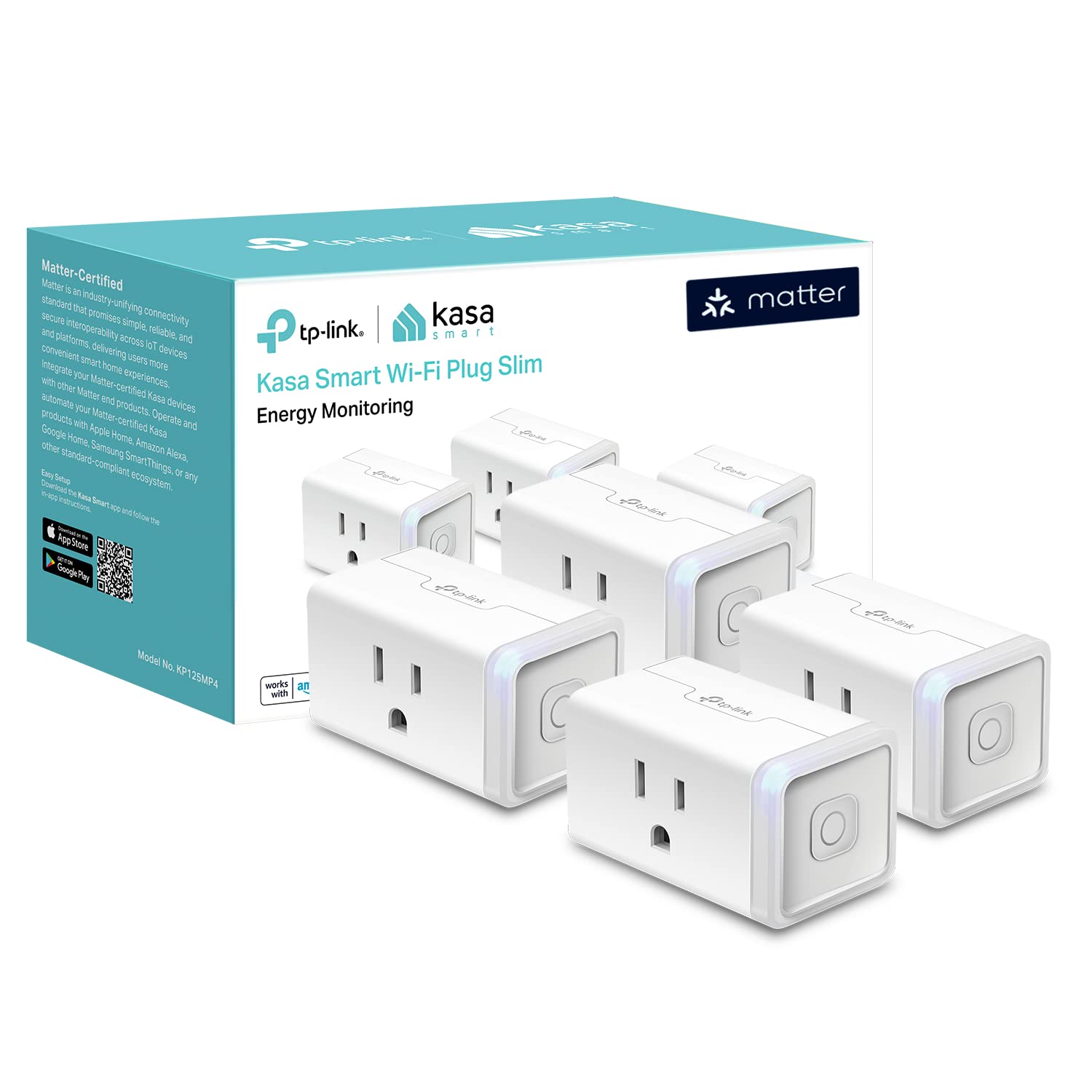
Pack Size: 4 plugs
Max Load: 1800W / 15A
Certification: UL
Wireless: 2.4GHz Wi-Fi
Ecosystems: Apple Home, Alexa, Google Home
Protocol: Matter
Matter support is the headline here. The plug pairs through Apple Home, Alexa or Google Home and then shares a single onboarding code across ecosystems, so an iPhone household can run it in the Home app without a separate Kasa account. The compact white body is designed to sit side by side in a duplex outlet, and the UL listing covers the electrical build. Monitoring data still flows through the Kasa app, which is where the consumption graphs live.
This pack suits buyers already inside Apple Home or planning to add a HomePod or Apple TV as a hub. The trade-off is price: the Matter badge and Apple certification push this four-pack above the Tapo equivalents, so buyers who only need Alexa or Google control are paying for compatibility they will not use.
Check the current price on Amazon
3. Tapo P110M (4-Pack) — Best Matter-Compatible Value
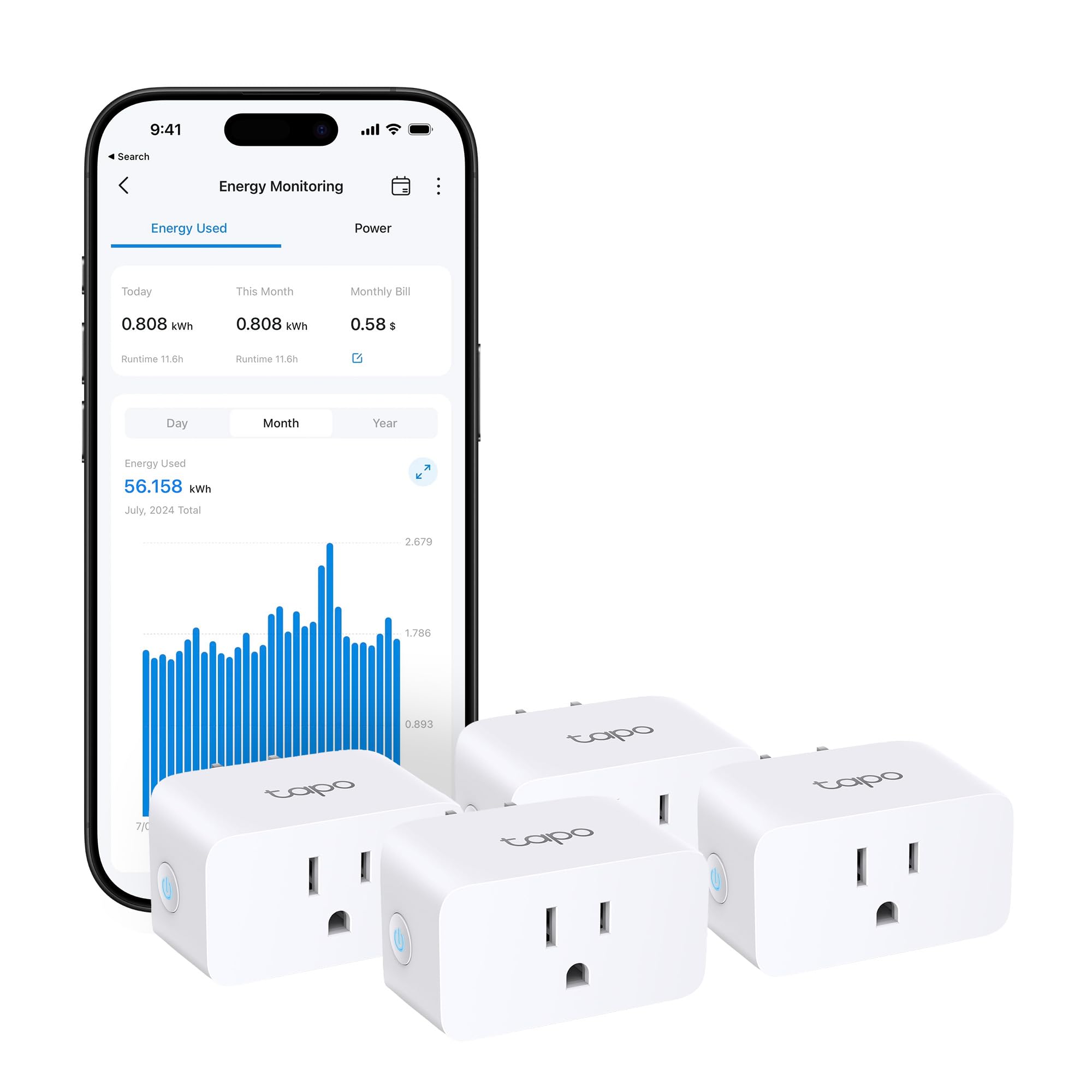
Pack Size: 4 plugs
Max Load: 15A
Certification: UL
Wireless: 2.4GHz Wi-Fi only
Ecosystems: Alexa, Google Home, Samsung SmartThings
Protocol: Matter compatible
The P110M sits between the budget P115 and the Kasa Matter pack: it keeps the Tapo app and ecosystem list but adds Matter compatibility, which lets it join a local smart-home controller alongside the cloud apps. The UL listing and 15A rating match the rest of the field, and the four-pack format spreads monitoring across a whole room. Energy data is available in the Tapo app with history and per-plug breakdowns.
This is the pick for buyers who want Matter flexibility without Apple Home pricing. The trade-off is ecosystem overlap: the name lists Alexa, Google and SmartThings alongside Matter, and mixing the two connection paths can confuse setup, so buyers should pick one route and stay with it rather than enrolling the plug twice.
Check the current price on Amazon
4. Emporia Energy Monitoring Smart Plug (4-Pack) — Best for Usage Data
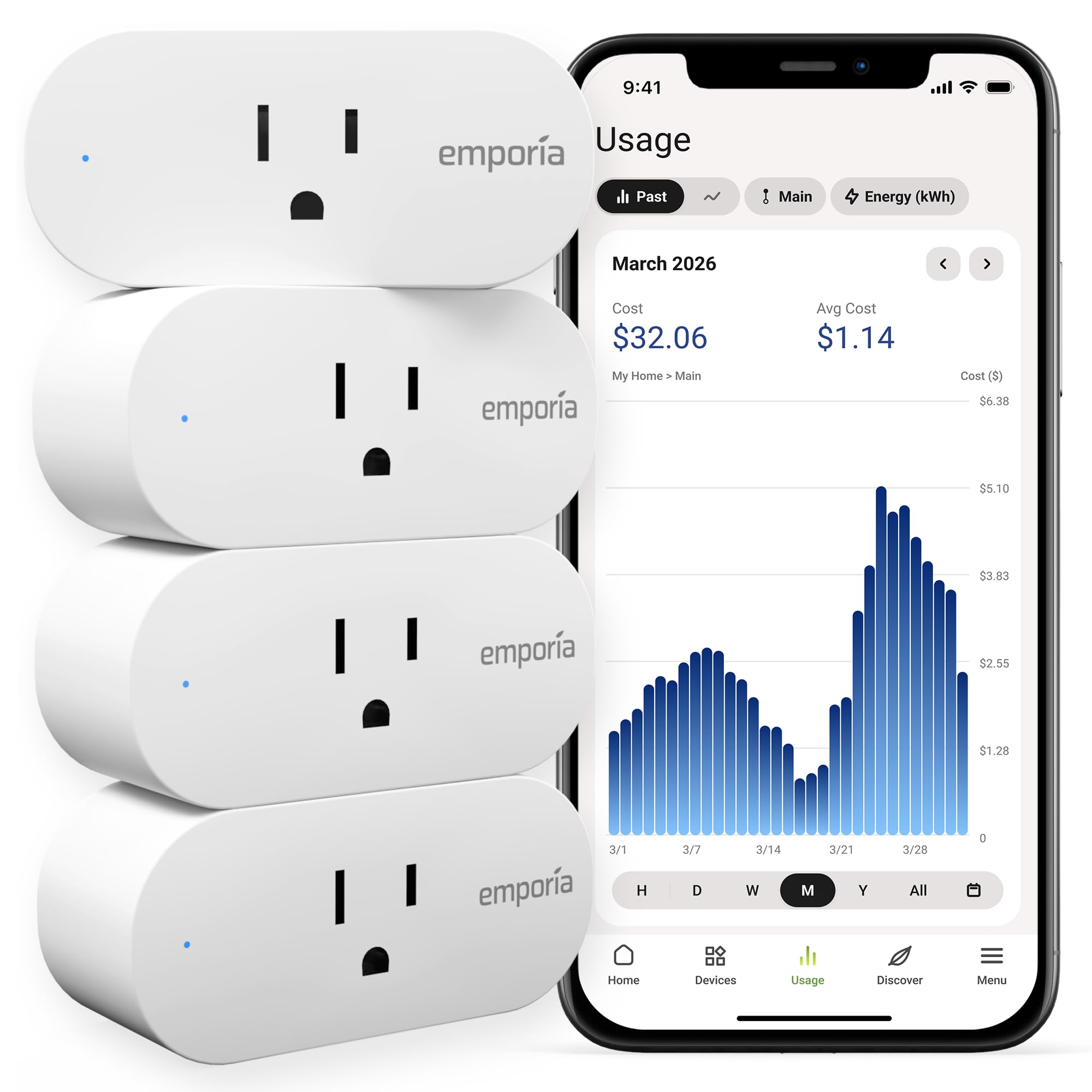
Pack Size: 4 plugs
Max Load: 15A
Wireless: 2.4GHz Wi-Fi only
Ecosystems: Alexa, Google Home
App Features: Timer, scheduling, mobile monitoring
Brand Focus: Home energy monitoring
Emporia builds its name around home energy monitoring, and this plug reflects that focus: the app is the centerpiece, with scheduling and consumption readouts designed for tracking which appliances cost the most to run. The 15A rating covers typical loads, and Alexa and Google Home handle voice control. The four-pack format lets buyers meter a whole circuit’s worth of devices at once.
This pick suits the buyer who wants the data more than the voice tricks — someone comparing a fridge, a space heater and a gaming PC across a month. The trade-off is ecosystem reach: there is no Apple Home or Matter support here, so iPhone-first homes and local-hub setups should skip it, and Samsung SmartThings users are also left out.
Check the current price on Amazon
5. Tapo P115 (2-Pack) — Best Small Pack

Pack Size: 2 plugs
Max Load: 1800W / 15A
Certification: ETL
Wireless: 2.4GHz Wi-Fi only
Ecosystems: Alexa, Google Home, Samsung SmartThings
Timer: Built-in scheduling
The two-pack is the same P115 hardware in a smaller box: 15A, 1800W, ETL listed, 2.4GHz Wi-Fi, and the same Tapo app with monitoring and timers. It is the lowest-cost entry in this roundup and the natural first purchase for a buyer who wants to test whether energy monitoring is useful before committing to a four-pack. Two plugs cover a TV setup and a space heater, or a washer and dryer pair.
This pick suits renters and small apartments where four outlets is more than needed. The trade-off is per-plug value: the two-pack costs more per plug than the four-pack, so buyers who end up wanting more coverage will pay a second time — the four-pack is the better deal for anyone with three or more devices to meter.
Check the current price on Amazon
Before You Buy
- Compatibility: Check the hub first — Apple Home needs Matter or HomeKit, while Alexa and Google work with all five picks.
- Wi-Fi band: Every plug here is 2.4GHz only, so a router that hides or splits that band will cause setup failures.
- Load rating: All five are 15A/1800W max; high-draw appliances like space heaters should stay under that ceiling.
- Certification: ETL and UL listings appear across the picks; both signal third-party electrical testing.
- Pack size: Per-plug cost drops sharply from the two-pack to the four-packs, so buy for the number of outlets actually needed.
- App ecosystem: Monitoring graphs live in the brand app, not the voice assistant, so pick the app that will actually be opened.
Frequently Asked Questions
- What does a plug with energy monitoring actually measure? It reports the live wattage and accumulated consumption of whatever is plugged into it, usually as a graph in the companion app.
- Do these plugs need a hub? No — all five connect directly over 2.4GHz Wi-Fi, though Matter models can also join a local smart-home controller.
- Can a plug with energy monitoring handle a space heater? Yes, provided the heater stays under the 15A/1800W rating shared by every pick here.
- Why is 2.4GHz Wi-Fi specified on every model? The plugs use the longer-range 2.4GHz band for reliability through walls, so a router must broadcast it during setup.
- Which pick works with Apple Home? Only the Kasa Matter pack lists Apple Home support; the others cover Alexa, Google and, in some cases, SmartThings.
- Is a four-pack cheaper per plug than a two-pack? Yes — the four-packs here lower the per-outlet cost, which matters for buyers metering several devices.
Bottom Line
The Tapo P115 four-pack is the strongest overall value: ETL-listed, 15A, broad Alexa/Google/SmartThings support and the lowest per-plug cost in this roundup. Apple Home households should step up to the Kasa Matter pack, and buyers who want the deepest usage data should take the Emporia. Everyone else can start with the two-pack and scale up later.