Why there are Amazon links here: Brave Review is paid a commission for qualifying Amazon purchases made through the links below. Your price does not change, and using our links is entirely optional. How this works
Reolink Duo 3 PoE vs Reolink Duo 2V PoE: Which Dual-Lens Camera Fits Your Setup
The Reolink Duo 3 PoE and the Reolink Duo 2V PoE are both dual-lens wired cameras built to watch a wide area with one mount, but they solve different problems. The Duo 3 PoE leans on a panoramic 180° view and motion tracking, while the Duo 2V PoE leans on a rugged vandal-proof housing and a fixed wide field of view. This comparison breaks down the differences that actually decide a purchase, then names who each camera suits.
Quick Overview of the Picks
| Product | Key Spec | Best Use | Price Tier |
|---|---|---|---|
| Reolink Duo 3 PoE | 180° panoramic dual-lens, motion track, up to 512GB microSD | Wide open areas that need one camera to cover a lot of ground | Higher |
| Reolink Duo 2V PoE | 8MP dual-lens, IK10 vandal-proof, IP67, no PT | Exposed or high-risk spots where the housing takes abuse | Mid |
The Duo 3 PoE is the more feature-forward of the two, and the Duo 2V PoE is the tougher, more fixed installation. Buyers who want the widest coverage and tracking should look at the Duo 3 PoE; buyers who need a camera that can survive a parking structure, alley, or commercial wall should look at the Duo 2V PoE. The sections below explain where that split comes from.
Reolink Duo 3 PoE
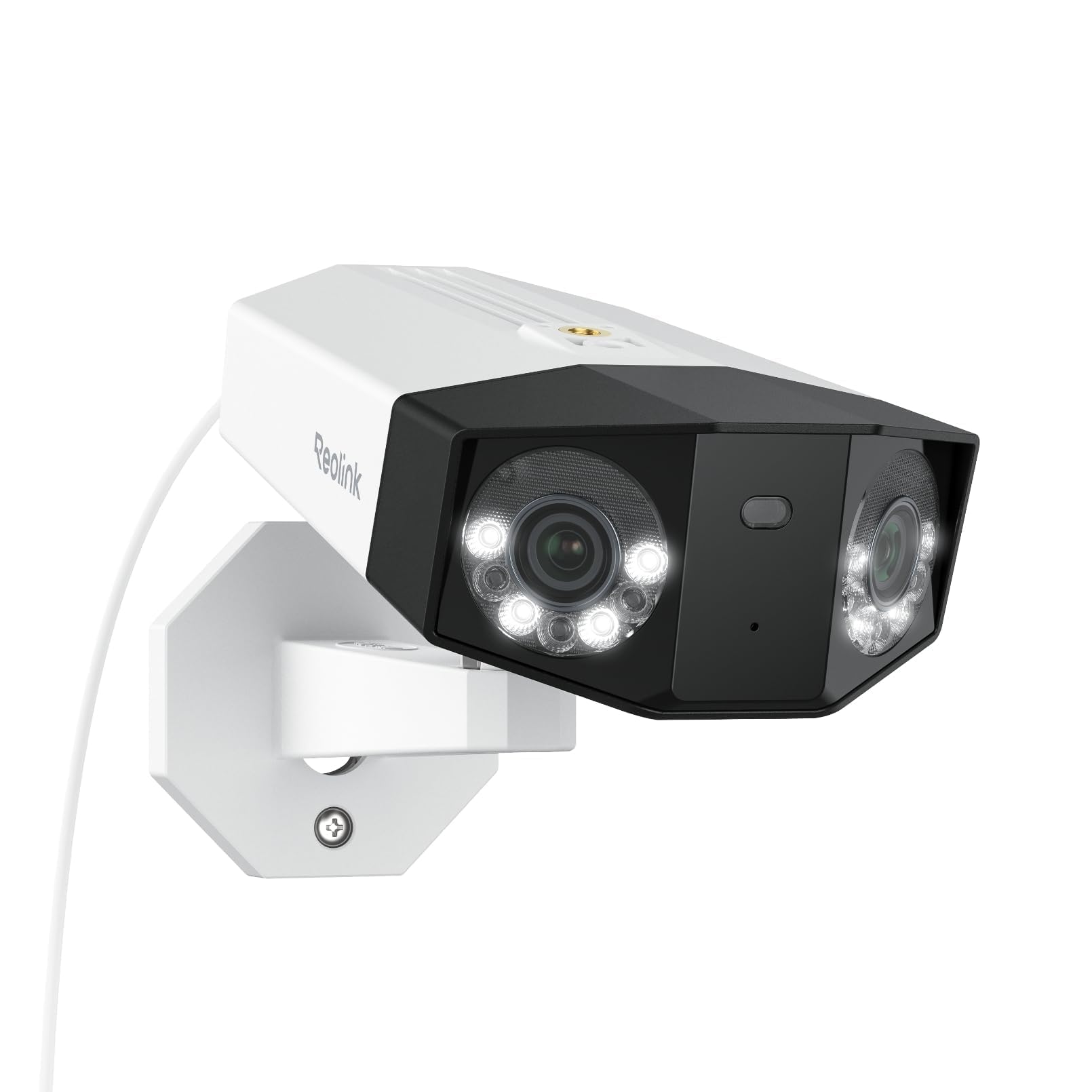
Type: Dual-lens PoE security camera
Field of View: 180° panoramic
Night Vision: Color night vision (F1.6)
Detection: Person, vehicle, animal
Recording: 24/7 recording, up to 512GB microSD
Extras: Motion tracking, two-way talk
The Duo 3 PoE is built around coverage. Its dual lenses stitch a 180° panoramic image, so a single unit can watch a driveway, a side yard, or a storefront corner that would otherwise need two cameras. Motion tracking adds a layer of active monitoring: when the camera detects movement, it follows the subject across the frame instead of leaving it at the edge.
The F1.6 aperture and color night vision are the parts that matter after dark. A wider aperture pulls in more light, which is what allows color night footage rather than the usual black-and-white IR look. Person, vehicle, and animal detection cut down on nuisance alerts from swaying branches, and 24/7 recording to a microSD card up to 512GB means the camera can keep a rolling record without a subscription.
Trade-off: A panoramic dual-lens camera trades some per-pixel detail at the far edges for that wide view, so a subject at the edge of the frame will look softer than one dead center.
Check the current price on Amazon
Reolink Duo 2V PoE

Type: Dual-lens PoE security camera
Resolution: 8MP
Detection: Person, vehicle, animal
Night Vision: Color night vision with spotlight
Weatherproofing: IP67
Housing: IK10 vandal-proof
Extras: Two-way talk, no PT (pan/tilt) support
The Duo 2V PoE is the hardened option. Its IK10 rating is the standout spec: that is a vandal-resistance standard, meaning the housing is built to shrug off physical impact. Paired with IP67 weatherproofing, it is aimed at installs where the camera itself is a target or where it sits in punishing weather — a commercial back lot, a public-facing wall, a parking area.
The 8MP dual-lens sensor delivers a high-resolution wide image, and color night vision with a built-in spotlight means the camera can light up its own scene rather than rely purely on ambient light. Person, vehicle, and animal detection and two-way talk are both present, so the core smart features match the Duo 3 PoE. The "no PT supported" note is worth reading carefully: this is a fixed-position camera, and buyers who expect pan and tilt should look elsewhere.
Trade-off: The rugged housing and fixed mount make the Duo 2V PoE a set-and-leave camera, so buyers who want the lens to actively follow a subject will find it less flexible than a tracking model.
Check the current price on Amazon
Side-by-Side Comparison
| Feature | Reolink Duo 3 PoE | Reolink Duo 2V PoE |
|---|---|---|
| Lenses | Dual-lens | Dual-lens |
| Field of View | 180° panoramic | Wide dual-lens (fixed) |
| Resolution | Not the headline spec | 8MP |
| Night Vision | Color (F1.6) | Color with spotlight |
| Detection | Person/vehicle/animal | Person/vehicle/animal |
| Motion Tracking | Yes | No (no PT support) |
| Recording | 24/7, up to 512GB microSD | Local recording (PoE setup) |
| Weatherproofing | Outdoor PoE build | IP67 |
| Vandal-Proofing | Not the headline spec | IK10 |
| Two-Way Talk | Yes | Yes |
| Mount Behavior | Tracks motion | Fixed |
The table reads cleanly along one axis: the Duo 3 PoE wins on coverage and active monitoring, and the Duo 2V PoE wins on physical resilience and resolution. Everything else — dual lenses, color night vision, person/vehicle/animal detection, two-way talk, PoE power — is shared ground, which is why the decision comes down to two or three dimensions rather than a long list.
The first dimension is view and movement. A 180° panoramic image with motion tracking suits a buyer who wants one camera to cover a wide, open area and follow whatever crosses it. The Duo 2V PoE’s fixed dual-lens view is wide but static, so it suits a buyer who knows exactly what the camera should watch and wants it locked there.
The second dimension is the housing. IK10 vandal-proofing and IP67 weatherproofing are not marketing garnish — they are the specs that decide whether a camera survives a public wall or a coastal fence line. A buyer installing in a protected residential soffit has less need for them; a buyer installing at head height on a commercial property has a lot.
The third dimension is resolution versus field of view. The Duo 2V PoE’s 8MP sensor gives a denser image across its frame, which helps when identifying a face or a plate at distance. The Duo 3 PoE’s panoramic stitching spreads its pixels across a wider arc, so its advantage is breadth, not pixel density at the edge.
Which Should You Buy?
Choose the Reolink Duo 3 PoE if the priority is covering as much ground as possible with one camera and having that camera actively follow movement. It suits a wide driveway, a corner lot, or a small business frontage where a single panoramic unit with 24/7 local recording replaces two narrower cameras.
Choose the Reolink Duo 2V PoE if the priority is a camera that can take a hit and keep working. The IK10 housing and IP67 rating make it the better fit for exposed, public-facing, or high-risk installs, and the 8MP sensor gives a denser image for identification at range.
Buyers who want pan and tilt control should not choose the Duo 2V PoE — it explicitly does not support it. Buyers who need the absolute sharpest edge-to-edge detail from a single wide shot should weigh the Duo 3 PoE’s panoramic stitching against that trade-off.
FAQ
-
What is the main difference between the Reolink Duo 3 PoE and the Duo 2V PoE?
The Duo 3 PoE focuses on a 180° panoramic view with motion tracking and 24/7 microSD recording, while the Duo 2V PoE focuses on a rugged IK10 vandal-proof, IP67 weatherproof housing with an 8MP dual-lens sensor and no pan/tilt support. -
Do both cameras detect people, vehicles, and animals?
Yes. Both product names list person, vehicle, and animal detection, so the smart alert categories are shared. -
Which one is better for outdoor use?
Both are PoE outdoor cameras, but the Duo 2V PoE carries explicit IP67 weatherproofing and IK10 vandal-proofing, making it the more clearly hardened choice for exposed installations. -
Does the Duo 3 PoE record without a subscription?
The Duo 3 PoE supports 24/7 recording to a microSD card up to 512GB, which allows local storage without depending on a cloud plan. -
Can the Duo 2V PoE pan and tilt?
No. The product name states no PT support, so it is a fixed-position camera. -
Which camera has color night vision?
Both do. The Duo 3 PoE uses an F1.6 aperture for color night vision, and the Duo 2V PoE uses color night vision with a spotlight. -
Are both cameras PoE powered?
Yes. Both are PoE cameras, so each runs power and data over a single Ethernet cable to a PoE recorder or switch. -
Which is the better buy for a commercial property?
The Duo 2V PoE is the stronger commercial pick because of its vandal-proof housing and weatherproofing, while the Duo 3 PoE suits buyers who need wide panoramic coverage and motion tracking more than physical toughness.
Bottom Line
The Reolink Duo 3 PoE is the better pick for most buyers who want one camera to watch a wide area and follow movement, thanks to its 180° panoramic view, motion tracking, and 24/7 local recording. The Reolink Duo 2V PoE remains the right call for exposed or high-risk installs where the IK10 vandal-proof housing and IP67 weatherproofing matter more than tracking. Buyers ready to decide can check the current price on the Reolink Duo 3 PoE and confirm it fits the install.