Why there are Amazon links here: Brave Review is paid a commission for qualifying Amazon purchases made through the links below. Your price does not change, and using our links is entirely optional. How this works
Reolink Elite Pro Floodlight PoE: The 16MP Dual-Lens Watchtower
The Reolink Elite Pro Floodlight PoE is a wired security camera built for homeowners who want one device to light up a driveway, record around the clock, and identify people and vehicles without a subscription. This review covers its specifications, how the dual-lens and floodlight design work together, and where the hardware asks for patience. Buyers who want a battery camera or a quick plug-in install should look elsewhere before reading further.
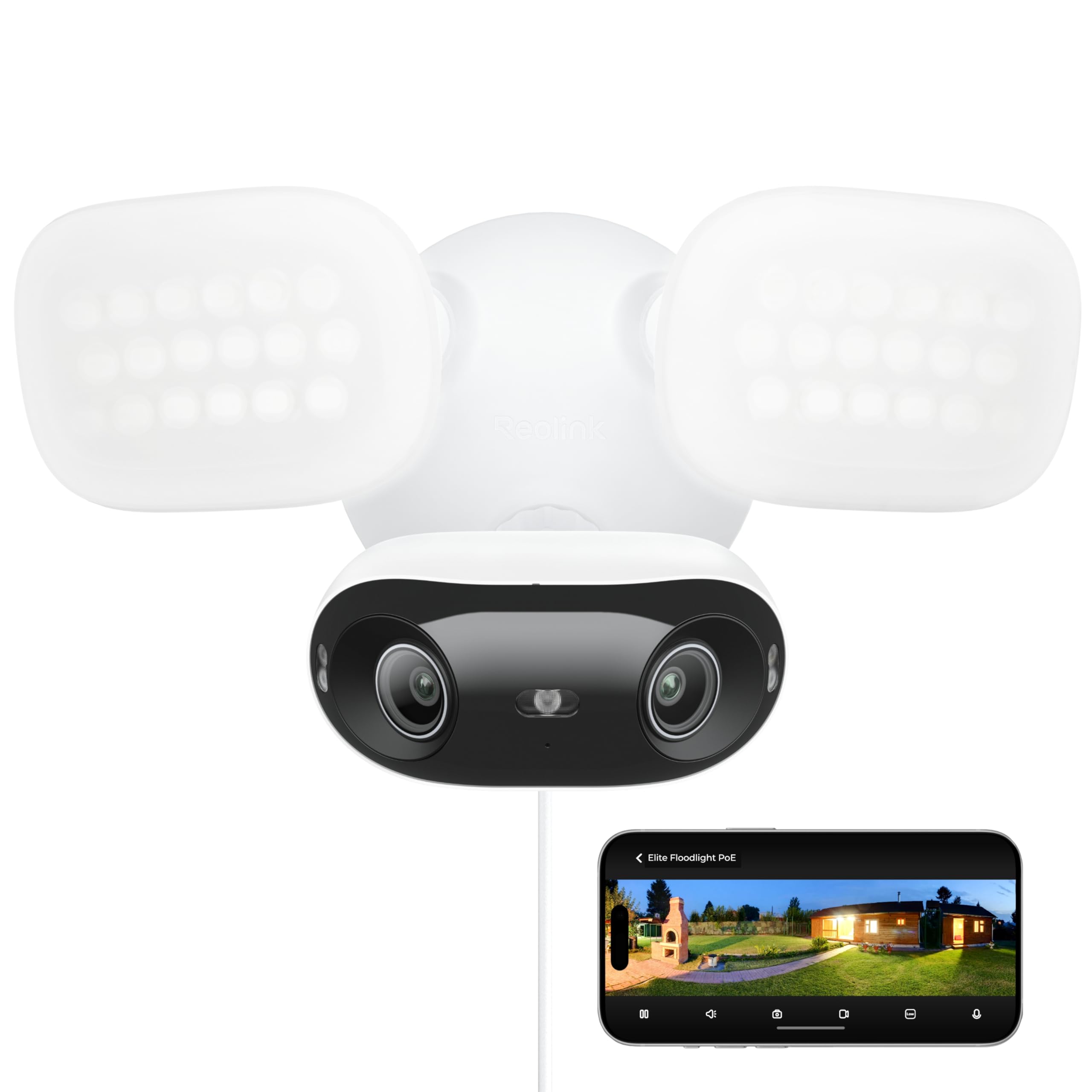
Features and Specifications
- Product Type: Floodlight PoE security camera
- Resolution: 16MP dual lens
- Field of View: 180°
- Lighting: 2800 lumens
- Night Vision: Infrared
- Recording: 24/7 continuous with motion track
- Detection: Smart detection with local AI video search
- Power Source: Power over Ethernet (PoE)
- Price Tier: Premium
- Best Use: Driveways, side yards, and entry points with existing network cabling
The headline number is the 16MP dual-lens sensor, which puts this camera well above the 4MP and 8MP units that dominate the mid-range. Two lenses stitched into a 180° view mean a single mount can cover a wide driveway or the corner of a building without a second camera. The 2800-lumen floodlight is bright enough to act as a real deterrent rather than a decorative glow.
Power over Ethernet is the other defining feature. One cable carries both data and power, so the camera stays online around the clock and records continuously instead of waking on motion. That combination — constant recording plus local AI — is what separates this unit from the battery-powered floodlight cameras sold at half the price.
Build and Design
The Elite Pro is a fixed-mount outdoor unit, and the floodlight head and camera body are integrated into one housing. Buyers should expect a substantial piece of hardware: a 16MP dual-lens assembly plus a 2800-lumen lamp needs more chassis and more heat dissipation than a compact bullet camera. Mounting it high on a wall or under an eave is the natural placement, and the 180° view rewards a corner position.
Trade-off: The integrated floodlight head makes the unit larger and more conspicuous than a plain camera, which suits deterrence but limits where it can be tucked away.
The PoE requirement shapes the install more than the housing does. There is no battery and no Wi-Fi fallback, so the camera needs a PoE switch, injector, or NVR port within cable reach of the mounting spot. Homes that already run Ethernet to the eaves will find the install routine; homes that do not will need to plan a cable run before ordering.
Resolution and the Dual-Lens View
16MP across two lenses is the reason to consider this model. At that resolution, a face or a license plate at the far edge of a driveway has a chance of staying legible when zoomed, which is the whole point of buying a high-megapixel camera. The 180° horizontal coverage means one unit watches a span that would otherwise take two narrower cameras and two cable runs.
Trade-off: High-resolution dual-lens footage produces large files, so continuous 24/7 recording fills storage noticeably faster than a 4MP camera would.
That storage appetite is the practical cost of the resolution. Buyers planning 24/7 recording should size the NVR drive or microSD card with headroom, and should expect the camera to be at its best when paired with a recorder rather than run as a standalone. The wide view also introduces the usual edge distortion of a 180° lens, so the center of the frame remains the most reliable zone for identification.
Floodlight and Night Vision
The 2800-lumen floodlight is the active deterrent, and infrared night vision is the passive one. In practice the two cover different situations: the floodlight switches on for motion and lights the scene in color, while infrared keeps the camera watching in low light without announcing itself. Buyers who want quiet surveillance can lean on IR; buyers who want the light to do the warning have the lumens for it.
Trade-off: A 2800-lumen floodlight draws real power and can wash out close-range detail, so aiming matters as much as brightness.
The floodlight’s brightness is a genuine asset at the far end of a driveway and a nuisance if the camera is mounted low or pointed at a reflective surface. Placement above head height and angled slightly downward keeps the beam useful. The IR illuminators handle the hours when the light is off, and the combination means the camera is never fully blind.
Smart Detection and Local AI
Smart detection filters motion by object type — people and vehicles rather than every passing cat — and the local AI video search lets buyers query recorded footage for what they want to find. Local processing is the key phrase: the analysis runs on the device and the recordings stay on the buyer’s own storage rather than a cloud plan.
Trade-off: Local AI search is only as good as the recorder and storage behind it, so the feature’s usefulness depends on the rest of the setup.
This is a subscription-free design, which is unusual at any price and welcome at this one. The catch is that the buyer supplies the storage and the network, and the AI search works across whatever footage is actually retained. Buyers who record continuously to a large NVR get the most out of it; buyers who rely on a small card will find the searchable window short.
24/7 Recording and Motion Track
Continuous recording with motion track is the feature that turns this from a motion-triggered floodlight into a genuine surveillance camera. Instead of clips that start when something moves, the camera keeps a full record, and motion track follows a subject across the frame so the event stays centered in the footage.
Trade-off: Continuous recording and PoE tethering mean this camera is not a quick weekend install for a renter or a home without network cabling.
The always-on design is the reason the PoE requirement exists. A battery camera cannot record 24/7 for long, and a Wi-Fi camera cannot guarantee the bandwidth a 16MP dual-lens stream needs. Buyers who can run the cable get the full benefit; buyers who cannot should treat this as a project rather than a purchase.
Who It Suits and Who It Does Not
This camera suits homeowners with existing PoE infrastructure or a willingness to run cable, a driveway or side yard wide enough to justify a 180° view, and a preference for local storage over cloud subscriptions. It also suits buyers who want the floodlight and the camera to be one device rather than two.
It does not suit renters, buyers who want a battery or Wi-Fi install, or anyone who needs a discreet camera rather than a visible deterrent. Buyers on a tight budget should also look at single-lens PoE cameras, which cost less and still record around the clock.
FAQ
-
Does the Reolink Elite Pro Floodlight PoE need a subscription?
No. Detection and AI video search run locally, and recordings stay on the buyer’s own storage. There is no cloud plan required to use the camera’s core features. -
What does PoE mean for installation?
Power over Ethernet means one cable carries both power and data. The camera needs a PoE switch, injector, or NVR port within cable reach, so the install is a cabling job rather than a plug-in one. -
Is 16MP overkill for a home camera?
Not for identification at distance. The extra resolution is what keeps faces and plates legible at the far edge of a wide view. The cost is larger files and more storage. -
How bright is the 2800-lumen floodlight?
It is bright enough to light a driveway and act as a visible deterrent. Placement above head height and angled downward keeps the beam useful without washing out close detail. -
Can this camera record 24/7?
Yes. Continuous recording is a core feature, and the PoE connection keeps it powered and online around the clock. Storage size determines how far back the recordings go. -
Does the dual-lens design really cover 180°?
The two lenses combine into a 180° horizontal view. The center of the frame stays the most reliable zone for identification, with the usual edge distortion of a wide lens. -
What is local AI video search?
It is an on-device way to search recorded footage for specific objects or events without sending video to a cloud service. Its usefulness depends on how much footage the recorder retains. -
Does it work without an NVR?
It can run with a microSD card, but continuous 24/7 recording at 16MP fills storage quickly. A recorder gives the camera the storage and the AI search window it is built for. -
Is this camera visible to neighbors and passersby?
Yes. The integrated floodlight head makes it a conspicuous unit, which is part of the deterrent value but a drawback for buyers who want a discreet install. -
Who should skip this model?
Renters, buyers who need a battery or Wi-Fi install, and anyone who wants a small, hidden camera. A single-lens PoE camera covers the basics for less.
Bottom Line
The Reolink Elite Pro Floodlight PoE is the pick for buyers who can run Ethernet and want one device to light, watch, and record a wide outdoor area without a subscription. The 16MP dual-lens view, 2800-lumen floodlight, and local AI search justify the premium tier, while the PoE tether and storage appetite are the honest costs. Buyers with existing network cabling should check the current price on Amazon and plan the storage before mounting.
