Why there are Amazon links here: Brave Review is paid a commission for qualifying Amazon purchases made through the links below. Your price does not change, and using our links is entirely optional. How this works
Ring Spotlight Cam Plus, Battery: A Wire-Free Security Camera for Home or Business
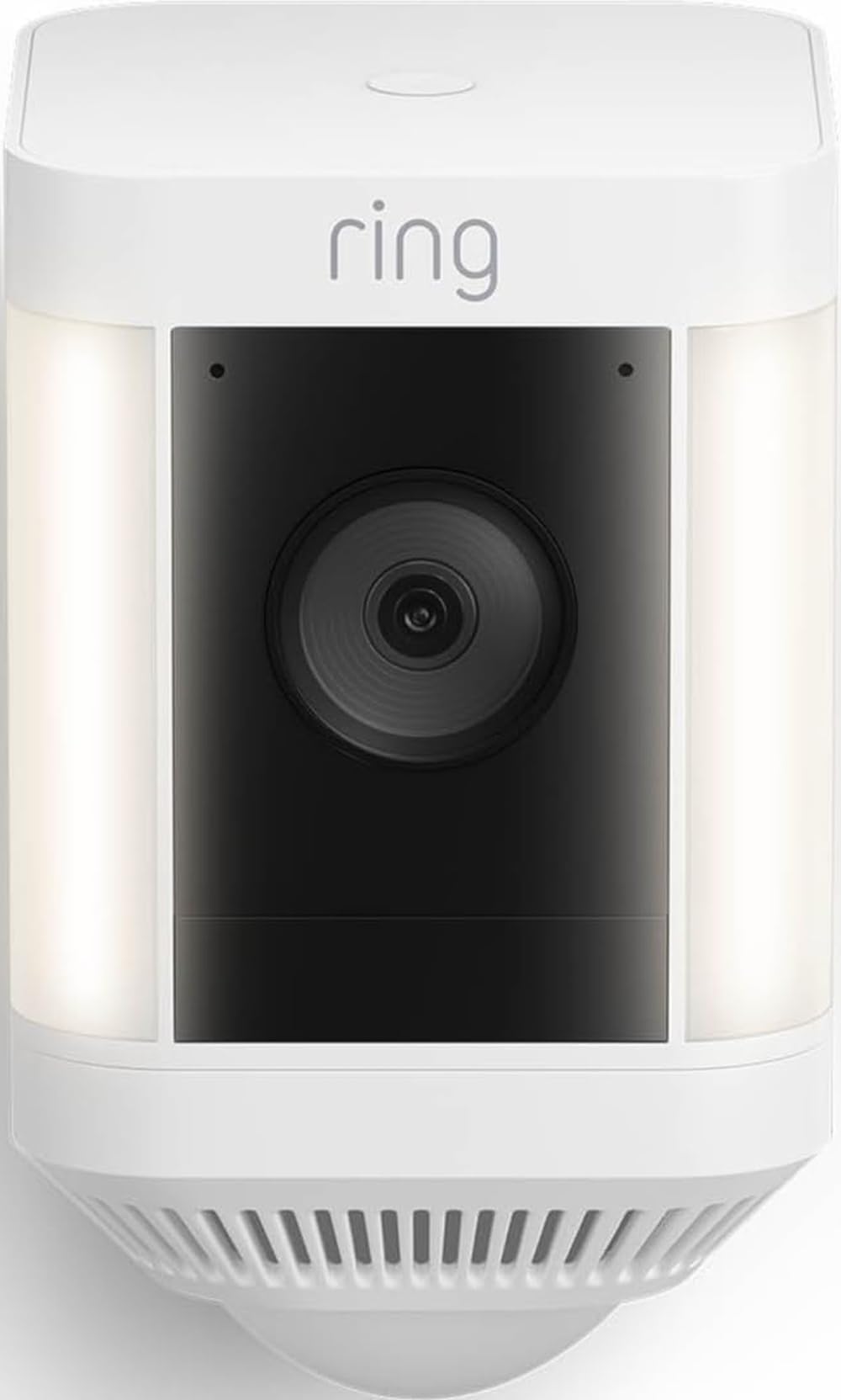
The Ring Spotlight Cam Plus, Battery is a wire-free outdoor security camera that combines HD video, a built-in spotlight, two-way talk, color night vision and a security siren in a single white housing. It suits homeowners and small-business owners who want a camera on a fence, shed, driveway or back door without running power cable to the spot. This review covers the specifications, how the camera is built, what its features mean in daily use, where it falls short, and who should look elsewhere. Readers ready to buy can jump straight to the price check below.
Features and Specifications
- Product: Ring Spotlight Cam Plus, Battery
- Power Source: Battery (wire-free)
- Video: HD
- Night Vision: Color Night Vision
- Audio: Two-Way Talk
- Alarm: Built-in Security Siren
- Suitable For: Home or Business Security
- Color: White
These lines are the whole story of the camera. The name tells a buyer that this is a battery-powered model rather than a wired one, that it records in HD, that it can show color after dark, that it lets the user talk and listen through the app, and that it carries a siren loud enough to be worth having on a wall. What the name does not say, and what this review works through below, is what those features mean in practice — how the battery shapes the way the camera gets used, what the spotlight and siren actually do for a property, and where a wire-free design forces a compromise.
The headline point is that the power source is the battery. That single fact drives everything else: where the camera can go, how often it needs attention, and how the owner should think about motion settings. A reader who wants a camera on a porch with an outlet nearby has an easier decision than one who wants to cover a detached garage at the back of a lot.
Build and Design
The housing is a single white unit, which matters more than it sounds. White blends into light siding, garage trim and fence posts, so the camera reads as part of the building rather than a black box bolted to it. That is a real advantage for a business that does not want a security camera shouting at customers, and for a homeowner who wants coverage without changing the look of the front of the house.
The wire-free design is the defining build decision. There is no power cable to route, no electrician to call and no hole to drill through a wall for mains voltage. The camera mounts where the view is best rather than where the wiring is easiest. For a renter, or for anyone covering a shed, a gate or a side yard, that flexibility is the reason to choose this model over a wired alternative.
The trade-off is weight and mounting. A battery camera is heavier than a wired one because the cells sit inside the housing, so the mount has to be fixed into something solid — wood, masonry, a sturdy post — rather than a hollow panel. Buyers should plan the mounting surface before ordering, because a camera that sags or shifts loses the framing that makes footage useful.
Power and Battery Life
Battery operation is the feature that decides how this camera feels to live with. It removes the installation barrier entirely, which is why wire-free cameras sell so well to people who are not comfortable with wiring. It also means the camera is only as reliable as its charge, and that the owner has to build a charging routine into ownership.
How long a charge lasts depends heavily on settings and on how busy the scene is. A camera pointed at a quiet side yard that records a handful of events a day will go far longer than one watching a busy driveway where cars and delivery people trigger it constantly. That is not a flaw in the product — it is how every battery camera behaves — but it is the number one thing buyers underestimate.
The practical answer is to treat motion sensitivity and recording length as battery settings, not just as picture settings. Tightening the motion zone so the camera ignores the sidewalk, and shortening how long it records per event, stretches the time between charges considerably. Ring sells solar panels and spare batteries for this family of cameras, and buyers who plan to mount the camera high or in a cold climate should budget for one of those accessories from the start rather than discovering the need in the first cold snap.
Video, Night Vision and the Spotlight
HD video is the baseline expectation for a security camera at this level, and it is enough to identify a person at the distance the camera is likely to be mounted. The more interesting specification is color night vision, which changes what footage is actually good for. Black-and-white infrared footage shows shapes and movement; color footage shows clothing, vehicle paint and other details that help a person describe what happened.
Color night vision depends on having some light to work with, and that is where the built-in spotlight earns its place. The spotlight serves two jobs at once: it lights the scene so the camera can render color after dark, and it acts as a deterrent when motion is detected. A bright light snapping on above a driveway or back door does more to discourage someone from lingering than a camera alone.
The caution here is that the spotlight is a supplement, not a floodlight. It lights the area close to the camera, not the whole yard. Buyers who need to cover a long driveway or a large parking area should think of this camera as one part of a lighting plan rather than the whole of it.
Two-Way Talk and the Security Siren
Two-Way Talk turns the camera from a recorder into an intercom. A homeowner can answer a delivery driver, tell a contractor where to leave materials, or warn someone off the property from a phone. For a small business, it lets a manager speak to someone at a back entrance without walking to the door. The feature is most useful when the camera is mounted at a height where the microphone picks up speech clearly — too high and voices get thin.
The security siren is the loudest deterrent in the box. Triggered from the app or by a motion rule, it draws attention to the camera and to whatever is happening in front of it. It is not a substitute for a monitored alarm system, and it should not be treated as one: a siren scares off an opportunist, but it does not summon help on its own.
Together, talk and siren give the owner options at the moment something is happening rather than after the fact. That is the real value of a connected camera, and it is worth more than any single specification on the box.
Installation and Maintenance
Installation is the strongest argument for this model. The camera mounts to a wall, post or eave with hardware, connects to the home Wi-Fi, and pairs with the Ring app. No electrician, no cable runs, no cutting into siding. A competent DIYer can have it running in an afternoon, and a less confident one can still manage it with a helper holding the camera while the mount is marked.
Maintenance is the cost of that convenience. The camera needs periodic charging, the lens and spotlight need occasional cleaning, and the app settings need a look now and then to keep motion alerts useful rather than annoying. None of that is difficult, but it is real ownership work that a wired camera does not demand in the same way.
Trade-off: The wire-free design that makes this camera easy to place also means the owner is responsible for charging it, and a camera that runs flat is a camera that records nothing — so buyers who want set-and-forget coverage should weigh a wired or solar-assisted setup instead.
Who This Camera Suits — and Who It Does Not
This camera suits homeowners and small-business owners who have a specific spot to cover and no easy way to get power to it. A back door, a side gate, a detached garage, a shed, a loading area or a fence line are all natural fits. It also suits renters and anyone who does not want to modify a building’s wiring, and it suits buyers who want the deterrent value of a spotlight and siren in one unit.
It does not suit buyers who want continuous 24/7 recording, because a battery camera records events rather than everything. It does not suit anyone who wants to mount a camera and forget it entirely, since charging is part of ownership. And it does not suit a property that needs wide-area coverage from a single device — one camera covers one view, and a large yard needs more than one.
FAQ
-
Does the Ring Spotlight Cam Plus, Battery need to be plugged in?
No. It runs on battery power, which is what makes it wire-free. The camera needs Wi-Fi to send video and alerts, but it does not need a power cable run to its mounting spot. -
Does the battery camera record in color at night?
Yes. The camera offers Color Night Vision, and the built-in spotlight helps it render color after dark by lighting the scene in front of the lens. -
Can the camera be used for a business as well as a home?
Yes. Ring positions this model for home or business security. It suits a shop back door, a yard gate or a small parking area as readily as a residential driveway. -
What does Two-Way Talk let the owner do?
It lets the owner speak and listen through the camera using the Ring app. That covers answering a delivery, greeting a visitor or warning someone off the property from a phone. -
How loud is the security siren?
The camera includes a built-in security siren that is meant to draw attention and deter intruders. It is a deterrent, not a monitored alarm, so it should be treated as one layer of a wider security setup. -
Will the battery last forever on a single charge?
No battery camera does. Battery life depends on how busy the scene is and how the motion settings are configured, so a quiet spot lasts far longer than a busy one. Buyers should expect to charge the camera periodically. -
Can a solar panel be added to reduce charging?
Ring offers solar accessories for its battery cameras, and they are a sensible add-on for a camera mounted high or in a sunny spot. Buyers planning a difficult-to-reach mount should consider one. -
Does the camera work without a subscription?
The camera provides live view and motion alerts without a plan. Cloud video recording and history are subscription features, so buyers who want to store and review footage should check Ring’s plan options before buying. -
Where should the camera be mounted?
Anywhere with a solid surface, a clear view of the area to cover and a reliable Wi-Fi signal. Height helps the view and discourages tampering, but mounting too high can weaken Two-Way Talk audio. -
Is this camera a replacement for a full alarm system?
No. The spotlight and siren are deterrents. A monitored alarm, lighting and good locks remain the backbone of property security, and this camera works best as part of that picture.
Bottom Line
The Ring Spotlight Cam Plus, Battery is the right pick for a buyer who has a spot to watch and no easy way to power a camera there. The combination of HD video, color night vision, a spotlight, two-way talk and a siren in one white wire-free unit covers the jobs most people actually want from an outdoor camera, and the battery design removes the installation barrier that stops a lot of projects before they start. The honest caveat is that charging is part of ownership and the camera records events rather than everything. Buyers who accept that trade get a flexible, capable camera that goes almost anywhere.