Why there are Amazon links here: Brave Review is paid a commission for qualifying Amazon purchases made through the links below. Your price does not change, and using our links is entirely optional. How this works
Best Runtime Calculation for a UPS for Fast, Confident Backup Sizing
Runtime calculation for a UPS comes down to one relationship: the load in watts divided into the battery capacity, adjusted for efficiency losses and battery age. This guide covers five units that make that math easy to apply, from a compact 425VA standby box to a 1500VA lithium wall-mount model. It suits home-office users protecting a router and PC, small-business owners backing up a register or NAS, and anyone who wants a rack-mount unit with a replaceable battery. The overview table below puts every pick side by side.
Overview of the Picks
| Product | Key Spec | Best Use | Price Tier |
|---|---|---|---|
| APC BX1500M | 1500VA/900W, 10 outlets, 68 min @100W | Whole desk or home office | Mid |
| CyberPower ST425 | 425VA/260W, 8 outlets, compact | Router, modem, small electronics | Budget |
| SKE SK1500 | 1500VA/900W, 8 outlets | Budget high-capacity backup | Mid |
| GOLDENMATE 1500VA | 230Wh LiFePO4, wall-mount, 2 USB | Long runtime, wall placement | Premium |
| Tripp Lite SMART1500LCD | 1500VA/900W, 2U rack, replaceable battery | Rack and network closets | Premium |
The table shows the core trade-off in runtime calculation for a UPS: volt-ampere and watt ratings set the ceiling, while battery chemistry and capacity set how long the unit holds that ceiling. The APC and SKE units share the same 1500VA/900W rating, so a given load draws down both at a similar rate. The CyberPower trades capacity for a small footprint and a low price. The GOLDENMATE swaps lead-acid for lithium and publishes capacity in watt-hours, which is the cleanest number for runtime math. The Tripp Lite adds rack mounting and a user-replaceable battery for network installations.
APC BX1500M UPS Battery Backup & Surge Protector
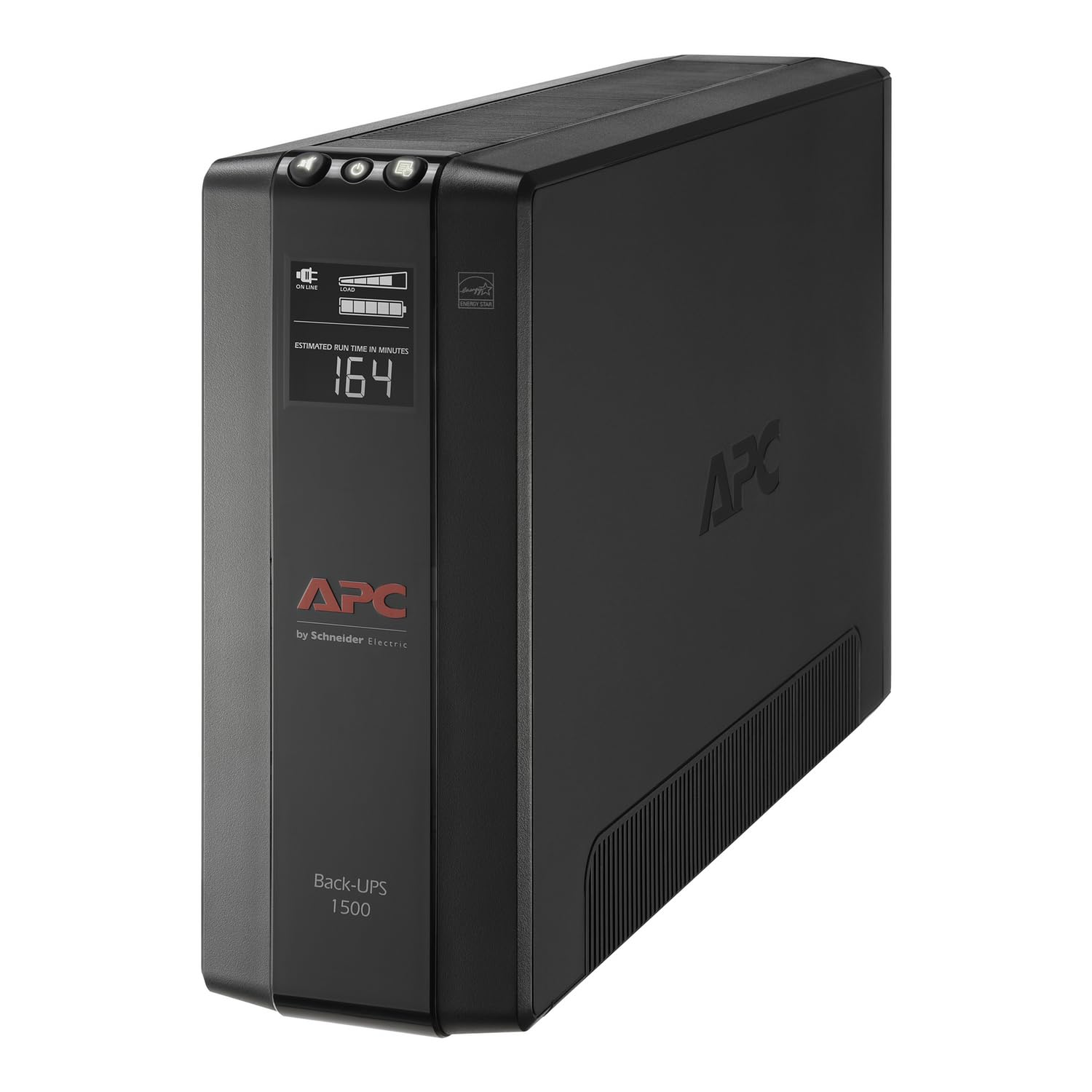
Capacity: 1500VA / 900W
Outlets: 10
Surge Protection: 789 joules
Voltage Regulation: AVR
Certification: UL certified
Runtime: 68 minutes at 100W
APC BX1500M UPS Battery Backup & Surge Protector for Computers, Electronics
This is the reference point for runtime calculation for a UPS in a home office. The 900W ceiling covers a desktop tower, monitor, router and a couple of peripherals without straining, and the published 68-minute figure at 100W gives buyers a realistic anchor for scaling down. Automatic voltage regulation smooths brownouts without draining the battery, which extends useful life. Ten outlets mean the whole desk plugs into one box.
The unit suits buyers running a full workstation or a small home server who want headroom rather than a minimal safety net. It earns its place because the wattage rating and the runtime disclosure make the math transparent. Trade-off: the lead-acid battery is sealed and not user-replaceable, so the whole unit retires when the cells fade.
CyberPower ST425 Standby UPS Battery Backup and Surge Protector

Capacity: 425VA / 260W
Outlets: 8
Form Factor: Compact
Certification: UL certified
Type: Standby UPS
CyberPower ST425 Standby UPS Battery Backup and Surge Protector
The ST425 is the budget entry in this comparison and the easiest unit for a first runtime calculation. A 260W ceiling fits a router, modem, a laptop charger and a phone, and the math is simple: divide the connected load into the capacity and accept a short hold time. Eight outlets cover a small entertainment shelf or a network corner. The compact shell fits behind furniture or under a desk.
This pick suits renters, students and anyone protecting connectivity rather than a full desktop. It earns its place on price and size, not on capacity. Trade-off: at 260W the unit cannot carry a gaming PC or a large monitor, so buyers with serious hardware should size up.
SKE SK1500 UPS Battery Backup and Surge Protector

Capacity: 1500VA / 900W
Outlets: 8
Type: Uninterruptible power supply
Intended Use: Computers and electronics
The SK1500 matches the APC on paper at 1500VA/900W but lands in a lower price bracket, which is the whole appeal. Eight outlets handle a desktop, monitor, router and printer, and the 900W ceiling gives the same runtime math as any other 1500VA unit. The housing is a straightforward tower design that sits on a floor or a low shelf.
This unit suits budget-conscious buyers who need high capacity and will accept fewer frills. It earns its place as the value route to 900W. Trade-off: the lower price tier usually means a shorter warranty and less polished power-management software than the established brands, so buyers should weigh support against savings.
GOLDENMATE 1500VA/1000W Lithium UPS Battery Backup & Surge Protector
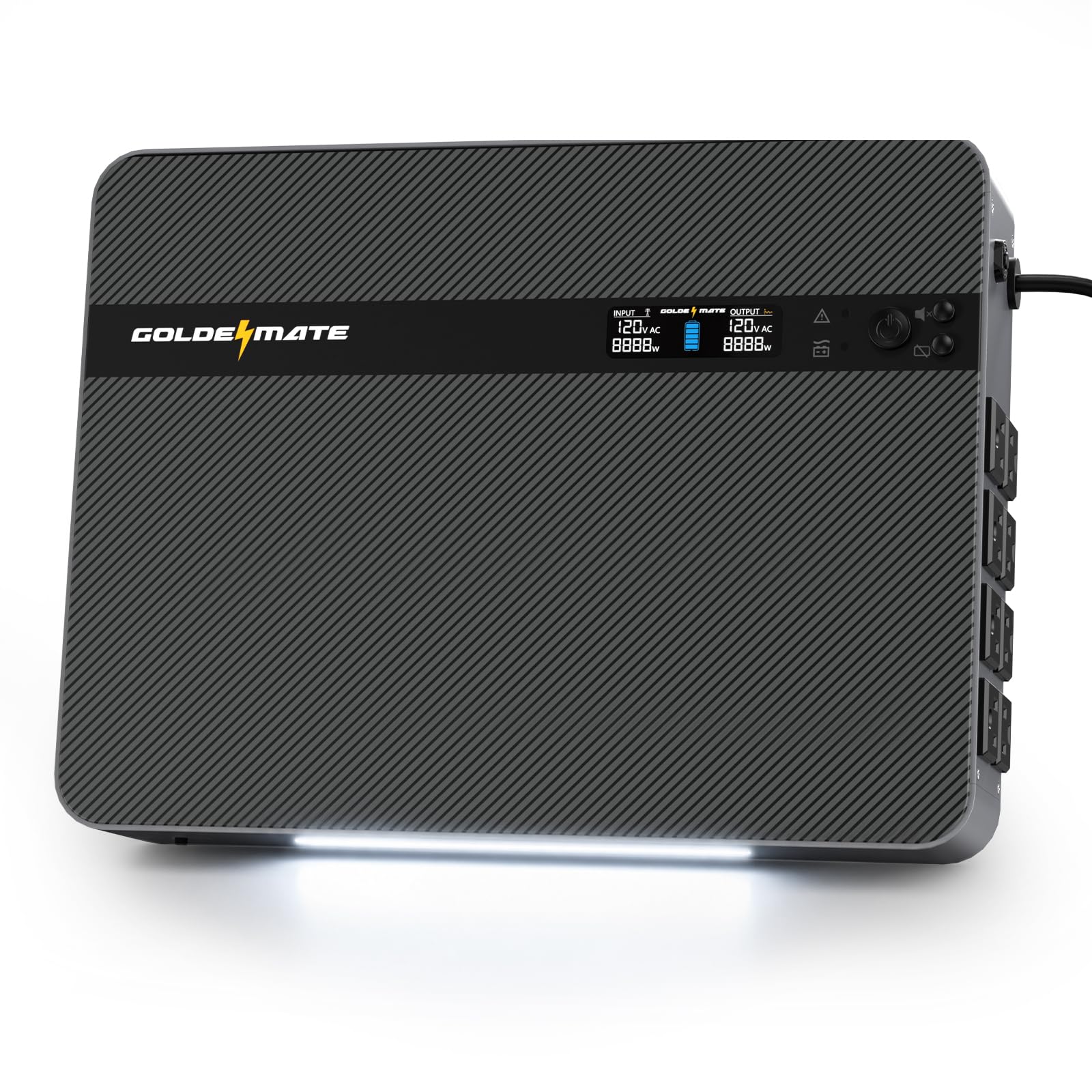
Capacity: 1500VA / 1000W
Battery: 230Wh LiFePO4
Outlets: 8 plus 2 USB ports
Waveform: Pure sine wave
Mounting: Wall-mount design
Display: LCD
GOLDENMATE 1500VA/1000W Lithium UPS Battery Backup & Surge Protector
This is the most interesting unit for runtime calculation because the battery capacity is stated in watt-hours. A 230Wh pack divided by the connected load gives a direct estimate before efficiency losses, and the 1000W ceiling is the highest here. Pure sine wave output keeps sensitive electronics and audio gear happy. The wall-mount shell frees floor space, and the LCD shows status at a glance.
The unit suits buyers who want lithium longevity, clean power and a wall installation in a garage, closet or office. It earns its place on chemistry and output quality. Trade-off: the premium price is steep for a 230Wh pack, and wall mounting demands studs or proper anchors, so installation is more involved than setting a tower on the floor.
Eaton Tripp Lite SMART1500LCD Rack Mount UPS

Capacity: 1500VA / 900W
Outlets: 8
Form Factor: 2U rack mount
Battery: Replaceable
Voltage Regulation: AVR
Cord: 6ft flat plug extension cord
Eaton Tripp Lite SMART1500LCD 1500VA 2U Rack Mount UPS 900W Battery Backup
The SMART1500LCD is built for racks, not desks. The 2U chassis bolts into a standard equipment rack, and the 900W rating supports a switch, server and network gear. AVR keeps voltage steady, and the replaceable battery is the standout feature: when the cells wear out, the unit gets a fresh pack instead of a trip to recycling. The flat-plug cord reaches an outlet in tight spaces.
This pick suits network closets, home labs and small server rooms where the UPS lives in the rack. It earns its place on serviceability. Trade-off: the rack form factor is awkward outside a rack, and the price is high for buyers who only need desk-level backup.
Before You Buy
- Load in watts: Add up the wattage on every device that must stay on, then compare that total to the unit’s watt rating, not its VA rating.
- Runtime target: Decide how many minutes the equipment needs to shut down cleanly, then scale the published runtime figure to the actual load.
- Battery chemistry: Lead-acid is cheaper up front; lithium lasts longer and states capacity in watt-hours, which simplifies the math.
- Form factor: Measure the space before ordering — tower, compact, wall-mount and 2U rack units are not interchangeable.
- Replaceable battery: Check whether the cells can be swapped, since a serviceable unit outlives a sealed one.
- Outlet count and type: Count plugs, including wall adapters that block neighboring outlets, and note any USB ports.
- Certification: A UL listing is the baseline safety mark for any unit plugged into a wall for years.
Frequently Asked Questions
-
How is UPS runtime calculated?
Divide the battery capacity in watt-hours by the connected load in watts, then subtract roughly 10 to 15 percent for inverter efficiency and battery age. The result is an estimate, not a guarantee. -
Why do VA and watt ratings differ?
VA measures apparent power and watts measure real power; the gap is the power factor. Always size against the watt rating, since that is what the battery actually delivers. -
Does a higher VA rating always mean longer runtime?
No. Runtime depends on battery capacity and load, so two units with the same VA rating can hold different loads for different times. -
How much runtime does a computer need?
Enough to save work and shut down cleanly, typically a few minutes. Servers and network gear may need longer to ride out short outages. -
Can a UPS battery be replaced?
Only on units designed for it, such as the Tripp Lite model here. Sealed units are retired as a whole when the battery fades. -
Does lithium change the runtime math?
It simplifies it, because lithium packs are often rated in watt-hours, which plugs directly into the calculation.
Bottom Line
For most buyers, the APC BX1500M is the top pick: its 1500VA/900W rating, ten outlets and published 68-minute runtime at 100W make runtime calculation for a UPS straightforward and give a home office real headroom. Buyers on a tight budget should look at the CyberPower ST425, and rack owners should go straight to the Tripp Lite. Check current prices before ordering, since these figures move.