Why there are Amazon links here: Brave Review is paid a commission for qualifying Amazon purchases made through the links below. Your price does not change, and using our links is entirely optional. How this works
Best Scheduling Runs While Out Planners for Staying Consistent
Scheduling runs while out of the house is mostly a planning problem, not a fitness one. A training plan only works when the week is visible in advance — on a wall, on a desk, or in a bag. This roundup covers five planners and logs that make that possible, from a full wall calendar for the whole household to a pocket running journal built for mileage and pace.
The picks suit three kinds of buyers: runners who plan a race block and need weekly structure, busy households juggling workouts against chores and appointments, and casual runners who only want a simple place to record distance. The overview table below shows each option side by side before the detailed reviews.
Overview of the Picks
| Product | Key Spec | Best Use | Price Tier |
|---|---|---|---|
| Schedule Magic Time Blocking Planner (Weekly) | Weekly time-blocking layout | Blocking run slots around a workday | Budget |
| 2027 Monthly Calendar, Decorative Floral Design | 12-month monthly grid, 8.27 x 8.27 in | Light monthly run scheduling | Budget |
| Wall Decor Planner 2027-2028 | 18-month wall planner, Jan 2027–Jun 2028 | Long-term training blocks on a wall | Mid-range |
| Gone For a Run Running Journal | 160 pages, vinyl cover, 7.5 x 5 in | Logging runs, races and goals in a bag | Premium |
| Run Tracker (1 Year Running Calendar) | One-year mileage, pace and goals layout | Simple year-long mileage tracking | Budget |
1. Schedule Magic Time Blocking Planner (Weekly)
Format: Weekly time-blocking planner
Intended Use: Scheduling runs around daily commitments
Layout: Time blocks by week
Best For: Runners with a fixed weekly routine

Schedule Magic Time Blocking Planner (Weekly)
This planner earns its spot because it treats a run the way it treats any other appointment: as a block of time that has to be reserved. The weekly spread is built around time blocking rather than a simple to-do list, so a runner can pencil in a Tuesday evening easy run and see immediately whether the rest of the day has room for it. It suits people whose schedule changes week to week and who need to renegotiate run times constantly.
Buyers who already keep a separate training log will find this complementary rather than a replacement — it schedules the run but does not track mileage or pace. The trade-off is that a time-blocking layout only works if the planner is actually opened every week; anyone who prefers a single glanceable month will find it too granular.
Check the current price on Amazon
Trade-off: It organizes time but records nothing about the run itself, so a separate log is still needed for distance and pace.
2. 2027 Monthly Calendar, Decorative Floral Design
Format: 12-month wall calendar
Layout: Sunday-start monthly grid
Size: 8.27 x 8.27 inches
Binding: Spiral bound
Design: Decorative floral
Best For: Light monthly run scheduling in a small space

This is the smallest and simplest option here: a square-format monthly calendar with a Sunday-start grid and writing boxes sized for legible entries. The spiral binding lets it hang flat, and the floral design means it does not look out of place in a kitchen or hallway. It suits runners who plan at the month level — marking long-run days, race dates and rest weeks — rather than mapping out individual hours.
The monthly grid is the whole story, so anyone needing to schedule two runs on the same day with different times will run out of room fast. Buyers should also note the calendar covers a single year, which makes it a poor fit for a training block that crosses into the next.
Check the current price on Amazon
Trade-off: A month-at-a-glance grid leaves little room for detail, so it suits broad scheduling rather than precise session planning.
3. Wall Decor Planner for Planning Reading Study School Task Home Office Cleaning Exercise Workout Vacation
Format: 18-month wall planner
Coverage: January 2027 through June 2028
Intended Use: Multi-category household and fitness planning
Best For: Long-range training blocks on a shared wall
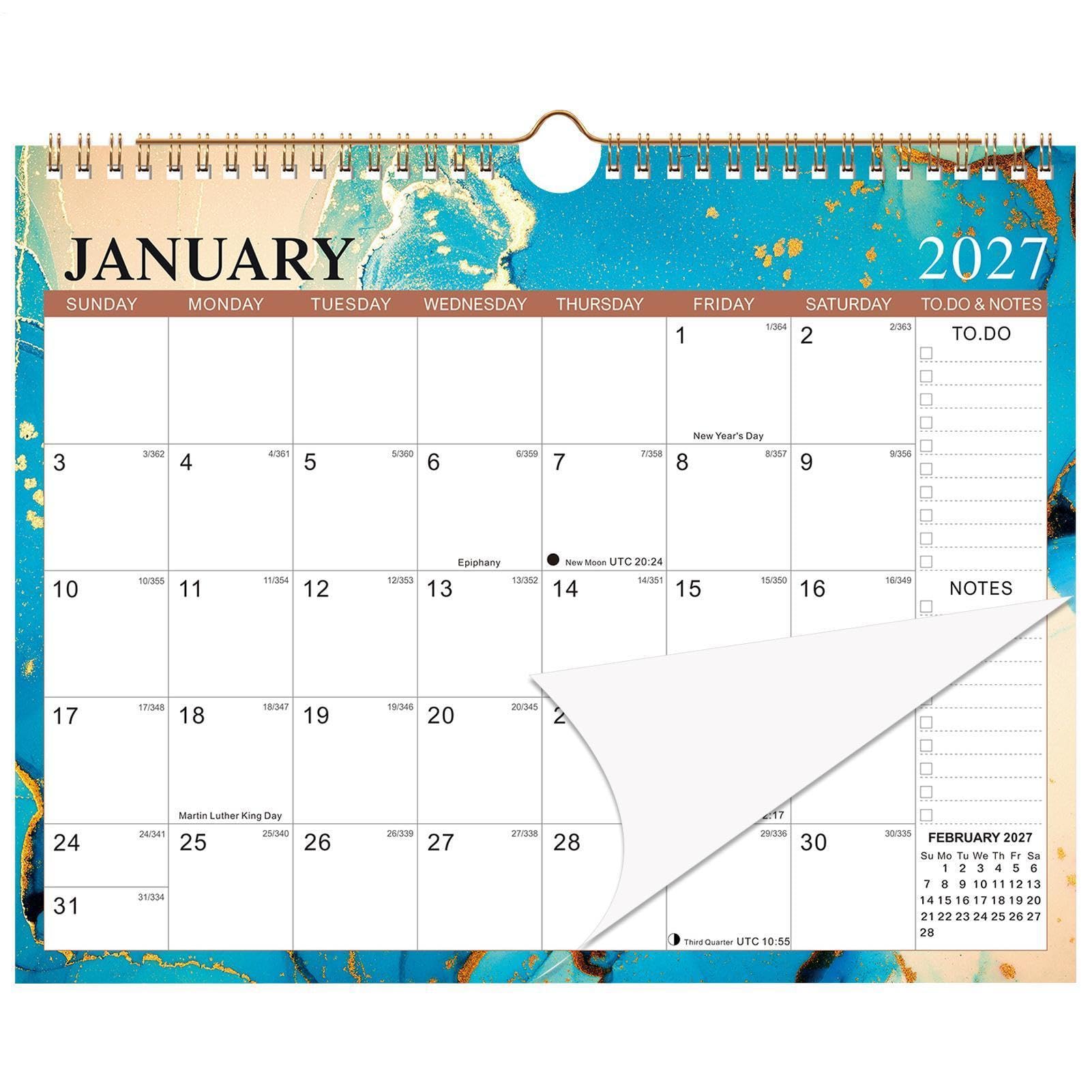
The standout feature here is the 18-month span, running from January 2027 through June 2028. That length matters for runners building toward a race: a marathon block planned in the back half of one year can be laid out without switching calendars mid-plan. The layout is designed for multiple categories of task — the name lists exercise and workout alongside cleaning, study and vacation — so it works as a shared household board rather than a personal training diary.
Because it is a wall planner, it lives in a common space, which is useful for accountability but less private. The trade-off is that a multi-purpose wall planner is a blunt instrument for detailed run data; it shows that a run is scheduled, not how far or how fast it went.
Check the current price on Amazon
Trade-off: Shared-wall format means no private space for detailed training notes, and the multi-category layout dilutes focus on running.
4. Gone For a Run Running Journal – Run Your Terrain
Format: Bound running journal
Pages: 160
Cover: Vinyl
Size: 7.5 x 5 inches
Sections: Running log, race log, goals page
Best For: Detailed run and race logging on the move

This is the only pick built specifically for runners rather than general scheduling. The 160 pages are split into a running log, a race log and a goals page, so a training block, its target races and the reasons behind them all live in one place. The vinyl cover and compact 7.5 x 5 inch size make it the one option here that fits in a gym bag or jacket pocket, which matters for anyone logging a run before leaving the trailhead.
It is also the most expensive pick, and the cost buys structure rather than volume. The trade-off is that a compact journal has limited room per entry, so runners who like to write long session notes or paste in splits may find the space tight.
Check the current price on Amazon
Trade-off: The premium price and compact page size make it a poor match for runners who want expansive free-form notes.
5. Run Tracker (1 Year Running Calendar)
Format: One-year running calendar
Coverage: Mileage, pace, goals and reflections
Intended Use: Year-long progress tracking
Best For: Simple, low-cost mileage tracking

Run Tracker (1 Year Running Calendar): Mileage, Pace, Goals & Reflections
The most affordable pick in the roundup is also the most single-minded. It is a one-year running calendar organized around four things: mileage, pace, goals and reflections. That structure suits a runner who wants to see a full year of consistency at a glance without committing to a daily diary format. It works well as a second planner kept alongside a wall calendar — one for scheduling, one for recording.
At this price tier the construction is likely to be simple paper stock rather than a hard cover, so it is a desk or drawer item rather than something thrown in a bag. The trade-off is that the fixed year-long format offers little flexibility for anyone whose training year does not line up with the calendar year.
Check the current price on Amazon
Trade-off: Budget paper construction and a fixed annual format limit durability and flexibility for non-calendar training cycles.
Before You Buy
- Format: Decide between a wall calendar for shared visibility and a bound journal for portable logging; the two solve different problems.
- Coverage length: A 12-month calendar suits a single season, while an 18-month planner covers a race block that crosses a year boundary.
- Size: Check the footprint before buying — a square wall calendar fits small spaces, while a compact journal fits a bag but offers less writing room per entry.
- Detail level: Monthly grids schedule runs; running logs record mileage, pace and races. Most runners end up wanting both.
- Material and cover: Vinyl covers survive a gym bag; paper calendars are better kept on a desk or wall.
- Storage: Wall planners need visible wall space to work; a planner that gets folded into a drawer stops being consulted.
Frequently Asked Questions
-
What is the best way to schedule runs while out of the house?
Use a wall calendar for the week’s plan and a compact running journal for the run itself. The calendar schedules the slot; the journal records what happened. -
Is a monthly calendar enough for marathon training?
A monthly grid can mark long-run days and race dates, but most marathon blocks need weekly detail, so a time-blocking planner or running log is a better fit alongside it. -
Do these planners track mileage and pace?
Only the two running-specific options do. The calendars and the time-blocking planner schedule runs but do not record distance or pace. -
Which pick is best for a shared household?
The 18-month wall planner, because its multi-category layout covers chores, appointments and workouts on one visible surface. -
Can a runner use more than one of these at once?
Yes, and it is a common setup: a wall calendar for scheduling and a journal for logging. The two formats are complementary rather than redundant. -
Which option travels best?
The Gone For a Run journal, thanks to its compact size and vinyl cover. The wall calendars are not designed to leave the house.
Bottom Line
For most runners, the strongest single pick is the Gone For a Run Running Journal — it is the only option built around running data, it covers goals and races as well as daily mileage, and its compact size means it travels to the run rather than waiting at home. Buyers who need the week visible on a wall should pair it with the 18-month wall planner for scheduling.