Why there are Amazon links here: Brave Review is paid a commission for qualifying Amazon purchases made through the links below. Your price does not change, and using our links is entirely optional. How this works
Shark RV2110 Navigator vs Shark UR2360S Ultra: Self-Empty or Simple?
The Shark RV2110 Navigator and the Shark UR2360S Ultra are both renewed robot vacuums from the same brand, and the decision between them comes down to one question: does the buyer want a self-emptying base, or a simpler machine that costs less? The Navigator is the budget-leaning option with smart path navigation and an anti-hair-wrap brushroll. The Ultra adds precision mapping, matrix cleaning and a bagless self-empty base that holds debris for about a month.
Both are renewed units, so the buyer is trading a lower price for a machine that has been restored rather than sold new. The short answer: households with pets and wall-to-wall carpet lean toward the Ultra, while smaller homes and hard-floor apartments get everything they need from the Navigator. The details below settle the rest.
Shark RV2110 Navigator Robot Vacuum (Renewed)
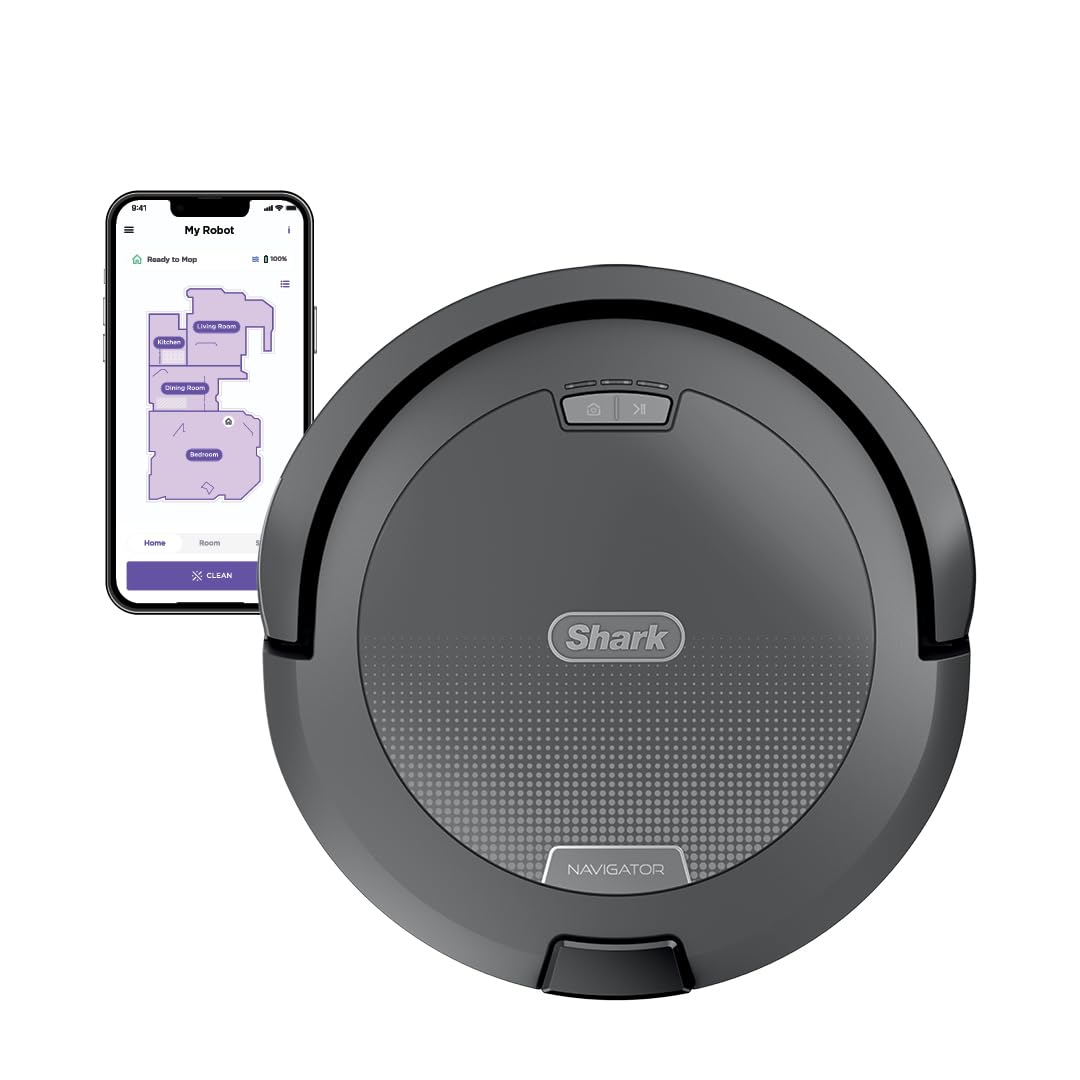
Product Type: Robot vacuum, renewed
Navigation: SmartPath Navigation
Brushroll: Self-cleaning, anti-hair wrap
Surface Use: Carpets and hard floors
Specialty: Pet hair pickup
Color: Steel Grey
The Navigator is built as a straightforward cleaning robot: it maps a route with SmartPath Navigation, runs a self-cleaning brushroll that resists hair tangles, and picks up pet hair from both carpet and hard flooring. There is no self-empty base in the name, so the dustbin is emptied by hand. That is the core trade the Navigator makes against its sibling.
That manual empty is not a flaw so much as a category choice. A robot without a base station is smaller, cheaper to buy, and easier to tuck under low furniture or into a closet between runs. For a one-bedroom apartment or a house with mostly hard floors, the bin rarely fills fast enough for the emptying chore to matter.
The self-cleaning brushroll is the feature that earns the Navigator its place. Hair wrap is the most common reason robot vacuums get abandoned, and a brushroll that sheds hair on its own keeps suction strong without weekly maintenance. Buyers with a shedding dog or cat get the pet-hair pickup they need without paying for the base.
Trade-off: Without a self-empty base, the dustbin must be emptied by hand after most runs, which is a real chore in a large or heavily soiled home.
Check the current price on Amazon
Shark UR2360S Ultra Robot Vacuum (Renewed)

Product Type: Robot vacuum with self-empty base, renewed
Navigation: Matrix Clean with precision mapping
Base: 30-day capacity, HEPA, bagless, self-empty
Brushroll: Self-cleaning, pet hair focused
Connectivity: WiFi
Color: Black
The Ultra is the more automated machine. Its precision mapping lets it plan coverage room by room, Matrix Clean handles the back-and-forth passes, and the bagless HEPA self-empty base collects debris for roughly a month before it needs attention. WiFi puts scheduling and control on a phone rather than the robot itself.
The base is the reason to pay more. Emptying a robot every day is the task most owners tire of first, and a base that holds about a month of debris removes it from the routine entirely. The bagless design also means no recurring bag purchases, which matters over the life of the machine. The HEPA filtration is a bonus for allergy-sensitive households.
Precision mapping is the second differentiator. A robot that knows the layout cleans more predictably and wastes less time bumping into the same wall. That is worth real money in a multi-room home, and it is the feature that separates the Ultra from a budget path-navigation machine.
Trade-off: The self-empty base needs floor space and a power outlet, and the renewed unit carries the same restoration caveats as any renewed robot vacuum.
Check the current price on Amazon
Side-by-Side Comparison
| Feature | Shark RV2110 Navigator | Shark UR2360S Ultra |
|---|---|---|
| Navigation | SmartPath Navigation | Matrix Clean with precision mapping |
| Self-empty base | No | Yes, 30-day capacity |
| Filtration | Not stated in name | HEPA, bagless |
| Brushroll | Self-cleaning, anti-hair wrap | Self-cleaning, pet hair focused |
| Connectivity | Not stated in name | WiFi |
| Surface use | Carpets and hard floors | Not stated in name |
| Color | Steel Grey | Black |
| Price tier | Budget | Mid-range |
The table reads cleanly: the Navigator wins on simplicity and price, the Ultra wins on automation and mapping. Everything else is close. Both carry a self-cleaning brushroll aimed at pet hair, both are renewed, and both are built for mixed flooring in a typical home.
The one row that is not a straight win is the base. It is a genuine upgrade for a busy household, but it is also a piece of furniture that needs a permanent spot with an outlet. A buyer in a small apartment may find the base takes up more floor than the robot saves in effort.
The connectivity row matters more than it looks. WiFi on the Ultra means scheduling and remote starts, which is how most people actually use a robot vacuum. The Navigator relies on its onboard controls and SmartPath route, which is fine but less flexible.
Which Should You Buy?
Choose the Shark RV2110 Navigator if: the home is small to mid-sized, floors are mostly hard, the budget is the priority, and emptying a bin by hand a few times a week is acceptable. It is the better first robot vacuum and the better fit for renters.
Choose the Shark UR2360S Ultra if: the home has multiple rooms, carpet, or a heavy-shedding pet; the buyer wants to set a schedule and forget the machine for weeks; and there is a permanent spot for the base. The 30-day bagless base and precision mapping justify the higher price tier for that household.
Neither is the right pick for someone who wants a brand-new unit with a full manufacturer warranty, or for a home with multiple floor levels that would need a robot carried between them.
FAQ
-
Is the Shark UR2360S Ultra worth the extra cost over the RV2110 Navigator?
For a household that would otherwise empty a bin daily, yes. The self-empty base and precision mapping remove the two biggest friction points of robot ownership. For a small apartment, the Navigator covers the same floors for less. -
Do both vacuums handle pet hair?
Both names specify a self-cleaning, anti-hair-wrap brushroll aimed at pet hair. The Ultra adds HEPA filtration in its base, which is the bigger difference for allergy-sensitive homes. -
What does "renewed" mean for these robot vacuums?
Renewed means the unit has been restored and resold rather than sold new. Buyers should expect the same model and function but a shorter or different warranty than a new unit, and should confirm the return window before buying. -
Does the Navigator have a self-empty base?
No. The Navigator’s name lists no base station, so the dustbin is emptied by hand. The Ultra is the model with the 30-day self-empty base. -
Can the Ultra be controlled by phone?
The name specifies WiFi, which is how app control and scheduling work on this class of robot. The Navigator’s name does not list WiFi, so onboard controls are the safer expectation. -
Which is better for carpet?
The Navigator explicitly lists carpets and hard floors. The Ultra’s name does not state surface use, but its mapping and Matrix Clean passes are aimed at whole-home coverage. Buyers with mostly carpet should confirm carpet performance on the product page. -
Do both need bags?
The Ultra’s base is bagless, so no recurring bag purchases. The Navigator has no base at all, so there is nothing to bag.
Bottom Line
The Shark UR2360S Ultra is the better robot vacuum for most buyers: the 30-day bagless HEPA self-empty base and precision mapping remove the daily chore that makes people give up on robot vacuums, and the price gap over the Navigator is modest for what it adds. The Shark RV2110 Navigator remains the right pick for small homes, hard floors and tight budgets, where a simple self-cleaning brushroll and SmartPath navigation cover the job without a base station taking up floor space.
