Why there are Amazon links here: Brave Review is paid a commission for qualifying Amazon purchases made through the links below. Your price does not change, and using our links is entirely optional. How this works
Best Socket Tester for a Home Audit: 5 Picks for Safe, Fast Outlet Checks
A socket tester for a home audit turns a walkthrough into a real inspection: plug it in, read the result, and move on. This roundup covers five outlet testers, from a basic three-light model to a GFCI tester with an LCD readout. Three buyer profiles matter here: the homeowner checking a new house, the DIYer tracing a dead or miswired outlet, and the landlord documenting a rental between tenants. The overview table below shows each pick at a glance.
The Picks at a Glance
| Product | Key Spec | Best Use | Price Tier |
|---|---|---|---|
| Klein Tools RT250 | LCD display, GFCI testing, 3-wire 120V | Whole-home audits with voltage readout | Mid |
| Klein Tools RT210 | GFCI and standard outlet testing | Quick pass/fail checks on any receptacle | Budget |
| Klein Tools RT110 | Standard AC receptacle testing | Basic wiring checks, tool bag spare | Budget |
| KAIWEETS GFCI Tester | LCD display, CAT II 300V, live and neutral check | Voltage plus fault diagnosis in one tool | Mid |
| Yellow Outlet Tester | North American outlet testing | Occasional light-duty checks | Budget |
1. Klein Tools RT250 GFCI Outlet Tester

Type: GFCI outlet tester with LCD display
Intended Use: Standard 3-wire 120V electrical receptacles
Display: LCD with voltage readout
GFCI Testing: Yes
Region: North America
The RT250 is the most capable tester in this group. The LCD shows actual voltage instead of forcing a guess from a light pattern, and it can trip a GFCI so a homeowner knows the protection circuit still works. Klein builds it as a plug-in handheld, sized for a tool bag or a kitchen drawer. It suits anyone auditing a whole house, where both wiring faults and low voltage are worth catching.
This is the pick for buyers who want numbers, not just a pass/fail light. It earns its place as the anchor of a home audit because one tool covers wiring faults, voltage, and GFCI function. Trade-off: The LCD and GFCI circuitry push the price above basic testers, so a buyer who only needs a yes/no wiring check pays for features they may never use.
Check the current price on Amazon
2. Klein Tools RT210 GFCI and Standard AC Outlet Tester

Type: GFCI and standard AC outlet tester
Intended Use: North American receptacles
Function: Detects common wiring problems
GFCI Testing: Yes
Region: North America
The RT210 keeps things simple: plug it in, read the indicator lights, and move to the next outlet. It covers both standard receptacles and GFCI outlets, so a full sweep of a home needs only this one tool. The housing is the familiar Klein handheld shape, built for repeated plugging and unplugging. It suits a homeowner or landlord who wants a fast yes/no answer without reading a display.
This is the workhorse pick for a first audit, and it is the one most buyers will reach for by default. It earns its place on speed and coverage rather than on detail. Trade-off: The light pattern tells a buyer that something is wrong but not how much voltage is present, so intermittent or marginal faults can slip past a quick check.
Check the current price on Amazon
3. Klein Tools RT110 Outlet Tester

Type: AC electrical receptacle tester
Intended Use: North American outlets
Function: Standard wiring check
Display: Indicator lights
Region: North America
The RT110 is the stripped-down member of the Klein family here. It checks a receptacle and reports the result through its indicator lights, with no GFCI trip button and no display. The body is compact and pocketable, which makes it easy to keep in a drawer or a small tool kit. It suits a renter or a first-time buyer who wants a basic sanity check before plugging in anything valuable.
This pick earns its place as the low-cost entry point and as a spare that can live in a second location. It is the right tool for a quick wiring confirmation, not a deep audit. Trade-off: Without GFCI testing, it cannot confirm that a bathroom or kitchen outlet’s protection circuit actually trips, which is one of the most important checks in a home audit.
Check the current price on Amazon
4. KAIWEETS GFCI Outlet Tester
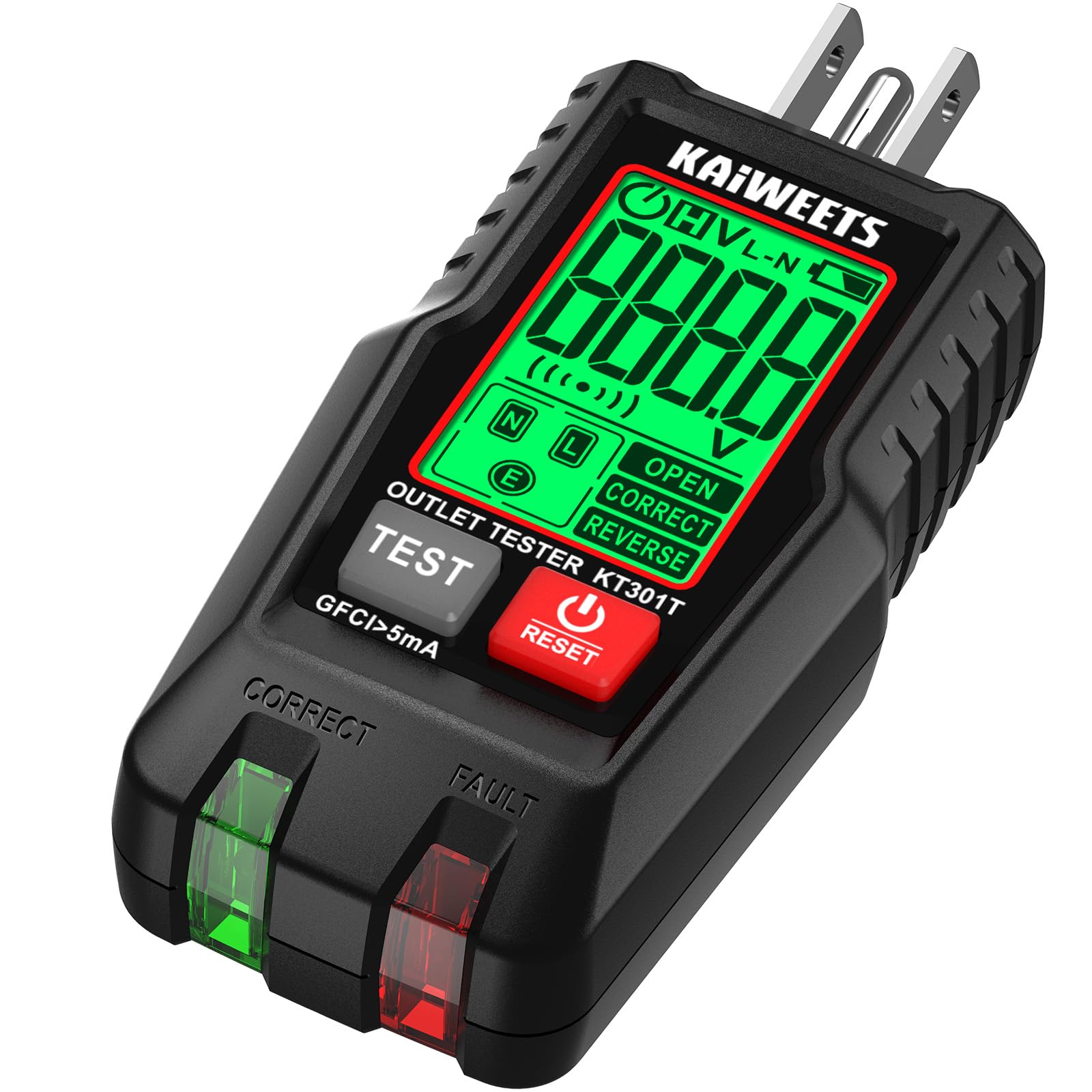
Type: GFCI outlet tester and circuit analyzer
Intended Use: North American outlets, AC 120V
Display: LCD with voltage readout
Safety Rating: CAT II 300V
Checks: Live and neutral, wiring fault diagnosis
The KAIWEETS tester combines an LCD voltage readout with GFCI testing and a live/neutral check in one plug-in unit. The CAT II 300V rating is a measurement category, a label that signals the tool is built for work on household circuits rather than only for continuity. It suits a DIYer who wants both a voltage number and a fault diagnosis from a single pass around the house.
This pick earns its place as the closest competitor to the RT250, with a feature set aimed at buyers who want the readout plus the safety labeling. It is a strong choice for a thorough audit where every outlet gets checked twice. Trade-off: The feature density means more to learn than a three-light tester, and a buyer who just wants a quick pass/fail will find the display and modes unnecessary.
Check the current price on Amazon
5. Yellow Outlet Tester
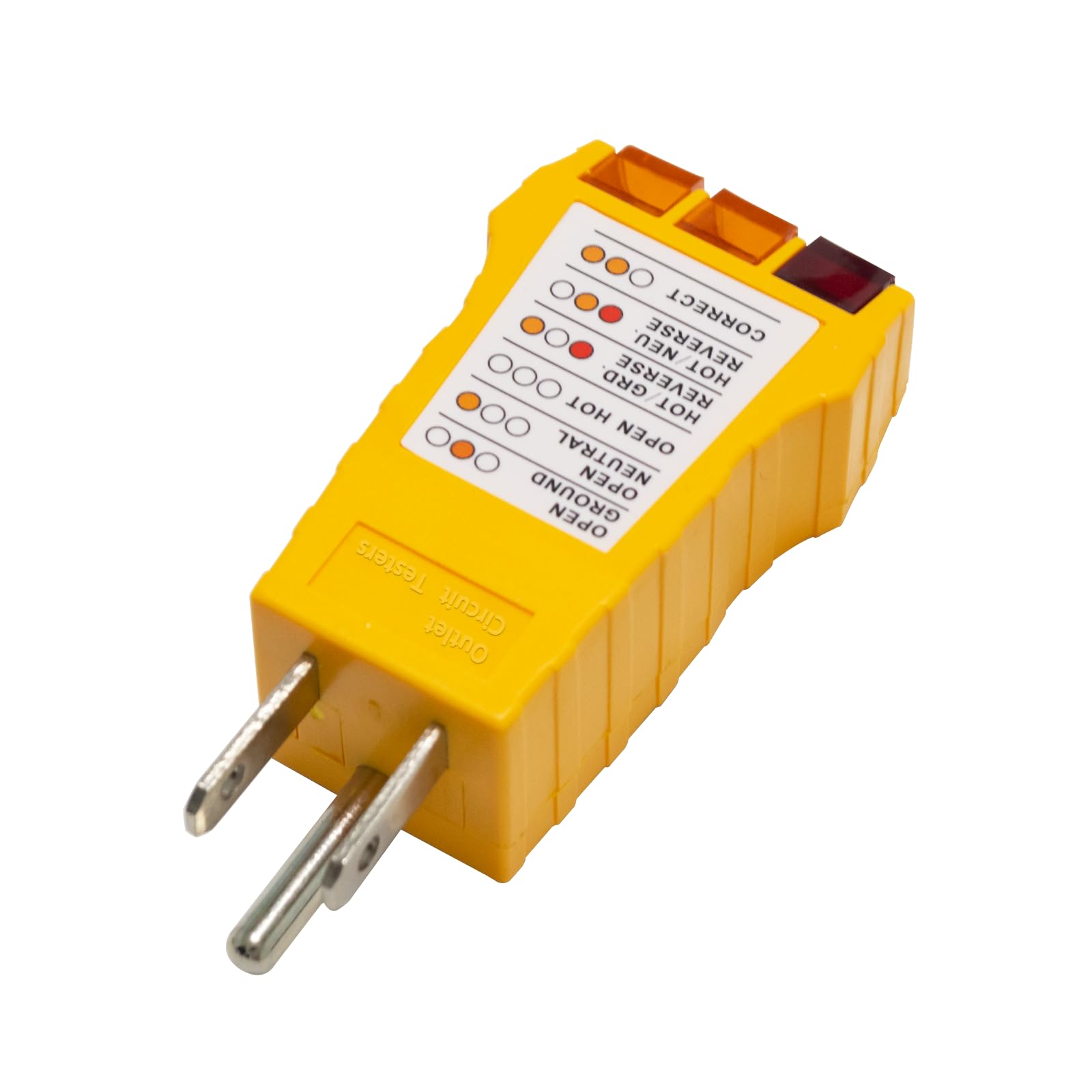
Type: Electrical receptacle and socket tester
Intended Use: North American outlets
Display: Indicator lights
Color: Yellow
Region: North America
The yellow outlet tester is the budget option in this roundup. It plugs into a North American receptacle and reports the wiring result through its indicator lights, with a bright yellow body that is easy to spot in a drawer. The build is simple and the operation is a single step. It suits a buyer who needs an occasional check, a spare for a guest house, or a low-cost first tester.
This pick earns its place on price and simplicity, and it covers the basic wiring check that most home audits start with. It is not the tool for a full inspection. Trade-off: The budget tier usually means a lighter housing and no GFCI trip function, so it should be treated as a quick indicator rather than a complete audit tool.
Check the current price on Amazon
Before You Buy
- GFCI testing: A home audit should include bathroom, kitchen, garage, and exterior outlets, so a tester with a GFCI trip function covers far more ground than a plain wiring checker.
- Display type: An LCD readout shows actual voltage and catches marginal problems; indicator lights only report pass or fail.
- Compatibility: Every pick here is built for North American receptacles and 120V circuits, so buyers outside that region need a different tool.
- Safety rating: A CAT II 300V label signals a tool rated for household circuit measurements, which matters when probing live outlets.
- Build and housing: Repeated plugging wears on the prongs and body, so a sturdier housing suits anyone auditing a whole house in one session.
- Storage: Compact testers fit a tool bag or a kitchen drawer, but a bright color or a labeled pouch keeps one from disappearing between audits.
Frequently Asked Questions
-
What does a socket tester for a home audit actually check? It verifies that a receptacle is wired correctly and, on GFCI-capable models, that the protection circuit trips. Some models also report voltage on a display.
-
Is a GFCI tester necessary for a home audit? It is the fastest way to confirm that bathroom, kitchen, and outdoor outlets are protected. A basic wiring tester cannot perform that check.
-
Can a socket tester detect a serious wiring fault? It flags common problems such as reversed polarity, an open ground, or an open neutral. It is a screening tool, not a replacement for an electrician’s diagnosis.
-
Do these testers work outside North America? No. All five are built for North American receptacles and 120V circuits, and plugging one into a different system is unsafe.
-
Which tester suits a first-time homebuyer? The RT210 covers both standard and GFCI outlets with a simple light readout, which makes it the easiest starting point. A buyer who wants voltage numbers should step up to the RT250 or the KAIWEETS.
-
How often should outlets be retested? A full sweep at move-in and again after any electrical work is a sensible baseline. High-use outlets and GFCI-protected circuits benefit from a periodic recheck.
Bottom Line
For most home audits, the Klein Tools RT250 is the best socket tester for the job: it combines a voltage display, GFCI testing, and standard wiring checks in one handheld tool, so a single pass around the house produces real numbers instead of a light pattern. Buyers on a tight budget can start with the RT210 and still cover every outlet type, while the KAIWEETS is the pick for anyone who wants the display plus a CAT II safety rating.
