Why there are Amazon links here: Brave Review is paid a commission for qualifying Amazon purchases made through the links below. Your price does not change, and using our links is entirely optional. How this works
Best Surge Protection for a Camera System for Continuous Recording
A camera system is only as reliable as the power feeding it. One good spike can take out an NVR, a DVR or a whole bank of cameras at once, and the replacement bill usually dwarfs the cost of a decent protector. This guide covers five surge protectors that suit three kinds of buyers: the renter or dorm user running a small Wi-Fi camera setup, the homeowner wiring a full multi-camera system, and the home-theater owner who wants coax and phone lines covered alongside the recorder. The overview table below lines up every pick by key spec, best use and price tier so a decision is possible in under a minute.
Overview of the Picks
| Product | Key Spec | Best Use | Price Tier |
|---|---|---|---|
| Anker Power Strip with 2100J Surge Protector | 2100J, 12 AC, 1 USB-C, 2 USB-A | Compact desk or shelf setup with a Wi-Fi camera | Mid |
| CyberPower ST425 Standby UPS | 425VA/260W, 8 outlets, battery backup | Keeping a recorder alive through short outages | Mid |
| CyberPower HT812TC Home Theater Surge Protector | 4350J, 8 outlets, coax and phone protection | Full camera system with coax cabling | Premium |
| ALESTOR 6 Ft Surge Protector Power Strip | 2700J, 12 outlets, 4 USB ports | Large multi-camera install on a budget | Budget |
| SUPERDANNY Power Strip Surge Protector | 2100J, 22 AC, 6 USB, flat plug | High-outlet-count gaming room or office | Budget |
1. Anker Power Strip with 2100J Surge Protector

Surge Rating: 2100 joules
Outlets: 12 AC
USB Ports: 1 USB-C, 2 USB-A (20W)
Cord Length: 5 ft
Listing: TUV Listed
Best For: Compact camera hubs and desk setups
Build and Capability: The Anker unit packs twelve AC outlets plus a USB-C and two USB-A ports into a strip built for a home office or dorm shelf. The 2100-joule rating is solid for a small camera hub, a Wi-Fi router and a monitor sharing one bar. The 20W USB-C port can top up a phone or a small camera accessory without a separate brick. The five-foot cord keeps placement flexible without turning a desk into a cable nest.
Who It Suits: This is the pick for a renter or dorm user running one or two Wi-Fi cameras off a single shelf, where outlet count and a clean footprint matter more than raw joule capacity. It is not the right choice for a homeowner with a hardwired eight-camera NVR that needs coax protection and a much higher surge rating.
Trade-off: The compact body and mid-range joule rating mean this strip is sized for small electronics, not a full rack of recording hardware.
2. CyberPower ST425 Standby UPS Battery Backup

Capacity: 425VA / 260W
Outlets: 8
Type: Standby UPS with battery backup
Listing: UL Certified
Best For: Riding out short outages without losing a recording
Build and Capability: A standby UPS does something a plain surge strip cannot: it keeps the connected gear running for a few minutes when the power drops. The 425VA/260W capacity is enough to carry a small NVR or DVR plus a router through a brief outage or a clean shutdown. Eight outlets cover the recorder, the router and a monitor without a second strip. The compact body tucks under a desk or behind a shelf.
Who It Suits: This is the pick for a buyer whose main worry is a brief power blip killing a recording mid-write. It suits a small system with a single recorder and a handful of cameras, not a large install drawing serious wattage.
Trade-off: Battery capacity is modest, so it buys minutes rather than hours and will not carry a large multi-camera system through an extended outage.
3. CyberPower HT812TC Home Theater Surge Protector
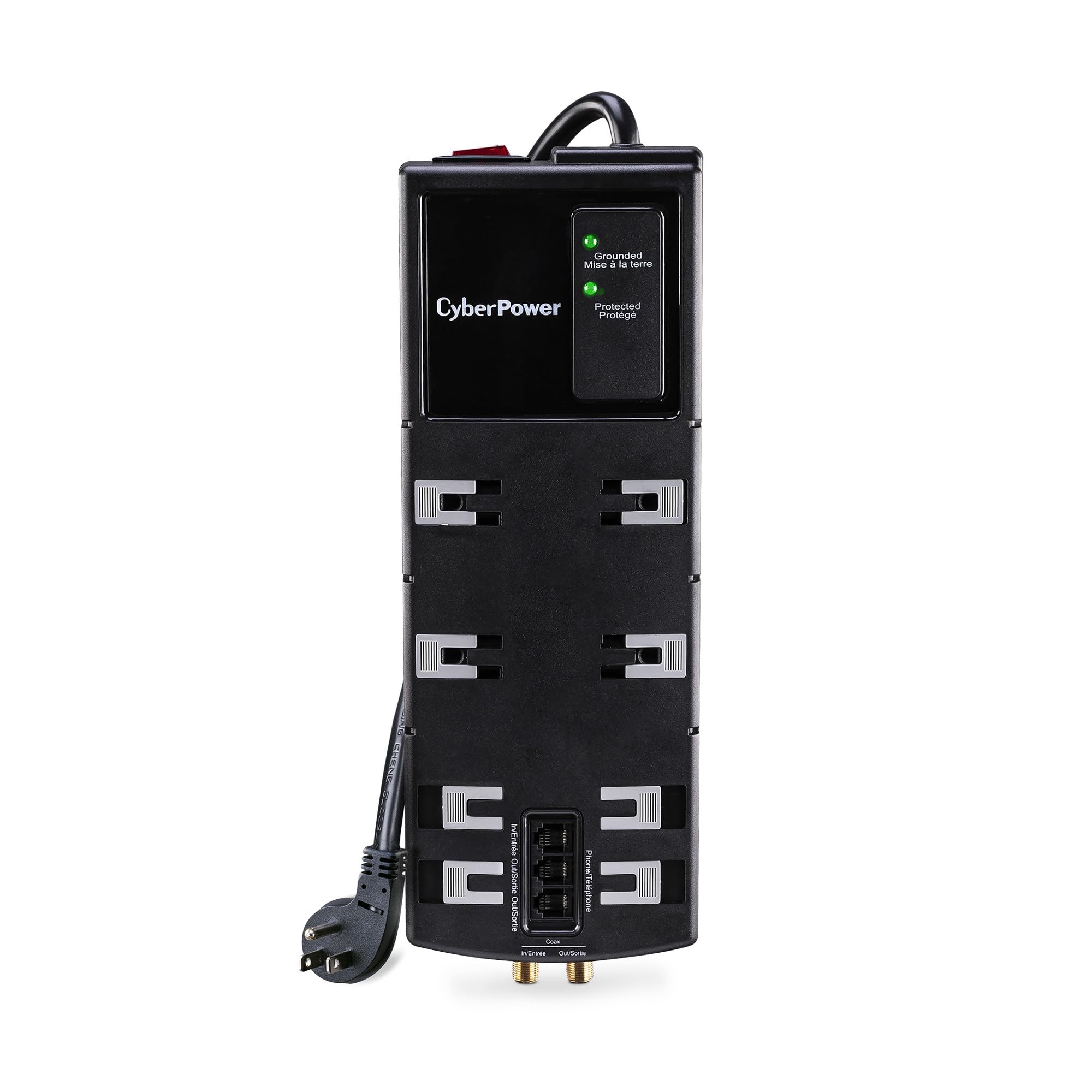
Surge Rating: 4350 joules / 120V
Outlets: 8 (4 wide spaced)
Cord Length: 6 ft
Plug: Right-angle
Extras: Coax and phone line protection, dust covers
Best For: Full camera systems with coax cabling
Build and Capability: This is the most protective pick in the group, and the only one that covers coax and phone lines alongside the AC outlets. A camera system fed by coax cable can take a surge in through the signal line, not just the power cord, so the coax protection matters for a hardwired install. The 4350-joule rating is the highest here, and four wide-spaced outlets accommodate bulky adapters. The right-angle plug and six-foot cord make it easier to fit behind a media cabinet.
Who It Suits: This is the pick for a homeowner with a full multi-camera DVR or NVR setup, especially one wired over coax, where the signal line is as much of a risk as the power line. It is overkill for a single Wi-Fi camera on a desk.
Trade-off: The higher protection level and specialty ports push this into the premium tier, and the added coax and phone jacks are wasted on an all-Wi-Fi camera setup.
4. ALESTOR 6 Ft Surge Protector Power Strip

Surge Rating: 2700 joules
Outlets: 12
USB Ports: 4
Cord Length: 6 ft
Listing: ETL Listed
Best For: Large multi-camera installs on a budget
Build and Capability: The ALESTOR strip balances a strong 2700-joule rating against a budget price, which is the combination most multi-camera buyers are hunting for. Twelve outlets and four USB ports cover a recorder, a router, a monitor and a row of camera power adapters on one bar. The six-foot heavy-duty cord reaches a wall outlet from a shelf or cabinet. The black finish blends into a media closet.
Who It Suits: This is the pick for a buyer powering a full NVR or DVR plus several camera adapters who wants strong protection without paying premium prices. It is not the choice for a buyer who needs coax or phone line protection, since this strip only covers AC and USB.
Trade-off: The budget build keeps costs down, but it offers no signal-line protection, so a coax-fed system still needs a separate coax protector.
5. SUPERDANNY Power Strip Surge Protector

Surge Rating: 2100 joules
Outlets: 22 AC
USB Ports: 6
Cord Length: 6.5 ft
Plug: Flat plug
Power: 1875W / 15A
Best For: High outlet count in a gaming room or office
Build and Capability: The SUPERDANNY strip leads the group on outlet count with twenty-two AC outlets and six USB ports on a single bar. The 2100-joule rating matches the Anker, and the flat plug lets the strip sit tight against a wall behind furniture. The 6.5-foot cord and 1875W/15A rating handle a busy desk or gaming setup. It is a practical way to power many small devices from one protected bar.
Who It Suits: This is the pick for a buyer running a gaming room, office or dorm desk with a dozen small devices and one or two cameras mixed in. It is not the right fit for a dedicated camera system that needs higher joule capacity or signal-line protection.
Trade-off: Spreading 2100 joules across twenty-two outlets means each device gets a smaller share of protection, so a serious camera install deserves a higher-rated unit.
Before You Buy
- Joule rating: Higher joules mean more surge energy absorbed before the strip gives out; a full camera system with a recorder deserves 2000J or more.
- Signal-line protection: A coax-fed camera system can take a surge through the cable, so coax and phone jacks matter as much as AC outlets.
- Battery backup: A UPS keeps a recorder writing through a short outage; a plain surge strip only blocks spikes.
- Outlet count and spacing: Count the recorder, router, monitor and every camera adapter, and check for wide-spaced outlets for bulky power bricks.
- Cord length and plug type: Measure the run from the wall outlet to the shelf, and consider a flat or right-angle plug for tight spaces.
- Listing and certification: Look for a TUV, UL or ETL listing on the unit, which signals the strip has been tested to a safety standard.
Frequently Asked Questions
-
How many joules does a camera system need?
A small Wi-Fi camera setup can run on a 2000J strip, while a full NVR or DVR with multiple cameras benefits from 2700J or higher. -
Does a surge protector protect cameras on coax cable?
Only if it has coax jacks. A strip with coax and phone protection, like the CyberPower HT812TC, covers the signal line as well as the power line. -
Is a UPS better than a surge protector for a camera system?
A UPS adds battery backup so a recorder keeps running through a short outage, while a surge protector only blocks spikes; the two solve different problems. -
Can one power strip handle a recorder and all the cameras?
It can if the outlet count and joule rating are high enough; count every adapter and pick a strip with headroom to spare. -
Where should the surge protector sit in a camera setup?
Place it between the wall outlet and the recorder, router and camera adapters, and keep the cord run short to reduce clutter and strain. -
Does a higher joule rating always mean better protection?
A higher rating means more surge capacity, but signal-line protection and outlet fit matter just as much for a camera system.
Bottom Line
For most camera-system owners, the CyberPower HT812TC Home Theater Surge Protector is the strongest single choice: the highest joule rating in the group plus coax and phone protection covers both the power line and the signal line a hardwired system depends on. Buyers on a tighter budget with an all-AC setup should look at the ALESTOR strip, and anyone worried about short outages should add the CyberPower ST425 UPS.
