Why there are Amazon links here: Brave Review is paid a commission for qualifying Amazon purchases made through the links below. Your price does not change, and using our links is entirely optional. How this works
TRENDnet TPE-115GI: The PoE+ Injector That Powers One Device
The TRENDnet TPE-115GI is a single-port PoE+ injector for anyone who needs to power one network device — a ceiling access point, an outdoor camera, a door intercom — without buying a PoE switch. It pushes 30W of power and Gigabit data down a single Ethernet run of up to 100 meters, and it does that from a small metal box that sits between the router and the device. This review covers what the injector is built to do, where its 30W budget is enough, where it is not, and which buyers should skip it entirely.
The short version: it suits a home or small-office setup with one power-hungry device on a long cable run. Buyers who need to power two or more devices, or who want the injector to negotiate power centrally, want a PoE switch instead.
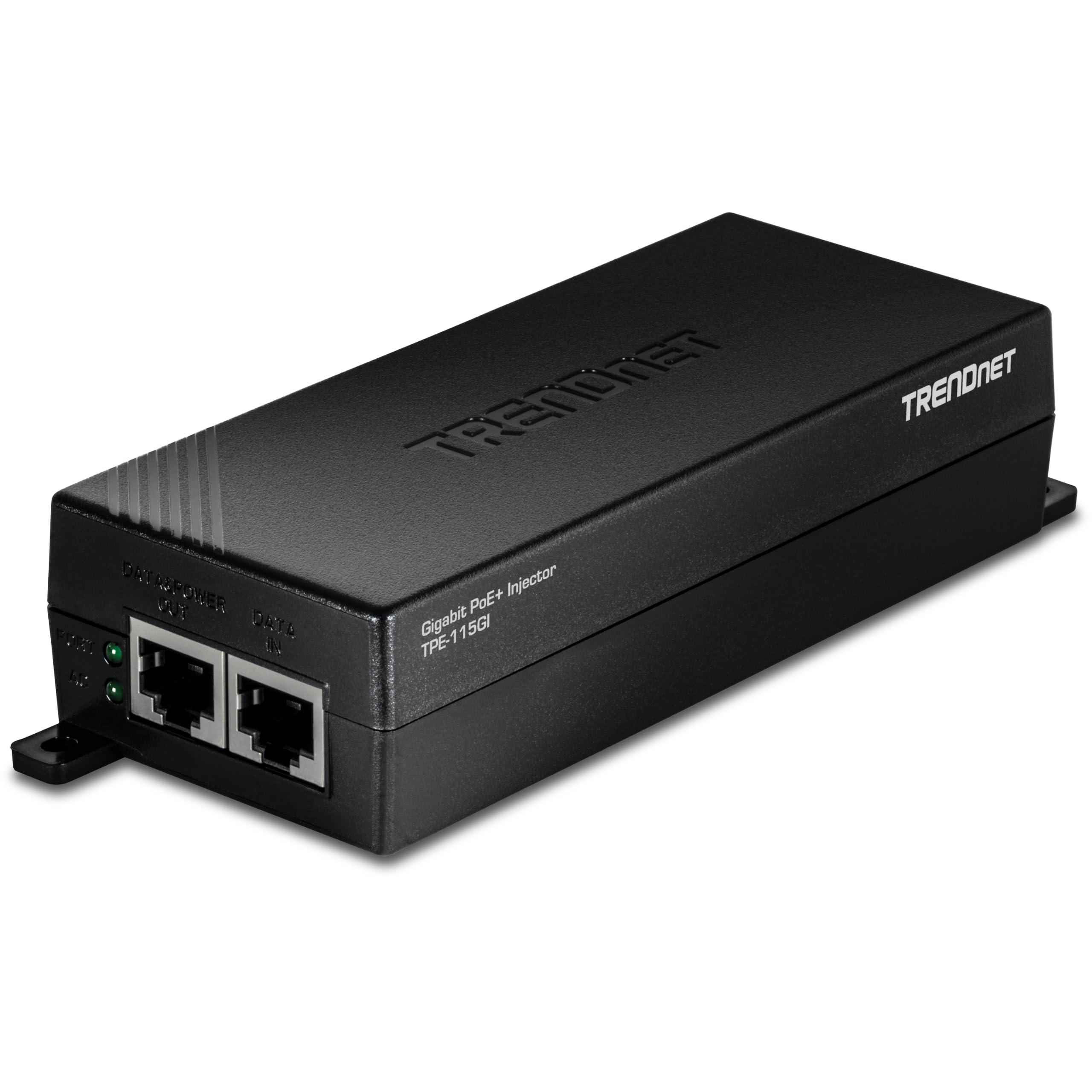
Features and Specifications
Type: Gigabit Power over Ethernet Plus (PoE+) injector
Power Output: 30W
Data Rate: Gigabit Ethernet
Maximum Cable Run: 100M (328 ft.)
Housing: Metal
Color: Black
Intended Use: Delivering power and data to a single PoE+ network device
These are the numbers that decide the purchase, and they are worth reading slowly. The 30W figure is the headline: standard PoE tops out at roughly half that, so this unit is aimed at devices that need the higher PoE+ budget — pan-tilt-zoom cameras, modern Wi-Fi access points, video doorbells with heaters or IR arrays. The Gigabit data rate means the injector will not become the bottleneck on a fast local network.
The 100-meter ceiling is the standard Ethernet limit, not a special weakness of this unit. It matters because it tells buyers the injector will not extend a run beyond what copper cable can carry anyway; a device 150 meters away needs fiber or a mid-span repeater, not a different injector.
Build and Housing
The metal housing is the detail that separates this from the cheapest injectors on the market. A metal case handles heat better than plastic and survives being screwed to a wall, dropped behind a desk, or tucked into a wiring closet where it will sit untouched for years. The black finish is unremarkable, which is the point — this is a device meant to disappear.
The trade-off in a compact single-port body is that there is no room for a display, a management interface, or status reporting beyond the usual link lights. Buyers who want to log into the injector and check power draw, set a schedule, or reboot the port remotely are looking at the wrong class of product. This injector passes power and data; it does not manage them.
Power and the 30W Budget
PoE+ at 30W covers most of what a small installation needs. A single ceiling access point, an outdoor bullet camera, or a video intercom all sit comfortably inside that envelope. The injector sits inline between the network switch or router and the device, so the existing non-PoE switch keeps doing its job and the injector adds the power.
The caution is arithmetic. The 30W rating is the injector’s output ceiling, and a device that draws close to that figure leaves nothing spare — there is no second port and no headroom to share. Buyers planning a second camera later should not buy two of these and stack them; at that point a small PoE+ switch is cheaper, tidier, and easier to manage. One device is the honest use case.
Installation and Maintenance
Installation is about as simple as networking gets: one cable from the switch into the injector’s data port, one cable from the injector to the device, and power into the injector. No configuration, no software, no IP address. The 100-meter run means the injector can sit at the switch end and still reach a device at the far end of a normal building.
Maintenance is close to zero, which is the appeal. There is no fan to clog, no firmware to update, and no settings to forget. The flip side is that when a device stops responding, the injector gives no diagnostic beyond its link lights — troubleshooting means swapping cables and testing the device directly, not reading a status page.
Trade-off: The single-port, unmanaged design keeps the price and complexity low, but it cannot power a second device, report on power draw, or be controlled remotely — buyers who need any of that should budget for a PoE+ switch instead.
Who Should Buy It
The strongest fit is a homeowner or small-office admin adding one PoE+ device to a network that already works. A ceiling-mounted access point in a hallway, a camera over a back door, an intercom at a gate — each of those is one device, one cable, one injector, and the job is done without touching the existing switch.
It also suits installers who need to power a single device at the end of a long run where running mains power would mean an electrician. The injector turns one Ethernet cable into both data and power, which is exactly the problem PoE was invented to solve.
Who Should Skip It
Buyers with two or more PoE devices should skip this and buy a PoE+ switch; the per-port cost drops fast and management becomes possible. Buyers who need to monitor or remotely cycle power to a device should also skip it, because this injector has no management interface at all.
Finally, anyone whose device needs more than 30W — a large PTZ camera with a heater, for example — should check the device’s power requirement first. This injector will not exceed its rated output, and an underpowered device will behave erratically rather than fail cleanly.
FAQ
-
What does the TRENDnet TPE-115GI actually do?
It sits between a non-PoE network switch and a single PoE+ device, injecting power into the Ethernet cable so the device needs no separate power adapter. Data still passes through at Gigabit speed. -
How much power does the TPE-115GI deliver?
30W, which is the PoE+ level. That covers most access points, cameras, and intercoms, but it will not power devices that require more than 30W. -
How far can the cable run be with this injector?
Up to 100 meters (328 ft.), the standard Ethernet limit. The injector does not extend a run beyond what copper cable supports. -
Does it work with a regular non-PoE switch?
Yes. That is the point of an injector — the existing switch supplies data, and the injector adds power inline. No PoE switch is required. -
Is the TPE-115GI Gigabit or Fast Ethernet?
Gigabit. The injector will not slow a Gigabit network down to 100 Mbps, which cheaper Fast Ethernet injectors do. -
Can it power more than one device?
No. It has a single output port. Buyers with two or more PoE devices should look at a PoE+ switch rather than multiple injectors. -
Does it need configuration or software?
No. It is unmanaged and plug-and-play — cable in, cable out, power on. There is no IP address, web interface, or firmware to deal with. -
Is the metal housing important?
It helps with heat and durability. A metal case survives a wiring closet or a wall mount better than plastic and dissipates heat from the injector’s electronics more effectively. -
What happens if the device needs more than 30W?
The injector cannot supply more than its rating, so an oversized device may malfunction or fail to start. Check the device’s power requirement before buying. -
Is this a good choice for a home security camera?
For a single camera that runs on PoE+, yes. For a multi-camera system, a PoE+ switch is the better and usually cheaper route.
Bottom Line
The TRENDnet TPE-115GI is the right answer for one specific job: getting 30W of power and Gigabit data to a single device over a standard Ethernet run, with no configuration and no fuss. The metal housing and PoE+ budget put it a step above bargain injectors, and the simplicity is a feature rather than a limitation for that use case.
Buyers with one power-hungry device and an existing non-PoE switch should check the price and move on with their install. Buyers with two devices, a need for remote management, or a device above 30W should put the money toward a PoE+ switch instead — the injector is excellent at exactly one thing, and it does not pretend otherwise.
