Why there are Amazon links here: Brave Review is paid a commission for qualifying Amazon purchases made through the links below. Your price does not change, and using our links is entirely optional. How this works
Vine Thermostat vs Meross Smart Thermostat: Which Wiring Setup Fits Your Home
The vine thermostat vs meross smart thermostat decision usually comes down to wiring, not software. The vine unit is a conventional 24V thermostat that requires a C-wire and targets forced-air heating and cooling systems. The meross model is a line-voltage thermostat built for electric baseboard heaters and works with 120–240V circuits. The short answer: forced-air homes go vine, baseboard homes go meross. The rest of this comparison explains why that split holds and where each unit asks for a compromise.
Vine Smart Thermostat for House

Type: Conventional low-voltage thermostat
Compatibility: Alexa and Google Assistant
Programming: 7-day, 8 periods per day
Certification: Energy Star
Wiring: C-wire required
Connectivity: WiFi
The vine unit is the more conventional of the two. It speaks the standard low-voltage language of a furnace and air handler, so it slots into the same four-to-five wire setup most US forced-air homes already have at the wall plate. The 7-day by 8-period schedule is generous for the price tier — four setpoints per day across a full week covers a work schedule, a weekend schedule and everything between without forcing one routine onto the whole household.
Voice control through Alexa and Google Assistant is the headline convenience here, and Energy Star certification gives the efficiency claim some backing rather than leaving it as marketing copy. The C-wire requirement is the one thing to check before ordering: homes without a spare constant-power wire will need an adapter or a professional pull, and that erases the savings fast.
Trade-off: The C-wire requirement rules out older two-wire installations without extra work, so the low sticker price can climb once an adapter or an electrician enters the picture.
Check the current price on Amazon
Meross WiFi Programmable Thermostat
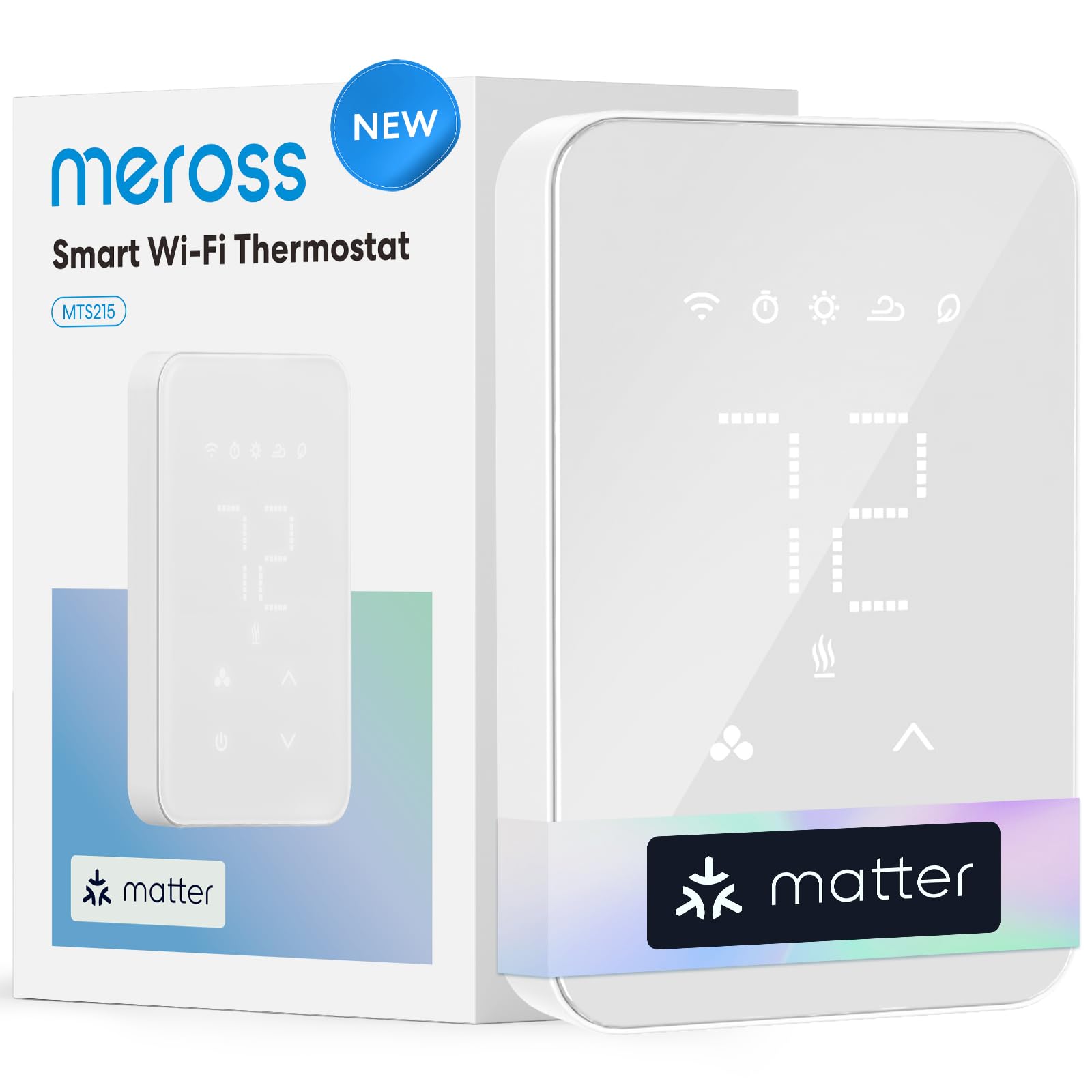
Type: Line-voltage thermostat
Voltage: 120–240V
Compatibility: HomeKit, Alexa, Google Home, SmartThings
Protocol: Matter
Intended use: Electric baseboard heaters
Connectivity: WiFi with remote control
The meross unit occupies a different lane entirely. It is a line-voltage thermostat, which means it switches the mains power feeding an electric baseboard heater directly rather than sending a low-voltage signal to a furnace board. That makes it the correct choice for apartments, additions and older homes heated room by room with baseboard units — a segment most mainstream smart thermostats simply ignore.
Platform support is the standout feature. HomeKit, Alexa, Google Home and SmartThings coverage in one device is unusually broad at this price, and Matter support means it should keep working with future hubs rather than aging out of an ecosystem. Remote control through the app allows preheating a room before arrival, which matters more for baseboard heat than for central systems because baseboard units warm slowly.
Trade-off: Baseboard heating is inherently zone-by-zone, so a single meross unit only controls the heater it is wired to — covering a whole home means buying one per room, and the cost multiplies quickly.
Check the current price on Amazon
Vine vs Meross: Side-by-Side Comparison
| Feature | Vine Smart Thermostat | Meross Smart Thermostat |
|---|---|---|
| Thermostat type | Conventional low-voltage | Line-voltage |
| System fit | Forced-air heating and cooling | Electric baseboard heaters |
| Voltage | Low voltage (C-wire required) | 120–240V |
| Voice assistants | Alexa, Google Assistant | HomeKit, Alexa, Google Home, SmartThings |
| Protocol | WiFi | WiFi with Matter |
| Programming | 7-day, 8 periods per day | Programmable schedule |
| Certification | Energy Star | Energy saving design |
| Price tier | Budget | Mid-range |
The Differences That Decide It
Wiring is the first and biggest divider. The vine thermostat needs a C-wire and expects a furnace or air handler on the other end of the circuit. The meross thermostat expects mains voltage and a resistive baseboard heater. These are not interchangeable — putting a line-voltage unit on a low-voltage circuit, or the reverse, is a safety problem, not a preference. Buyers should confirm what is behind the wall plate before anything else.
System coverage favors vine. A conventional thermostat can run both heating and cooling from one device, so a home with central air gets one control point for the whole year. The meross unit is a heating-only proposition for baseboard setups, and cooling in those homes typically comes from window units or a separate system it cannot touch.
Platform breadth favors meross. HomeKit support is the differentiator. Apple households that want thermostat control inside the Home app have very few budget options, and the meross unit covers HomeKit, Alexa, Google Home and SmartThings simultaneously. The vine unit covers the two most popular voice assistants but stops short of Apple’s ecosystem.
Efficiency credentials favor vine on paper. Energy Star certification is a defined program with testing behind it, while the meross listing leans on a general energy-saving claim. For buyers who weigh rebates and formal certification, the vine unit is the easier case to make to a utility or a landlord.
Scheduling depth favors vine slightly. Eight programmable periods per day is finer-grained than most households need, but it suits shift workers and homes with variable routines. The meross unit offers programmable scheduling without that level of granularity, which is adequate for a single room heated on a predictable pattern.
Scalability favors meross by necessity. A single meross thermostat covers a single baseboard heater, so a whole-home installation means several units and a higher total outlay. The vine thermostat covers an entire forced-air system from one device, which makes it the cheaper path per square foot — provided the wiring is already there.
Remote access is roughly even. Both units offer app-based control over WiFi, and both support voice commands through their respective assistants. Neither has a meaningful edge on responsiveness or app polish that would swing the decision on its own.
Which Should You Buy?
Choose the vine thermostat if: the home has a forced-air furnace or air handler with a C-wire available at the wall plate, central cooling needs to run from the same device, and the budget is the priority. It is also the better pick for buyers who want formal Energy Star certification and a schedule detailed enough for irregular routines.
Choose the meross thermostat if: the home is heated by electric baseboard units on a 120–240V circuit, Apple HomeKit control matters, or the household runs a mix of Alexa, Google and SmartThings devices and wants one thermostat that speaks to all of them. Matter support adds future-proofing that the vine unit does not advertise.
Neither is right if: the wall plate has two wires and no C-wire and the buyer has no intention of adding an adapter — in that case the vine unit needs extra work before it will run. Likewise, the meross unit is the wrong purchase for anyone with a gas furnace, because line-voltage thermostats are not built for that circuit.
FAQ
-
Can the vine thermostat work without a C-wire?
No. The product name states a C-wire requirement outright. Homes lacking a constant-power wire need an adapter or a new wire run before installation. -
Will the meross thermostat work with a gas furnace?
No. It is a line-voltage thermostat rated for 120–240V and intended for electric baseboard heaters, not low-voltage furnace control. -
Which one works with Apple HomeKit?
The meross unit lists HomeKit support alongside Alexa, Google Home and SmartThings. The vine unit covers Alexa and Google Assistant only. -
Does either thermostat support Matter?
The meross thermostat lists Matter support, which helps it stay compatible with future smart home hubs. The vine listing does not mention Matter. -
Can one meross thermostat control multiple baseboard heaters?
Only the heater wired to that thermostat. Baseboard systems are zoned room by room, so whole-home coverage requires one unit per heater circuit. -
Which is better for a home with central air conditioning?
The vine thermostat, because it handles both heating and cooling from a single low-voltage connection. The meross unit is heating-only for baseboard systems. -
Is the vine thermostat Energy Star certified?
Yes. Energy Star certification is stated in the product name, which gives it a formal efficiency credential the meross listing does not claim.
Bottom Line
For most buyers with a standard forced-air home and a C-wire at the wall, the vine Smart Thermostat for House is the simpler, cheaper, more broadly capable pick — one device covering heat and cooling with certified efficiency and a deep schedule. The meross thermostat wins its own category outright: for electric baseboard heat, HomeKit households and multi-platform setups, it is the only sensible option of the two, and it does that job well. Confirm the wiring first, then buy accordingly.