Why there are Amazon links here: Brave Review is paid a commission for qualifying Amazon purchases made through the links below. Your price does not change, and using our links is entirely optional. How this works
WAVLINK BE5100 Outdoor WiFi 7 Extender: Whole-Yard Coverage That Survives the Weather
The WAVLINK BE5100 is a single product built for one clear job: pushing a fast WiFi 7 network past the walls of a house and into the yard, garage, shed, or second building. It suits homeowners who already run a WiFi 7 or recent router and are tired of dead zones at the back fence or in a detached workshop. This review covers what the hardware is, what the specs mean in practice, who it fits, and where the compromises land.
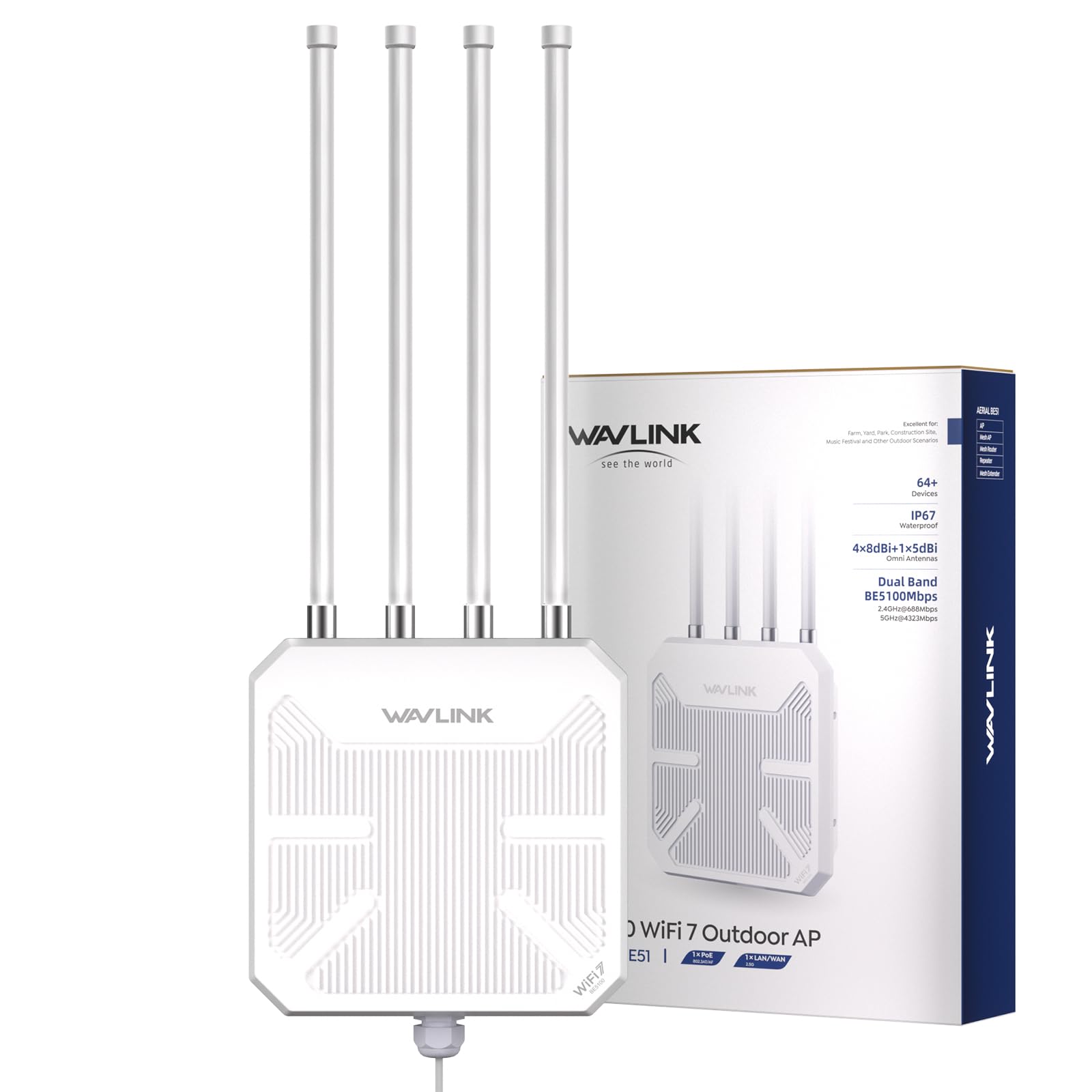
Check the current price on Amazon
Features and Specifications
- Product Type: Dual-band WiFi repeater, access point, and mesh router in one unit
- Wireless Standard: WiFi 7, BE5100 class
- Antennas: 4 × 8dBi high-gain
- Coverage Rating: Up to 2800 sq.ft
- Wired Port: 2.5 Gbps Ethernet
- Power Method: PoE (Power over Ethernet)
- Weather Rating: IP67 waterproof
- Mounting: Outdoor
The headline here is that this is not a plain repeater. WAVLINK ships it as a three-mode device — repeater, access point, and mesh node — which means the same box can slot into several different network layouts. The four 8dBi antennas and the WiFi 7 radio are what do the heavy lifting on range and throughput.
The IP67 rating and PoE power are the two details that matter most for outdoor work. IP67 means the housing is sealed against dust and survives temporary immersion, so rain, hose spray, and dust are not the failure points they would be on an indoor extender left on a patio shelf. PoE means one Ethernet cable carries both data and power, so there is no separate power brick to house outdoors or protect from moisture.
Build and Weatherproofing
The IP67 enclosure is the reason this unit can live outside permanently rather than being brought in after every storm. That rating covers dust ingress and short water immersion, which is well beyond the splash-and-rain exposure a backyard unit normally faces. For a buyer mounting on a fence post, eave, or pole, the sealed housing removes the biggest recurring worry with outdoor networking gear.
The four external 8dBi antennas are high-gain, which is how the unit reaches its stated coverage. High-gain antennas focus signal in a direction rather than spraying it evenly, so placement and aim affect real-world results more than the raw coverage number suggests. A buyer should expect to spend some time finding the right mounting angle.
Trade-off: The high-gain antennas and sealed housing make this a bulky, conspicuous unit, and the claimed 2800 sq.ft coverage assumes a clean line of sight — walls, trees, and metal siding will cut into it.
Coverage and Capacity
The 2800 sq.ft coverage figure is the number most buyers will scan for first. It is a best-case rating that assumes open outdoor space and a strong link back to the main router, so a buyer should treat it as a ceiling rather than a guarantee. In a yard with outbuildings or heavy foliage, expect meaningful range before the signal drops off.
The BE5100 class puts this in WiFi 7 territory, which matters only if the main router is also WiFi 7 or close to it. Paired with an older router, the extender will still work but will be capped by whatever the source can deliver. Buyers upgrading from an old WiFi 5 repeater will notice the difference mainly in congestion handling and throughput at distance.
Power and Wired Backhaul
PoE is the standout feature for anyone who has run outdoor cable before. A single Ethernet run from a PoE switch or injector powers the unit and carries data, which eliminates the need for an outdoor-rated power outlet near the mounting point. That is a genuine installation advantage over extenders that need a nearby socket.
The 2.5 Gbps Ethernet port is the other half of that story. It gives the unit a wired backhaul path fast enough not to bottleneck a WiFi 7 radio, and it can feed a wired device such as a camera or access point downstream. Buyers without a PoE source will need to add an injector, which is an extra cost and an extra part to source.
Trade-off: PoE is a strength only for buyers who already have a PoE switch or are willing to buy an injector — anyone expecting a simple wall-plug setup will find the install more involved than a basic indoor repeater.
Setup and Maintenance
The three operating modes give the unit flexibility, but they also mean setup starts with a decision: repeater, access point, or mesh node. Repeater mode is the simplest path for extending an existing network wirelessly; access point mode is the better choice when a wired run is available; mesh mode is for buyers building a coordinated multi-node system. Getting the mode right up front saves rework later.
Maintenance is minimal by design. The sealed IP67 housing needs no seasonal protection, and there are no moving parts to service. The realistic upkeep is occasional cleaning of the antenna housings and a check that the Ethernet connection and PoE injector are still dry and secure.
Trade-off: The multi-mode design adds setup steps and documentation reading that a single-purpose repeater avoids, and buyers who just want plug-and-play may find the configuration more hands-on than expected.
Who It Suits and Who It Does Not
This unit fits homeowners with a WiFi 7 or recent-generation router who need reliable coverage in a yard, detached garage, workshop, or outbuilding and who can run or already have Ethernet with PoE. It also suits buyers who want one box that can serve as an access point now and a mesh node later as the network grows.
It does not suit renters who cannot mount hardware outdoors, buyers without any PoE source and no appetite for adding one, or anyone whose main router is old enough that WiFi 7 gains would go unused. Buyers wanting a simple indoor plug-in extender should look elsewhere.
| Product | Key Spec | Best Use | Price Tier |
|---|---|---|---|
| WAVLINK BE5100 Outdoor WiFi 7 Extender | WiFi 7, IP67, PoE, 2.5 Gbps Ethernet | Yard, garage, and outbuilding coverage | Premium |
FAQ
-
What is the WAVLINK BE5100?
It is an outdoor WiFi 7 extender that works as a repeater, access point, or mesh router, with four high-gain antennas, a 2.5 Gbps Ethernet port, PoE power, and an IP67 waterproof housing. -
Does the WAVLINK BE5100 need a power outlet outside?
No. It runs on PoE, so a single Ethernet cable from a PoE switch or injector supplies both power and data. Buyers without a PoE source need to add an injector. -
Is the WAVLINK BE5100 actually waterproof?
It carries an IP67 rating, which covers dust ingress and temporary immersion. That is more than enough for permanent outdoor mounting in rain and dust. -
How much area does the WAVLINK BE5100 cover?
WAVLINK rates it at up to 2800 sq.ft. That figure assumes favorable conditions, so real coverage in a yard with walls, trees, or metal structures will be smaller. -
Does the WAVLINK BE5100 work with an older router?
It will connect and extend an older network, but the WiFi 7 radio only pays off when paired with a WiFi 7 or recent-generation router. -
Can the WAVLINK BE5100 be used indoors?
Yes, though its IP67 housing and PoE design are aimed at outdoor placement. Indoor use is fine but wastes the weatherproofing. -
What is the 2.5 Gbps Ethernet port for?
It provides a fast wired backhaul to the main network and can feed a downstream wired device such as a camera, avoiding a wireless bottleneck. -
How many antennas does the WAVLINK BE5100 have?
Four 8dBi high-gain antennas, which is how the unit reaches its stated outdoor coverage. -
Is the WAVLINK BE5100 hard to set up?
Setup is more involved than a basic repeater because the buyer must choose between repeater, access point, and mesh modes. Reading the documentation first saves time. -
Who should not buy the WAVLINK BE5100?
Renters who cannot mount outdoor hardware, buyers with no PoE source and no plan to add one, and anyone with an older router that cannot use WiFi 7.
Bottom Line
The WAVLINK BE5100 is a specialist tool for a specific problem: getting fast WiFi 7 coverage into outdoor and outbuilding spaces without running power to the mounting point. The IP67 housing, PoE power, and 2.5 Gbps port are the right features in the right places, and the three-mode design gives it room to grow with a network. Buyers who fit that profile and can supply PoE will find it a clean solution; buyers wanting a simple indoor plug-in extender should keep shopping.
