Why there are Amazon links here: Brave Review is paid a commission for qualifying Amazon purchases made through the links below. Your price does not change, and using our links is entirely optional. How this works
Jackery Explorer 500 v2 vs EGO Power Pad5000: Plug-In Power or Standalone Backup
The Jackery Explorer 500 v2 and the EGO Power Pad5000 look like the same kind of product from a distance, but they solve different problems. The Jackery is a self-contained solar generator with its own battery inside. The EGO Power+ Portable Inverter is a shell — it turns EGO batteries the buyer already owns into household AC power, and it ships with neither battery nor charger.
That single difference decides most of this comparison. Readers who want one box that works on day one lean toward the Jackery. Readers already invested in the EGO 56V platform get a far cheaper entry into backup power with the Power Pad5000. The sections below break down capacity, output, cost of ownership and use case so the choice takes under a minute.
Jackery Explorer 500 v2 vs EGO Power Pad5000 at a Glance
| Product | Key Spec | Best Use | Price Tier |
|---|---|---|---|
| Jackery Explorer 500 v2 | 512Wh LiFePO4, 500W AC (1000W peak) | Standalone camping and outage backup | Mid-range |
| EGO Power Pad5000 | 400W inverter, battery not included | Cheap AC power for EGO battery owners | Budget |
The table shows the split clearly. The Jackery carries its own energy storage; the EGO carries none. One is a complete system, the other is an accessory to a system the buyer may already have.
Jackery Explorer 500 v2: The Standalone Solar Generator
Jackery Explorer 500 v2
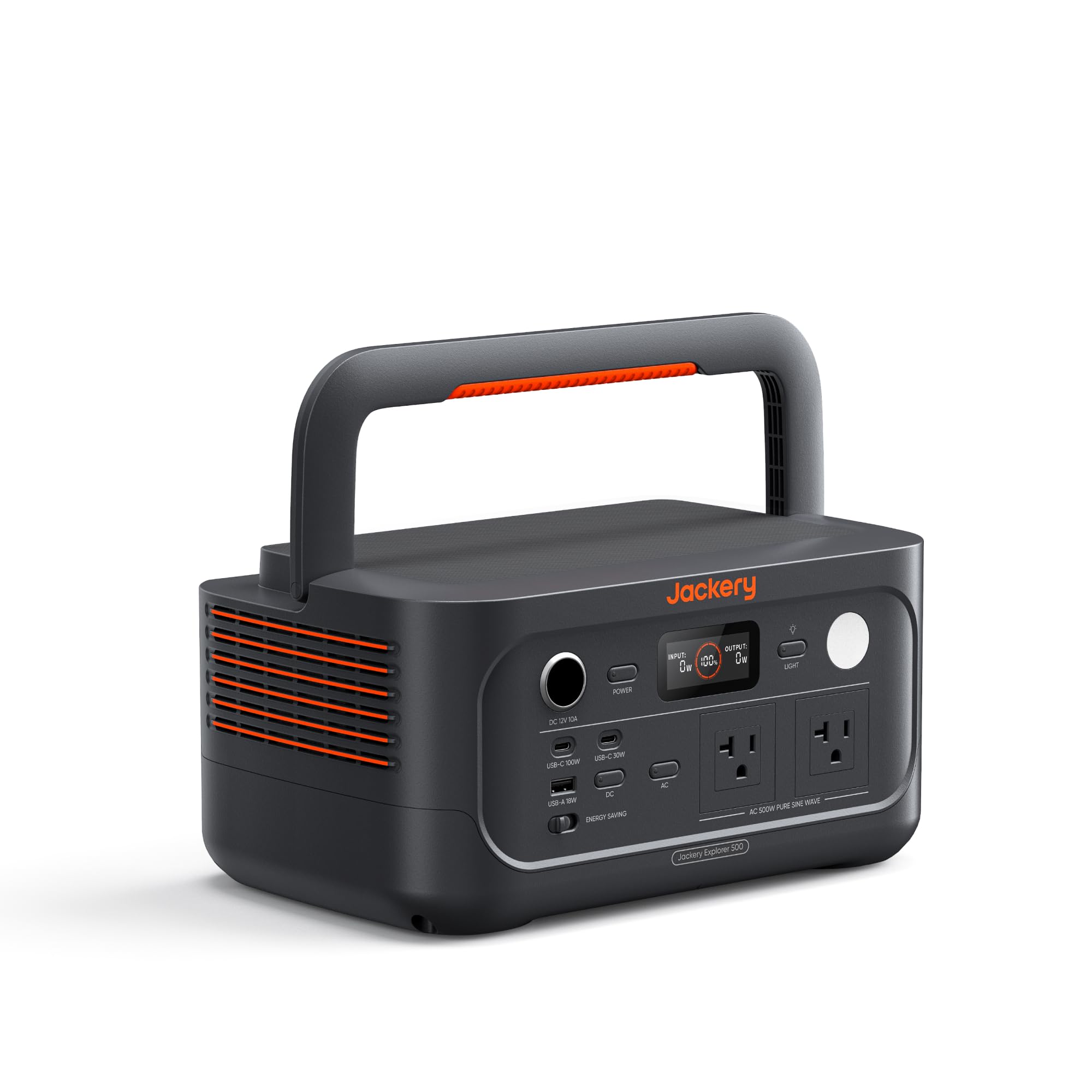
Battery Chemistry: LiFePO4
Capacity: 512Wh
AC Output: 500W continuous, 1000W peak
Intended Use: Camping, outdoors, power outages
Power Source: Internal battery, solar rechargeable
Type: Portable power station
The Explorer 500 v2 is a complete power station. Its 512Wh LiFePO4 battery is built in, and the 500W AC inverter with a 1000W peak handles small appliances, laptops, lights, fans and phones without any add-on purchase. LiFePO4 chemistry is the durable side of the lithium family, and it is the reason this unit sits in the mid-range price tier rather than the bargain bin.
The 1000W peak rating matters more than the continuous number for real-world use. Motors and compressors draw a surge at startup, so a small fridge or a power tool can kick on briefly above the 500W continuous ceiling. Buyers planning to run a CPAP machine overnight, charge a camera kit at a campsite or keep a router and phone bank alive through an outage get a self-sufficient box with nothing else to buy.
The honest limit is capacity. 512Wh is a modest reserve — enough for small electronics and short appliance runs, not enough to carry a household through a multi-day outage. Buyers who need to run a full-size fridge for days are looking at the wrong class of product entirely.
Trade-off: The self-contained design costs more upfront than a battery-less inverter, and 512Wh runs out quickly under heavy loads.
Check the current price on Amazon
EGO Power Pad5000: The Battery-Less Inverter
EGO Power+ Portable Inverter PAD5000

Output: 400W
Type: Portable inverter
Power Source: EGO 56V battery (not included)
Battery and Charger: Not included
Noise: Quiet operation
Intended Use: Portable AC power from EGO batteries
The Power Pad5000 is a pure inverter: it takes an EGO battery, converts the DC stored in it to household AC, and delivers 400W to whatever is plugged in. There is no internal battery, no solar input and no charging circuitry for the pack itself. The buyer supplies the energy.
That design is the entire appeal. Anyone already running EGO outdoor power equipment — mowers, trimmers, blowers — owns batteries and a charger. The Power Pad5000 turns that existing investment into a backup power source at the lowest possible entry price. It is also genuinely quiet, since there is no engine and no cooling fan working against a large internal pack.
The catch is that the rated output and runtime both depend on what the buyer brings. A single small pack delivers far less usable energy than the Jackery’s 512Wh, and the 400W ceiling is lower than the Jackery’s continuous rating, so a few appliances that would run on the Explorer will trip or refuse to start here. Buyers with no EGO batteries face buying packs and a charger on top of the inverter, which erases the price advantage fast.
Trade-off: Without an existing EGO battery collection, this is an incomplete product, and 400W limits it to light loads.
Check the current price on Amazon
The Differences That Matter
The side-by-side table above carries the numbers; the paragraphs here read out what they mean.
Energy storage. The Jackery ships with 512Wh of LiFePO4 capacity built in. The EGO ships with none. This is not a minor spec difference — it changes what the product is. The Jackery is a power station; the EGO is a power adapter. Buyers who want to unbox something and plug a lamp into it on the same afternoon have exactly one option here.
Output ceiling. The Jackery’s 500W continuous and 1000W peak beats the EGO’s 400W flat rating. For phones, laptops, lights, fans and a small television, both are fine. For anything with a startup surge — a mini fridge, a sump pump, a power tool — the Jackery’s headroom is the difference between a device that runs and one that does not.
Cost of ownership. The EGO wins on sticker price by a wide margin, but that comparison only holds for buyers who already own EGO 56V batteries and a charger. Add a couple of packs and a charger to the EGO and the total climbs past the Jackery, which arrives complete. The Jackery’s price tier is higher because the battery is inside the box.
Recharge flexibility. The Jackery is built for solar recharging, which suits camping and off-grid use where wall power is unavailable. The EGO recharges only by swapping or refilling EGO packs from a wall charger, so its uptime is tied to how many charged batteries the buyer has on hand. For a weekend campsite, that is workable; for a multi-day outage, it is a constraint.
Portability and noise. Both are compact and quiet compared with a gas generator. The EGO has the edge on weight and simplicity because it carries no battery, and its quiet operation is a genuine selling point for campsites and shared spaces. The Jackery is heavier but needs no separate packs to function.
Who each one is not for. The Jackery is not for buyers who want the absolute lowest spend and already own EGO batteries — they would be paying for capacity they do not need to duplicate. The EGO is not for anyone without EGO packs, anyone who needs to run a surge-heavy appliance, or anyone who wants a device that works straight out of the box without a shopping trip first.
Which Should You Buy?
Choose the Jackery Explorer 500 v2 if: the priority is a single, complete unit that works immediately, solar recharging matters for camping or off-grid trips, and the loads include anything with a startup surge. It is the safer pick for power outages because there is nothing else to buy or remember to charge.
Choose the EGO Power Pad5000 if: EGO 56V batteries and a charger are already in the garage, the loads are light — phones, laptops, lights, a fan — and the goal is the cheapest possible route to portable AC power. It is a smart accessory for an existing platform, not a standalone purchase.
Buyers who are unsure should count their existing batteries first. Zero EGO packs points to the Jackery. Three or four charged packs and light loads point to the Power Pad5000.
FAQ
-
Does the EGO Power Pad5000 come with a battery?
No. The product name states clearly that the battery and charger are not included. Buyers need at least one EGO 56V pack and a charger before the inverter can do anything. -
Can the Jackery Explorer 500 v2 run a refrigerator?
It can handle brief surges up to its 1000W peak, which may start a small fridge, but 512Wh of capacity will not keep one running for long. It suits short appliance runs, not days of refrigeration. -
Which one is better for camping?
The Jackery, for most campers. It is self-contained and designed for solar recharging, so it does not depend on a stock of pre-charged packs. The EGO works at a campsite only if enough charged batteries come along. -
Is the EGO Power Pad5000 quieter than the Jackery?
Both are quiet because neither uses a gas engine. The EGO carries no internal battery, so it has less mass and no large pack to manage thermally, which keeps it simple and silent in use. -
Can the Jackery be charged from the wall and from solar?
Yes. It is built as a solar generator for camping and outages, so it accepts solar input as well as standard charging. That flexibility is a core part of its design. -
What happens if a device draws more than 400W from the EGO inverter?
The inverter is rated at 400W, so devices above that ceiling are outside its capability and may not run or start. Buyers with heavier appliances need a higher-output unit. -
Which is the better value?
It depends entirely on existing gear. For an EGO owner with charged packs, the Power Pad5000 is the cheaper path to backup power. For everyone else, the Jackery’s included battery makes it the better value despite the higher price.
Bottom Line
The Jackery Explorer 500 v2 is the better pick for most buyers because it is a complete, self-contained power station with a built-in LiFePO4 battery, higher output and solar recharging — no extra purchases, no dependency on a battery collection. The EGO Power Pad5000 is the smarter buy only for households already deep in the EGO 56V platform with light power needs. Start with the Jackery Explorer 500 v2 unless the garage is already full of EGO batteries.
