Why there are Amazon links here: Brave Review is paid a commission for qualifying Amazon purchases made through the links below. Your price does not change, and using our links is entirely optional. How this works
8 Best Smart Thermostats for a Large House – Zone Control That Actually Works
A large house defeats a thermostat that only reads the hallway. When a single sensor sits near a return vent, upstairs bedrooms and a finished basement drift far from the setpoint, and the system runs longer than it should trying to correct a temperature nobody is standing in. The best smart thermostat for a large house closes that gap with remote sensors, multi-stage HVAC support, and scheduling that treats rooms differently.
The top pick here is the ecobee Smart Thermostat Premium for its combination of a bundled smart sensor, built-in voice assistants, and air quality monitoring in one unit. The Google Nest Learning Thermostat (4th gen) bundle is the strongest alternative for households already living inside Google’s ecosystem.
Picks were judged on sensor support and how many remote sensors a system accepts, compatibility with multi-stage and heat-pump equipment, app and scheduling depth, ecosystem fit, and price tier relative to what each unit delivers. Eight models follow, ordered from most capable to simplest, with a comparison table up front and a buying guide at the end.
At a Glance
| Product | Key Spec | Best Use | Price Tier |
|---|---|---|---|
| ecobee Smart Thermostat Premium | Smart sensor included, Siri and Alexa built in | Whole-home coverage with voice control | Premium |
| Google Nest Learning Thermostat (4th gen) + Sensor | Learning schedule plus Nest Temperature Sensor | Google Home households | Premium |
| Honeywell Home RTH9585WF1004 | 7-day programmable color touchscreen | Straightforward room-by-room scheduling | Mid-range |
| Honeywell TH8321WF1001 Vision Pro 8000 | Up to 3 heat / 2 cool stages | Multi-stage and dual-fuel systems | Mid-range |
| ecobee Smart Thermostat Enhanced | Energy Star certified, programmable Wi-Fi | Sensor-ready coverage at lower cost | Mid-range |
| ecobee Smart Thermostat Essential | Energy Star certified, Siri/Alexa/Google | First smart thermostat in a big house | Budget |
| Sensi Smart Thermostat ST55 | DIY Wi-Fi, Energy Star certified | Simple installs and rentals | Budget |
| Amazon Smart Thermostat | Works with Alexa and Ring | Alexa-first homes on a tight budget | Budget |
Top 8 Best Smart Thermostats for a Large House Reviews
1. ecobee Smart Thermostat Premium

Type: Wi-Fi smart thermostat with bundled smart sensor
Voice Assistants: Siri and Alexa built in
Additional Function: Air quality monitoring
Ecosystem: Works with Alexa, Siri, and Google Home
Display: Touchscreen
The Premium sits at the top of the ecobee range and is the most complete single-box answer to a large floor plan. The bundled smart sensor is the key part: it can be placed in the room that runs hot or cold, and the thermostat averages or prioritizes that reading instead of trusting the hallway. Built-in Siri and Alexa mean voice control works without a separate speaker in the room.
In a big house, the practical benefit shows up in scheduling. Rooms that sit empty through the workday can be deprioritized, and the sensor can be moved seasonally — upstairs in summer, downstairs in winter — without buying anything else. The air quality readout is a bonus that matters more in tight, well-sealed new construction than in older drafty homes.
The trade-off is price and complexity. This is the most expensive pick on the list, and the full feature set only pays off if the household actually uses the sensors and the voice assistants.
Trade-off: The Premium costs more than most large-house owners need to spend if a simple schedule would solve the comfort problem.
2. Google Nest Learning Thermostat (4th gen) + Nest Temperature Sensor (2nd gen)

Type: Learning Wi-Fi thermostat with remote temperature sensor
Generation: 4th gen thermostat, 2nd gen sensor
Finish: Silver
Scheduling: Self-learning program
Ecosystem: Google Home
The Nest Learning Thermostat built its reputation on not needing a schedule at all. It watches adjustments for the first week and builds its own program, which suits a large household where manual programming never gets finished. The bundled second-generation temperature sensor extends that logic to a room the thermostat itself cannot feel.
For a large house, the sensor is the reason to buy the bundle rather than the thermostat alone. Placing it in a bedroom wing or a sunroom lets the system balance that zone against the main living area. The silver finish and rotating dial remain the most furniture-like design in this group, which matters in a visible hallway.
The catch is ecosystem lock-in. The learning behavior and sensor routines live inside the Google Home app, so an Apple or Alexa-first household gives up most of the convenience.
Trade-off: Buyers outside Google’s ecosystem lose the best features, and the learning curve takes a week before the schedule settles.
3. Honeywell Home RTH9585WF1004 Wi-Fi Smart Color Thermostat

Type: Wi-Fi programmable thermostat
Programming: 7-day, full week customization
Display: Color touchscreen
Certification: Energy Star
Voice: Alexa ready
Color: Gray
This Honeywell is the traditionalist’s smart thermostat. The 7-day programming gives every day of the week its own schedule, which is more granular than the weekday/weekend split many budget models offer. A large house with a variable routine — kids’ activities, shift work, weekend guests — can encode that pattern directly rather than fighting an auto-schedule.
The color touchscreen is bright and readable from across a hallway, and the interface keeps setpoint and schedule controls on the surface rather than buried in menus. Alexa readiness adds voice setpoint changes for households that already own an Echo.
The limitation is reach. There is no bundled remote sensor, so a single thermostat still reads one location. Buyers with a badly imbalanced second floor should plan on adding sensors or accept that the far rooms will drift.
Trade-off: Without a remote sensor in the box, this unit solves scheduling better than it solves room-to-room temperature imbalance.
4. Honeywell TH8321WF1001 Touchscreen Thermostat Wifi Vision Pro 8000

Type: Wi-Fi touchscreen thermostat
Staging: Up to 3 heat / 2 cool stages
Display: Touchscreen
Series: Vision Pro 8000
Connectivity: Wi-Fi
The Vision Pro 8000 is the pick for houses with serious mechanical equipment. Support for up to three heating stages and two cooling stages covers multi-stage furnaces, two-stage heat pumps, and dual-fuel setups that a basic thermostat simply cannot drive properly. In a large house, that staging is what keeps a big system from blasting at full output for short cycles.
This is a contractor-grade unit, and it behaves like one. The touchscreen interface is dense with installer settings, and the Wi-Fi app handles scheduling and remote adjustment without dressing it up. Households with zoned dampers or a variable-speed air handler will find the configuration depth useful rather than intimidating.
The downside is that the depth cuts both ways. Setup is not a fifteen-minute swap for a novice, and the interface assumes some familiarity with HVAC terminology.
Trade-off: The installer-level menus make this a poor fit for buyers who want a plug-and-play app experience.
5. ecobee Smart Thermostat Enhanced

Type: Programmable Wi-Fi smart thermostat
Certification: Energy Star
Voice: Works with Siri, Alexa, and Google Assistant
Scheduling: Programmable
Category: Smart home
The Enhanced is the sensible middle of the ecobee lineup. It keeps the sensor-ready platform that makes ecobee a strong fit for large homes — additional smart sensors can be added to cover bedrooms, offices, and basement space — while dropping the built-in speakers and air quality hardware that push the Premium’s price up.
For a household that already owns smart speakers, that trade makes sense. Voice control arrives through the existing Alexa, Siri, or Google device, and the thermostat concentrates its budget on sensing and scheduling. Energy Star certification is a reasonable baseline signal for efficiency-minded buyers.
The compromise is that the sensor-ready design only pays off if sensors are actually purchased. Out of the box, this is a single-location thermostat competing with cheaper units that do the same job.
Trade-off: The value depends on buying extra sensors later, so the sticker price understates the real cost of full-house coverage.
6. ecobee Smart Thermostat Essential

Type: Programmable Wi-Fi thermostat
Certification: Energy Star
Voice: Works with Siri, Alexa, and Google Assistant
Scheduling: Programmable
Category: Energy saving thermostat
The Essential is the entry point into the ecobee ecosystem and the best budget route to a sensor-capable platform. It carries the same triple-assistant compatibility as its siblings, so the household’s choice of Siri, Alexa, or Google does not lock anyone out. Energy Star certification keeps efficiency credentials intact at the low end.
In a large house, the appeal is upgrade headroom. A buyer can start with one thermostat, confirm the app and scheduling work for the household, then add sensors to the problem rooms instead of replacing the whole unit. That staged approach spreads cost across seasons.
The obvious sacrifice is features. There is no bundled sensor, no built-in voice, and the hardware feel is a step below the Enhanced and Premium. Buyers expecting premium materials at this price will be disappointed.
Trade-off: The Essential is a platform purchase, not a complete solution — it needs add-on sensors before it genuinely handles a big floor plan.
7. Sensi Smart Thermostat ST55
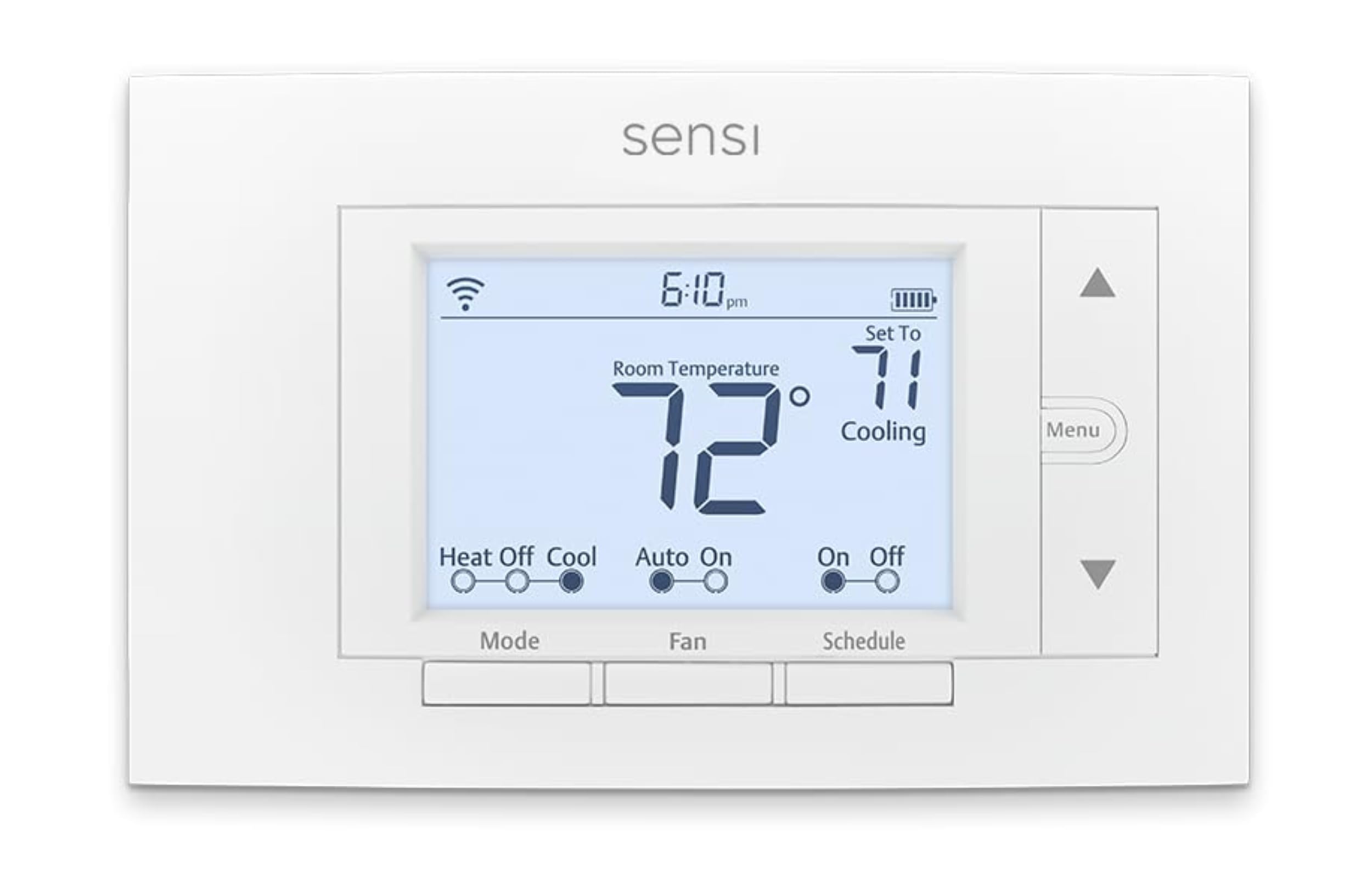
Type: DIY Wi-Fi smart thermostat
Certification: Energy Star
Voice: Alexa
Installation: DIY
Model: ST55
The Sensi ST55 is built for the buyer who wants smart control without a contractor visit. The DIY positioning is backed by a straightforward wiring setup and an app-guided install, which makes it a realistic weekend project in a house where the old thermostat is a simple single-stage unit. Energy Star certification and Alexa support cover the essentials.
For large homes, the ST55 works best as a secondary or supplemental thermostat — a garage conversion, a basement zone, or a rental property where full ecosystem integration is overkill. The app handles scheduling and remote adjustment reliably, and the price tier keeps multiples affordable.
The weak spot is sensor support and ecosystem depth. This is not the unit for a household that needs remote room sensors or deep integration with multiple assistant platforms.
Trade-off: The ST55 lacks the remote-sensor and multi-assistant depth a genuinely large, unevenly heated house usually needs.
8. Amazon Smart Thermostat
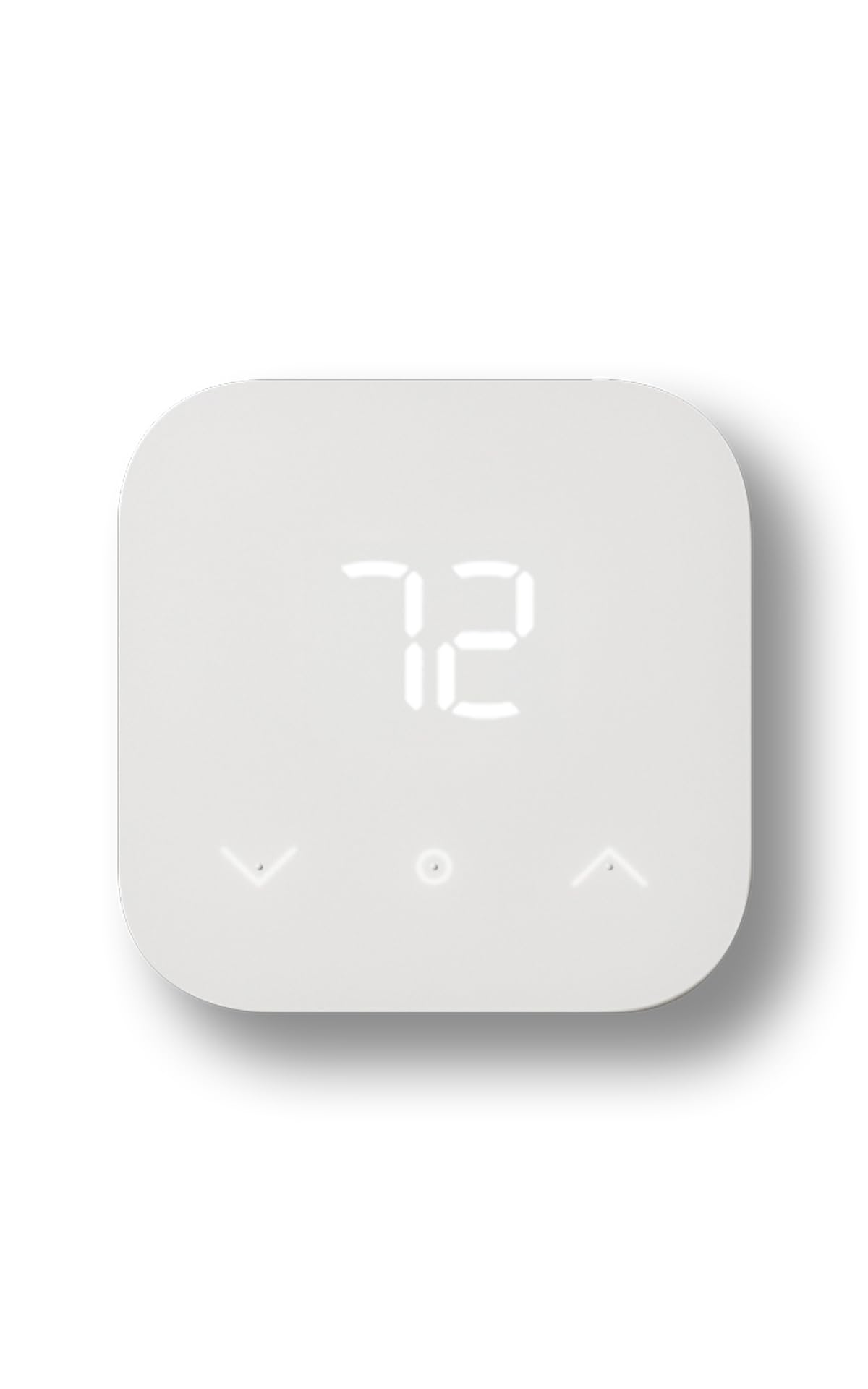
Type: Smart thermostat
Voice: Works with Alexa
Integration: Works with Ring
Focus: Energy savings
Ecosystem: Amazon
The Amazon Smart Thermostat is the cheapest credible way into smart climate control, and it is the most popular unit in this group by purchase volume. It leans entirely on Alexa for voice and app control, and it ties into Ring devices, which makes it a natural fit for a home already built around Amazon hardware.
In a large house, its realistic role is coverage rather than flagship duty. A second unit for a converted attic, a guest wing, or a finished basement can be added cheaply, and Alexa routines can coordinate setpoints across the house with voice commands. The energy-saving framing is honest for what the hardware does.
The limitation is ecosystem narrowness and sensor support. Households on Apple Home or Google Home should look elsewhere, and buyers needing remote room sensors will not find them here.
Trade-off: Alexa-only control and no remote sensor support rule this unit out for mixed-ecosystem or badly zoned homes.
Before You Decide
The single biggest decision is whether the house has a temperature imbalance problem or a scheduling problem. Imbalance calls for remote sensors and multi-stage support; scheduling calls for a strong programmable app. Matching the thermostat to the actual problem saves more money than buying the most expensive unit on the list.
What It Changes
- Remote sensors let the system respond to the room people actually occupy instead of a hallway setpoint.
- Multi-stage support runs long, gentle cycles instead of short blasts, which suits large ducted systems.
- Room-by-room scheduling trims runtime in wings that sit empty during the workday.
- Voice control through an existing assistant removes trips to a wall-mounted unit in a distant hallway.
- Staged purchases let a household add sensors and second thermostats over time rather than all at once.
- Energy Star certification gives a baseline efficiency signal when comparing units at similar prices.
The Buying Guide
Sensor Support and Coverage
Remote sensors are the defining feature for a large house. A thermostat that accepts one or more room sensors can average readings or prioritize an occupied room, which fixes the classic upstairs-hot, downstairs-cold split. The ecobee Smart Thermostat Premium bundles a sensor, while the Enhanced accepts add-ons.
HVAC Compatibility and Staging
Houses with multi-stage furnaces, heat pumps, or dual-fuel systems need a thermostat that can drive every stage. A basic single-stage unit will run the equipment below its capability. The Honeywell Vision Pro 8000 is the clearest example of a unit built for this.
Ecosystem Fit
The assistant a household already uses should decide the brand more often than the spec sheet does. Nest’s learning features live in Google Home, the Amazon Smart Thermostat leans on Alexa and Ring, and ecobee spans all three. Buying against the existing ecosystem wastes the best features.
Installation Complexity
DIY installs suit simple single-stage replacements, while installer-grade units reward professional setup. The Sensi ST55 targets the DIY buyer; the Vision Pro 8000 assumes a technician.
Scheduling Depth
A 7-day programmable schedule fits irregular routines better than a weekday/weekend split, and self-learning schedules suit households that never finish manual programming. The Honeywell RTH9585WF1004 is the strongest manual scheduler here.
Price Tier and Staging
Budget units make sense as secondary thermostats for wings and basements, while premium units belong on the main system. Spreading purchases across seasons keeps the total spend manageable.
FAQ
-
What makes a smart thermostat suited to a large house?
Remote room sensors, support for multi-stage HVAC equipment, and a scheduling app that can treat different areas differently. A single-sensor thermostat in a hallway will always struggle with a big, uneven floor plan. -
Are remote sensors necessary, or optional?
Necessary for most large homes with a temperature imbalance. They are optional only where the house heats and cools evenly and the main complaint is scheduling rather than comfort. -
Can a large house use more than one smart thermostat?
Yes. Zoned systems and separate wings often run multiple thermostats, and budget units like the Amazon Smart Thermostat make secondary installations affordable. -
Does a smart thermostat need professional installation?
Not always. Simple single-stage replacements are DIY-friendly, but multi-stage, heat-pump, and dual-fuel systems are safer in a technician’s hands. -
Which voice assistant should decide the purchase?
Whichever one the household already uses daily. Nest favors Google, the Amazon unit favors Alexa and Ring, and ecobee works across all three. -
Do energy savings justify the premium price?
Savings depend on the house, the climate, and how consistently the schedule is used. Sensors and better staging tend to deliver more comfort value than raw efficiency claims.
Bottom Line
The ecobee Smart Thermostat Premium is the best smart thermostat for a large house overall, because the bundled sensor, built-in voice assistants, and air quality monitoring cover the most ground in one purchase. The runner-up is the Google Nest Learning Thermostat (4th gen) bundle, which wins for households already invested in Google Home and prefer a schedule that builds itself. Buyers with multi-stage equipment should look hard at the Honeywell Vision Pro 8000 before deciding.
