Why there are Amazon links here: Brave Review is paid a commission for qualifying Amazon purchases made through the links below. Your price does not change, and using our links is entirely optional. How this works
Amazon eero 6+ Mesh WiFi System: Whole-Home Coverage for Gigabit Homes
The Amazon eero 6+ is a three-unit mesh WiFi system built for households that pay for fast internet and want it to reach every room. It is aimed at buyers with a gigabit-class plan, a home of up to roughly 4,500 square feet, and a growing pile of connected devices. This review covers what the hardware is, how the mesh design works in practice, where it fits and where it does not, so the decision takes a minute rather than an afternoon.
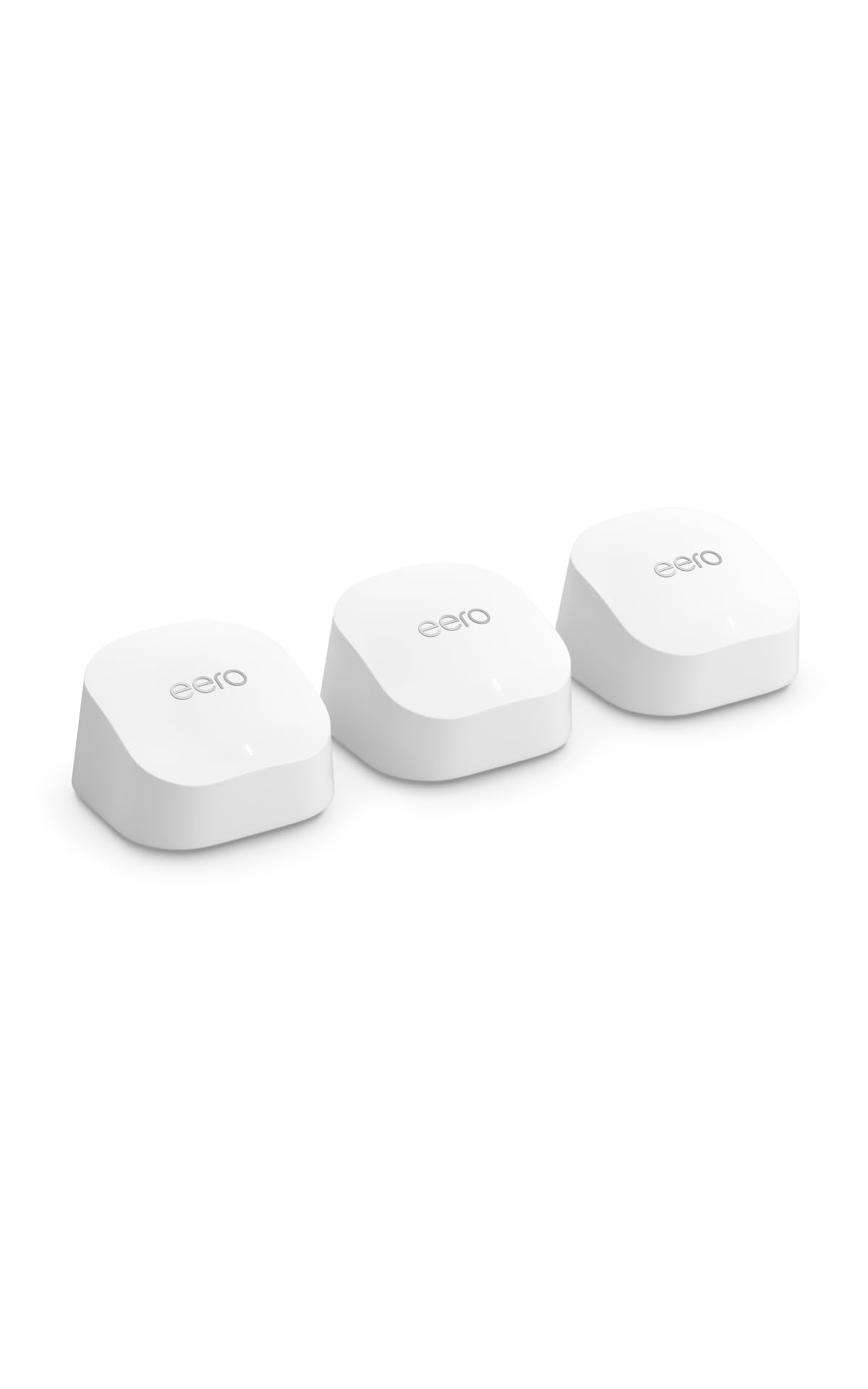
Check the current price on Amazon
Features and Specifications
Product name: Amazon eero 6+ mesh wifi system – Supports internet plans up to a Gigabit, Coverage up to 4,500 sq. ft., Connect 75+ devices, 3-pack
Type: Mesh WiFi system
Units in pack: 3
Rated coverage: Up to 4,500 sq. ft.
Internet plan support: Up to a Gigabit
Device capacity: 75+ connected devices
Best use: Whole-home coverage for large houses and busy device loads
What the eero 6+ Is Built to Do
The eero 6+ is a mesh system, which means the three units work as a single network rather than as a router with a couple of separate extenders. One unit connects to the modem and the others are placed around the house, handing devices off as a person moves from room to room. The point is one network name and one password across the whole home, with no dead zone at the far end of the hallway.
The headline spec is gigabit support. Buyers paying for an internet plan at or near a gigabit need a router that will not cap that speed, and the eero 6+ is explicitly rated for it. That matters more than raw coverage numbers for anyone who upgraded their plan and then found the old router was the bottleneck.
Coverage is rated up to 4,500 square feet across the three units, which puts this kit in the large-home bracket. A two-story house with a garage or a long single-story layout is the natural target. A small apartment is over-served by three units and would be better off with a single router.
Device capacity is the third pillar: 75+ connected devices. That figure reflects how modern homes fill up — phones, laptops, tablets, streaming boxes, smart speakers, thermostats, cameras and plugs all compete for airtime. A household with a dozen smart-home gadgets and a family’s worth of screens sits comfortably inside that rating.
Coverage and Placement
Three units rated for 4,500 square feet is roughly 1,500 square feet per unit, which is a realistic spread for a mesh node in an open-plan home. The practical limit is not the square footage figure but the walls and floors between units. Mesh systems need a decent signal between nodes, so placement matters more than the box number.
Buyers in a house with thick masonry walls, a detached garage or a separated extension should expect to experiment with placement. The 4,500 figure assumes reasonably open conditions. A dense layout will need the units closer together, which shrinks effective coverage.
The upside of three units is redundancy of reach: a large house gets coverage in the far bedroom and the basement without a second network name. The downside is that three units is more hardware than a small home needs, and the third unit can end up doing very little.
Trade-off: Three units are more mesh than a small home or apartment can use, and the 4,500-square-foot rating assumes walls and floors that do not fight the signal.
Gigabit Support and Real Throughput
The gigabit rating is the reason many buyers look at this model rather than a cheaper mesh kit. An internet plan at a gigabit is wasted on a router that tops out well below it, and the eero 6+ is positioned to pass that speed through.
That said, a mesh system splits its attention. The unit wired to the modem carries the full load, while the satellite units depend on the wireless link back to the main unit. Buyers who need the full gigabit at a far satellite should expect some falloff, which is true of every wireless mesh system at this price tier.
The honest framing: the gigabit support is real and it matters, but it is a ceiling for the system, not a guarantee at every node. Buyers whose heavy work happens near the main unit get the most from it.
Device Load and Smart Home Fit
The 75+ device rating is generous for a family home and reflects the direction households have moved — more small always-on devices rather than a few big ones. Smart plugs, cameras, bulbs and speakers are light individual users but numerous, and a router that chokes on device count produces the classic symptom of a network that is "fine" but drops smart devices randomly.
Buyers building out a smart home should weigh this figure heavily. A household with 20 or 30 connected devices is well inside the rating, which leaves headroom for the next round of gadgets. A household with only a laptop and a phone is paying for capacity it will not use.
The counterpoint is that device count is not the only stressor. A house full of 4K streaming and video calls stresses bandwidth, and the gigabit support is what covers that. The two specs work together rather than separately.
Trade-off: The 75+ device figure is comfortable for a busy family, but buyers with only a handful of devices are paying for headroom they will never touch.
Strengths and Weaknesses
The clearest strength is the combination of gigabit support and three-unit coverage at a mid-to-upper price tier. Buyers with a fast plan and a large house get a system that is rated for both, rather than a cheap mesh kit that caps speed or a single router that leaves dead zones.
The second strength is the device capacity. The 75+ rating is a sensible match for modern households, and it means the system does not need replacing the moment a few more smart devices arrive.
The weaknesses are structural to the category. Three units is more hardware than small homes need, and the coverage rating assumes favorable walls. The satellite units depend on a good wireless backhaul, so the full gigabit speed is not guaranteed at every node. And a mesh system at this price is an investment — buyers on a tight budget or in a small apartment will find it is more than the job requires.
FAQ
-
What is the Amazon eero 6+ best for?
It suits large homes — up to roughly 4,500 square feet — with a gigabit-class internet plan and a busy device load. Three units cover a spread-out house as one network. -
Does the eero 6+ really support gigabit internet?
Yes, it is rated for internet plans up to a Gigabit. That is the ceiling for the system, and satellite units connected wirelessly may see some falloff, as with any mesh kit. -
How many devices can the eero 6+ handle?
The system is rated for 75+ connected devices. That is comfortable for a family with phones, laptops, streaming boxes and a smart home full of small gadgets. -
Is a 3-pack too much for a small apartment?
Usually yes. Three units rated for 4,500 square feet is over-served in a small space, and a single router would be a better fit. The 3-pack is aimed at large homes. -
How much area does the eero 6+ cover?
Up to 4,500 square feet across the three units. Real-world coverage depends on walls and floors, so a dense layout will need the units placed closer together. -
Does the eero 6+ work with a gigabit plan from any provider?
It is built to support internet plans up to a Gigabit and connects to a modem like any router. Buyers should confirm their provider’s setup before ordering. -
Who should not buy the eero 6+?
Buyers in a small apartment, buyers on a slow internet plan, and buyers with only a few devices will pay for capacity they do not need. A single router is the better call there. -
Is a mesh system better than a single router for a large house?
For a large, spread-out home, yes. Mesh units hand devices off as a person moves around, which avoids the dead zones a single router leaves at the far end of the house. -
What matters most when placing the three eero 6+ units?
The link between units. Nodes need a solid signal to each other, so buyers should keep them within reasonable range and avoid thick walls between them. -
Is the eero 6+ a good fit for a smart home?
The 75+ device rating makes it a sensible match for a home with many small connected devices, and it leaves headroom for more gadgets later.
Bottom Line
The Amazon eero 6+ 3-pack is the right pick for a large home with a gigabit plan and a busy device load — three units, 4,500 square feet of rated coverage, and room for 75+ devices. Buyers in a small apartment or on a modest internet plan should look at a single router instead, because this kit is more mesh than those homes can use. For everyone else, it is a straightforward match of specs to the job.