Why there are Amazon links here: Brave Review is paid a commission for qualifying Amazon purchases made through the links below. Your price does not change, and using our links is entirely optional. How this works
Portable Power Station 120W vs EBL 2400W Portable Power Station: Small Backup or Whole-Home Power
This comparison settles a simple question: does the buyer need a pocket-sized 120W power bank with a wall outlet, or a 2400W LiFePO4 station that can carry a house through an outage? The 120W unit is a light-duty charger for phones, laptops and small DC gear on the move. The EBL 2400W is a serious home backup box with twelve outlets and a fast recharge. The short answer sits in the table below; the detail follows.
The Picks at a Glance
| Product | Key Spec | Best Use | Price Tier |
|---|---|---|---|
| DC 12V, 97.6Wh Portable External Battery Power Pack Generator | 97.6Wh, 120W, 110V AC outlet | Camping, van life, phone and laptop top-ups | Budget |
| EBL1843.2Wh Solar Generator | 1843.2Wh, 2400W AC, 12 outlets | Home backup, large appliances, long outages | Premium |
The gap between these two is not a matter of degree. One is a 97.6Wh pack that fits in a bag; the other is an 1843.2Wh LiFePO4 station built to run refrigerators and power tools. Buyers shopping the 120W model are usually solving a small, portable problem. Buyers shopping the EBL are solving a house-sized one.
DC 12V, 97.6Wh Portable Power Station 120W

Capacity: 97.6Wh
AC Output: 120W, 110V outlet
DC Output: 12V
Input: USB-C
Type: Portable external battery power pack
Best For: Camping, van life, small-device backup
This is a compact external battery pack with a genuine 110V AC outlet, not just USB ports. The 97.6Wh capacity is roughly enough for a few phone charges, a laptop top-up or a small fan, and the 12V DC output suits car accessories and camp gear. The USB-C input means it can be recharged from a laptop charger or a power bank rather than a dedicated wall brick.
The 120W ceiling is the number that matters most. Anything drawing more than that — a kettle, a space heater, a full-size blender — is out of reach, and even small appliances need checking against the limit before plugging in. Buyers who want a light, grab-and-go pack for a weekend trip or a glovebox backup will find it fits the job; buyers expecting to run household appliances will not.
Trade-off: The tiny capacity and 120W ceiling mean this pack is a device charger with an AC outlet, not a substitute for a home backup station, and heavy draws will drain it quickly.
EBL1843.2Wh Portable Power Station 2400W
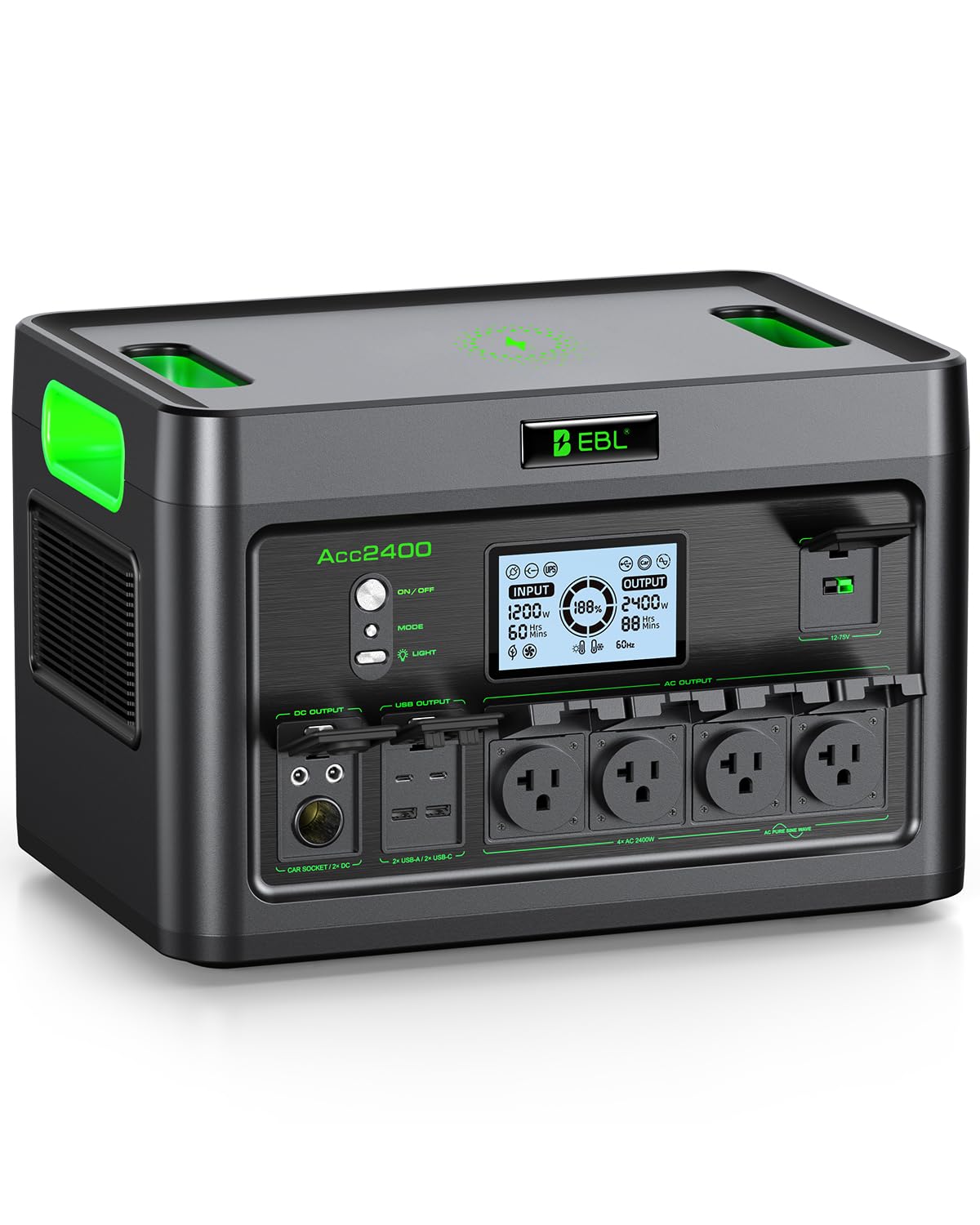
Capacity: 1843.2Wh
AC Output: 2400W across 12 outlets
Battery Chemistry: LiFePO4
USB-C: PD 100W
Recharge Time: 2 hours quick charge
Best For: Home battery backup, large appliances
The EBL is a home backup station in the proper sense. Its 1843.2Wh LiFePO4 battery is the chemistry buyers want for long life and stable output, and the 2400W AC output across twelve outlets is enough to run a fridge, a microwave or power tools one at a time. LiFePO4 also holds up better than older lithium chemistries over many charge cycles, which matters for a unit that sits waiting for an outage.
The 2-hour quick charge is the headline convenience: a station this size usually takes far longer to refill, and a fast turnaround means less time tethered to a wall outlet between uses. The 100W USB-C PD port charges laptops at full speed without an adapter. The name also flags solar generator capability, so buyers with panels can top it up off-grid — though the panels themselves are a separate purchase.
Trade-off: At this capacity the unit is heavy and bulky, so it is a stay-put home backup rather than something to carry on a hike, and the premium price tier reflects the LiFePO4 battery and high output.
Side-by-Side Comparison
| Feature | 120W Portable Power Station | EBL 2400W Portable Power Station |
|---|---|---|
| Capacity | 97.6Wh | 1843.2Wh |
| AC Output | 120W, 110V | 2400W |
| Outlets | One AC outlet plus DC | 12 outlets |
| Battery Chemistry | Not stated in name | LiFePO4 |
| USB-C | Input only | PD 100W output |
| Recharge Time | Not stated | 2 hours quick charge |
| Solar Input | No | Yes (solar generator) |
| Portability | Pocket/bag size | Stationary home unit |
| Price Tier | Budget | Premium |
The capacity gap is the first thing to read: 97.6Wh against 1843.2Wh is roughly a nineteen-fold difference, which is why these two are not really competitors. One is a device charger; the other is a home power reserve.
Output tells the same story. The 120W model can run a laptop or a small fan; the EBL’s 2400W can run a refrigerator or a circular saw. The outlet count — one against twelve — reflects that difference in ambition, and the EBL’s twelve outlets let several devices stay plugged in at once.
Charging separates them further. The 120W pack takes USB-C input, which is convenient for topping up from a laptop charger, but its recharge time is not part of its spec sheet. The EBL advertises a 2-hour quick charge, which is fast for a battery this size, and its solar generator label means panels can refill it when the grid is down. Buyers weighing the two should treat the EBL as infrastructure and the 120W pack as an accessory.
Which Should You Buy?
Choose the 120W portable power station if the job is small and mobile: charging phones and laptops at a campsite, keeping a dash cam or 12V cooler alive in a van, or having a light backup in a bag. It is the budget pick and the one that travels.
Choose the EBL 2400W if the goal is keeping a home running through an outage, powering large appliances, or running tools and gear off-grid for hours at a time. The LiFePO4 battery, twelve outlets and 2-hour recharge make it the pick for anyone who needs real capacity.
Buyers who cannot decide should ask one question: will it be carried, or will it stay put? Carried points to the 120W pack; stay-put points to the EBL.
FAQ
-
What is the difference between a 120W and a 2400W portable power station?
The number is the AC output ceiling. A 120W station runs small electronics like laptops and fans; a 2400W station can run refrigerators, microwaves and power tools. Capacity differs too — 97.6Wh against 1843.2Wh. -
Can the 120W power station run a refrigerator?
No. A refrigerator draws far more than 120W at startup, and the 97.6Wh capacity would not sustain it. The EBL 2400W is the model built for that job. -
Is LiFePO4 better than other battery types?
LiFePO4 is generally preferred for backup stations because it offers long cycle life and stable output. The EBL uses it; the 120W pack’s chemistry is not stated in its name. -
How fast does the EBL 2400W recharge?
Its name advertises a 2-hour quick charge, which is fast for a battery this size and shortens the wait between outages. -
Can the EBL run on solar?
Yes — it is marketed as a solar generator, so panels can recharge it. The panels are sold separately. -
Is the 120W station good for camping?
Yes, for light loads. It handles phones, laptops, lights and 12V accessories, but not high-draw camp appliances. -
Which one is more portable?
The 120W pack, clearly. The EBL is a heavy home unit meant to stay in one place.
Bottom Line
For most buyers with a home to protect, the EBL 2400W portable power station is the better buy: real capacity, LiFePO4 chemistry, twelve outlets and a fast recharge make it a genuine backup solution. The 120W pack is the right call only for buyers who need something small, cheap and carryable — and for that narrow job, it does it well.
