Why there are Amazon links here: Brave Review is paid a commission for qualifying Amazon purchases made through the links below. Your price does not change, and using our links is entirely optional. How this works
Aosu 2K Solar Security Cameras: Six Cameras, No Subscription
The aosu 2K Solar Security Cameras system is a six-camera wireless outdoor kit built for homeowners who want whole-property coverage without a monthly cloud bill. It pairs 2K resolution and color night vision with solar charging, on-device AI human detection, and local storage that needs no subscription. This review covers what the kit includes, how the pieces work together, and where a system at this price tier makes compromises. Buyers who want to blanket a house, driveway, and yard in one purchase will find the most to like here.
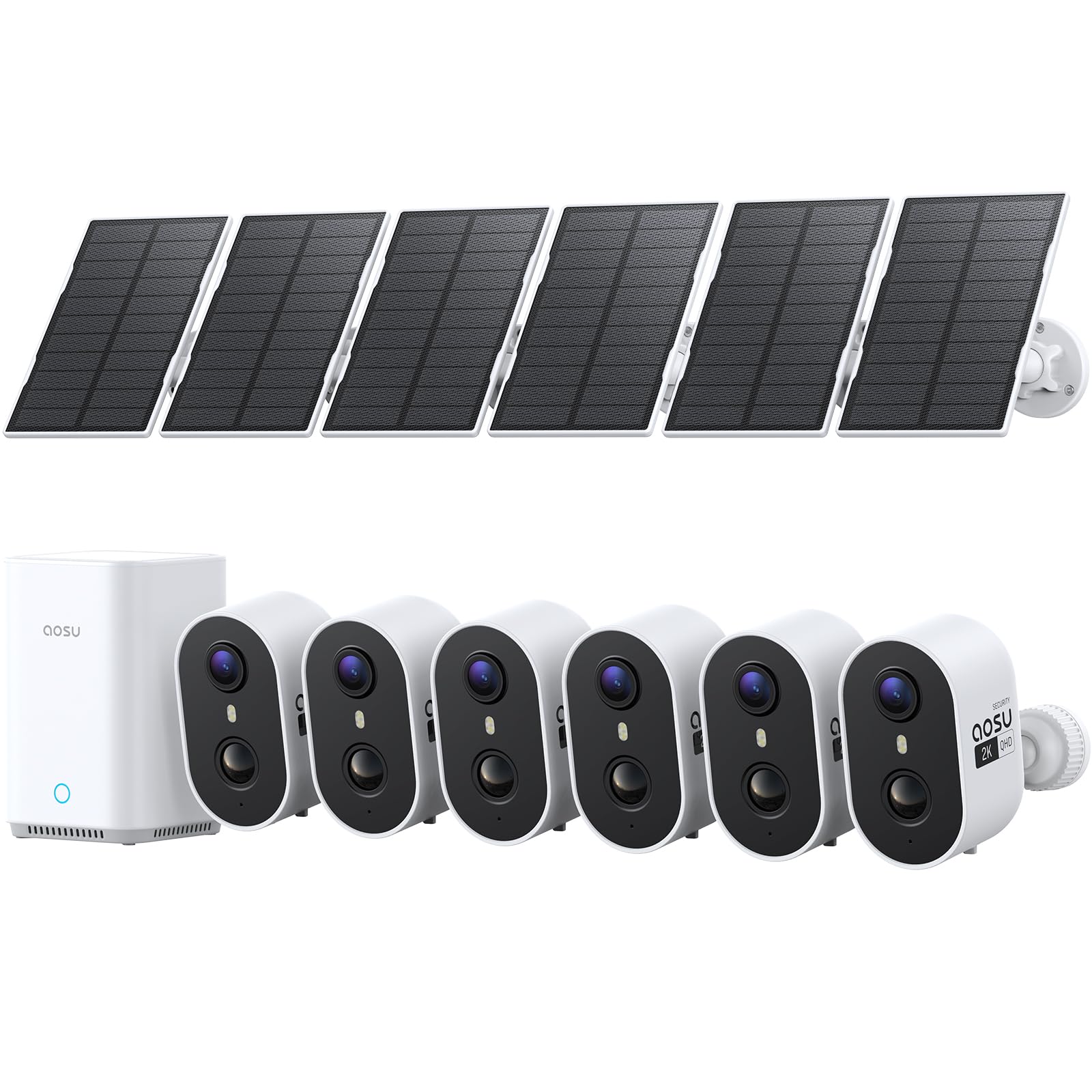
Features and Specifications
Resolution: 2K HD
Night Vision: Color night vision
Detection: PIR sensor plus AI human detection
Tracking: Cross-camera tracking
Power Source: Solar charging, wireless
Storage: Local storage, no subscription required
Kit Size: Six cameras
The headline here is the combination of 2K resolution and color night vision across six cameras. That matters because most budget wireless cams drop to grainy black-and-white infrared after dark, and a color image at night is far more useful for identifying a person or a vehicle than a washed-out monochrome frame. Six cameras is enough to cover a typical single-family home’s front door, back door, driveway, side gate, and a couple of blind spots, which is why the kit reads as a whole-property package rather than a starter camera.
The solar panels are the second pillar. Each camera charges from daylight, so the kit avoids the chore of pulling batteries every few weeks or running low-voltage wire through walls. For a homeowner who wants a set-and-forget install, that is a real convenience, though it depends on each camera’s panel getting reasonable sun through the year.
The third pillar is the local storage and no-subscription design. Recordings live on local storage rather than a paid cloud plan, so the cost of ownership stays flat after purchase. That is a meaningful difference from camera brands that gate playback and rich alerts behind a monthly fee.
Trade-off: Solar charging and a flat no-fee model are appealing, but a six-camera kit at this price means the hardware is built to a budget, so buyers should expect plastic housings and a local-storage setup that requires a bit of hands-on management rather than polished cloud convenience.
Check the current price on Amazon
Build and Design
The kit’s design logic follows from its wireless, solar-powered brief. Each camera is a self-contained unit with its own solar panel, so there is no central hub wiring to plan and no power run to each corner of the house. Installation is a matter of mounting the camera where it has a view and where its panel catches light, then connecting it to the system wirelessly. That makes the kit approachable for a homeowner who is comfortable with a drill and a ladder but not with an electrician.
Six cameras in one box is a lot of coverage, and the practical benefit is that a buyer can place cameras at the front, back, and sides without buying add-ons piecemeal. The trade-off of the all-in-one approach is that every camera shares the same design and capability, so there is no mix of a wide-angle overview cam and a tighter zoom cam. For most homes, uniform coverage is the right call; for a buyer who wants one camera to read a license plate at distance, this kit is not the tool.
The wireless, solar design also means placement is flexible in a way wired systems are not. Cameras can go on a shed, a fence post, or a detached garage where running cable would be painful. That flexibility is one of the strongest arguments for the kit.
Power and Charging
Solar power is the kit’s defining convenience and its main variable. Each camera relies on its panel to keep the battery topped up, which works well when the panel faces the sun for a good part of the day. In practice, that means the buyer should think about placement before mounting: a camera under a deep eave or on a north-facing wall may not get enough light to stay charged through winter.
The upside is that once a camera is placed well, it largely takes care of itself. There is no monthly battery swap and no wiring, so the ongoing maintenance is closer to occasional cleaning than regular charging. For a second home or a property where the owner is not on site every week, that is a strong fit.
The caution is seasonal. In regions with short winter days or heavy snow cover, solar charging slows, and a camera that runs its detection and night vision heavily may need more sun than it gets. Buyers in those climates should plan to check charge levels and possibly reposition panels, or accept that one or two cameras may need a manual top-up in the darkest months.
Detection and Tracking
The detection package is where the kit earns its keep for security. PIR sensors catch heat and motion, and the AI human detection layer filters alerts so the phone is not buzzing every time a cat crosses the yard. That combination is the difference between a camera system a homeowner actually pays attention to and one that gets muted after a week of false alarms.
Cross-camera tracking is the more distinctive feature. Instead of six cameras acting as six separate feeds, the system can follow a person’s movement from one camera’s view to the next, so a single event reads as a path across the property rather than six disconnected clips. For a buyer trying to understand what happened on a driveway or along a side yard, that continuity is genuinely useful.
The limits are the usual ones for on-device AI at this price. Human detection is tuned for people, so a package left at the door or an animal in the garden may not trigger the same way, and detection range and accuracy depend on placement and lighting. Buyers who need precise object classification — vehicles, pets, packages as separate categories — should expect a simpler filter set here.
Storage and the No-Subscription Model
Local storage is the kit’s answer to the subscription fatigue that has spread across the camera market. Recordings are kept on local storage rather than a paid cloud tier, so there is no monthly fee to unlock playback or extend history. Over a few years, that flat cost is the kit’s biggest financial advantage.
The trade-off is management. Local storage means the buyer is responsible for the storage medium and for reviewing or exporting footage, and there is no cloud backup if a camera is stolen or damaged. A cloud plan exists precisely to survive that scenario; a local-only setup does not. Buyers who want footage safe off-site should weigh that against the savings.
There is also a practical ceiling on how much history local storage holds before it overwrites. That is normal for the category, but it means the kit is better for recent-event review than for long-term archival. Buyers who need weeks of retained footage should plan accordingly.
Who It Suits and Who It Does Not
This kit suits homeowners who want broad outdoor coverage in one purchase, who have reasonable sun exposure on the walls where cameras will go, and who would rather pay once than subscribe. It also fits rentals, second homes, and outbuildings where wiring is impractical and a wireless, solar-powered install is the only realistic option.
It is not for buyers who need a single high-zoom camera to read plates at distance, who live somewhere with very little winter sun, or who insist on cloud backup as a theft safeguard. Buyers who want a polished app experience with tiered AI categories should also look at systems built around a paid plan, because the no-subscription model here trades some of that polish for cost.
Trade-off: The kit’s flat-cost, local-storage design is its strength, but it leaves footage on-site and puts storage management on the buyer, which is the wrong fit for anyone who wants automatic off-site backup.
See the aosu 6-camera kit on Amazon
FAQ
-
Do the aosu 2K solar security cameras require a subscription?
No. The kit is built around local storage with no subscription required, so playback and recording do not depend on a monthly plan. The buyer manages storage on-site instead. -
How many cameras come in the kit?
Six. The 6-Cam-Kit is designed to cover a typical home’s main entry points and yard in a single purchase. -
Are the cameras wireless?
Yes. They are wireless outdoor cameras charged by solar panels, so there is no power cable run to each camera. Installation is mounting and connecting rather than wiring. -
What resolution do the cameras record in?
2K HD. That is a step above 1080p and gives more detail for identifying faces and vehicles. -
Do the cameras see in color at night?
Yes. The kit specifies color night vision, which is more useful for identification than standard black-and-white infrared footage. -
What kind of detection do the cameras use?
PIR sensors combined with AI human detection. The PIR layer catches motion and heat, and the AI layer filters alerts toward people rather than every moving object. -
What is cross-camera tracking?
It lets the system follow a person’s movement from one camera to the next, so an event reads as a continuous path across the property instead of separate clips. -
Will solar charging work in winter?
It depends on sun exposure. Cameras with panels that face the sun for much of the day generally keep up, but short winter days and snow cover can slow charging, so placement matters. -
Where are recordings stored?
On local storage rather than a paid cloud. That keeps costs flat but means footage stays on-site and the buyer manages the storage. -
Who is this kit not for?
Buyers who need long-range zoom for license plates, who have very little sun on their mounting walls, or who require automatic cloud backup should look elsewhere.
Bottom Line
The aosu 2K Solar Security Cameras 6-Cam-Kit is the practical pick for a homeowner who wants to cover a whole property at once, avoid wiring, and stop paying a monthly camera bill. Its 2K color night vision, PIR plus AI human detection, and cross-camera tracking cover the essentials, and the solar-powered, local-storage design keeps ownership simple and flat-cost. The compromises — budget-tier hardware, on-site storage, and seasonal charging — are the ones this price and model make inevitable, and they are acceptable for most buyers. Those who need cloud backup or long-range zoom should look at a different class of system.
Check the price and availability of the aosu 6-camera kit on Amazon
