Why there are Amazon links here: Brave Review is paid a commission for qualifying Amazon purchases made through the links below. Your price does not change, and using our links is entirely optional. How this works
Best Appliance Level Power Monitoring for Tracking Real Energy Costs
Appliance level power monitoring tells a buyer exactly what each device in a home actually costs to run, rather than guessing from a utility bill. This roundup covers five meters that handle that job at different depths: whole-home circuit sensors for owners who want a full picture, single-plug meters for testing one appliance at a time, and multi-pack options for comparing several devices at once. Renters, shared-apartment dwellers, and homeowners chasing high bills all have a fit here. The overview table below narrows the choice in under a minute.
Overview of the Picks
| Product | Key Spec | Best Use | Price Tier |
|---|---|---|---|
| Smart Home Energy Monitor with 16 50A Circuit Level Sensors | 16 circuit sensors, app history | Whole-home circuit tracking | Premium |
| Home Electricity Usage Monitor Consumption | 7 modes, cord, backlight | General single-appliance testing | Budget |
| Upgraded Electrical Usage Monitor Consumption | 7 modes, compact plug-in | Lowest-cost single-appliance checks | Budget |
| Home Energy Monitor Consumption 2 Pack | 8 modes, two meters | Comparing two appliances | Mid-range |
| KETOTEK Watt Meter Plug | Cable-connected display | Remote or awkward outlet reads | Mid-range |
1. Smart Home Energy Monitor with 16 50A Circuit Level Sensors

Type: Circuit-level energy monitor
Sensors: 16 x 50A circuit sensors
Tracking: Real-time power usage and electricity cost
App: History logging
Compatibility: Home Assistant
Intended use: Rental homes and shared apartments
Price tier: Premium
Smart Home Energy Monitor with 16 50A Circuit Level Sensors
This is the only pick in the roundup that monitors at the circuit level rather than the outlet level. Sixteen 50A sensors clamp onto individual branch circuits, so the unit can separate the fridge, the HVAC, and the water heater instead of lumping them into one whole-home number. Real-time power usage and cost tracking feed into an app with history, and Home Assistant compatibility means the data can join an existing smart-home dashboard.
The design suits rental homes and shared apartments, where splitting a bill fairly depends on knowing which circuits draw the load. Buyers who want a permanent, always-on picture of a whole property get the most from it. The trade-off is that a circuit-level install is a bigger commitment than plugging in a meter: it needs panel access and comfort working around breakers, so it is not the pick for a renter who cannot touch the panel.
2. Home Electricity Usage Monitor Consumption

Type: Plug-in power meter
Modes: 7 display modes
Display: Backlight
Protection: Overload protection
Included: Cord
Measures: Energy, voltage, amps
Price tier: Budget
Home Electricity Usage Monitor Consumption
A plug-in meter for testing one appliance at a time, with seven display modes covering energy, voltage, and amps. The backlight keeps readings legible in a dim utility corner, and overload protection guards the meter itself when a heavy load is attached. The included cord adds reach, which matters for outlets tucked behind furniture or appliances.
This pick earns its place as the straightforward general-purpose tester: plug an appliance in, leave it for a day or a week, and read the consumption. It suits homeowners and renters who want a single flexible meter rather than a permanent install. The trade-off is that it reads one appliance at a time, so building a full-house picture means moving it from device to device over several days.
3. Upgraded Electrical Usage Monitor Consumption

Type: Plug-in power meter
Modes: 7 display modes
Display: Backlight
Protection: Overload protection
Measures: Energy, voltage, amps
Form: Compact plug-in
Price tier: Budget
Upgraded Electrical Usage Monitor Consumption
The lowest-cost entry in the roundup, and the most popular by purchase volume. Seven modes cover the same core readings as the pricier plug meters — energy, voltage, amps — with a backlight and overload protection. The compact plug-in body sits flush against the outlet, which helps in tight spots behind a washer or under a counter.
This is the pick for a buyer who wants to test a handful of appliances without spending much, or who wants a spare meter to leave in place on a known power hog. It covers the basics well. The trade-off is that a compact, low-cost body leaves little room for extras, so buyers who need a remote display or a longer reach should look at the cable-connected option below.
4. Home Energy Monitor Consumption 2 Pack

Type: Plug-in power meter, two-pack
Modes: 8 display modes
Display: Backlight
Protection: Overload protection
Quantity: 2 meters
Form: Meter sockets
Price tier: Mid-range
Home Energy Monitor Consumption 2 Pack
Two meters in one box, each with eight display modes — one more than the single-meter budget picks. The backlight and overload protection carry over, and the meter-socket form factor is built to sit in an outlet while an appliance plugs into it. Having a second unit means two appliances can be measured over the same period instead of one after the other.
This pick suits a buyer comparing two suspects side by side: an old fridge against a new one, or a space heater against a heat pump. It also works for anyone who wants one meter permanently parked on a heavy load and one free for spot checks. The trade-off is that the pair costs more than two of the cheapest singles, so buyers testing only one appliance pay for a second meter they may not need.
5. KETOTEK Watt Meter Plug
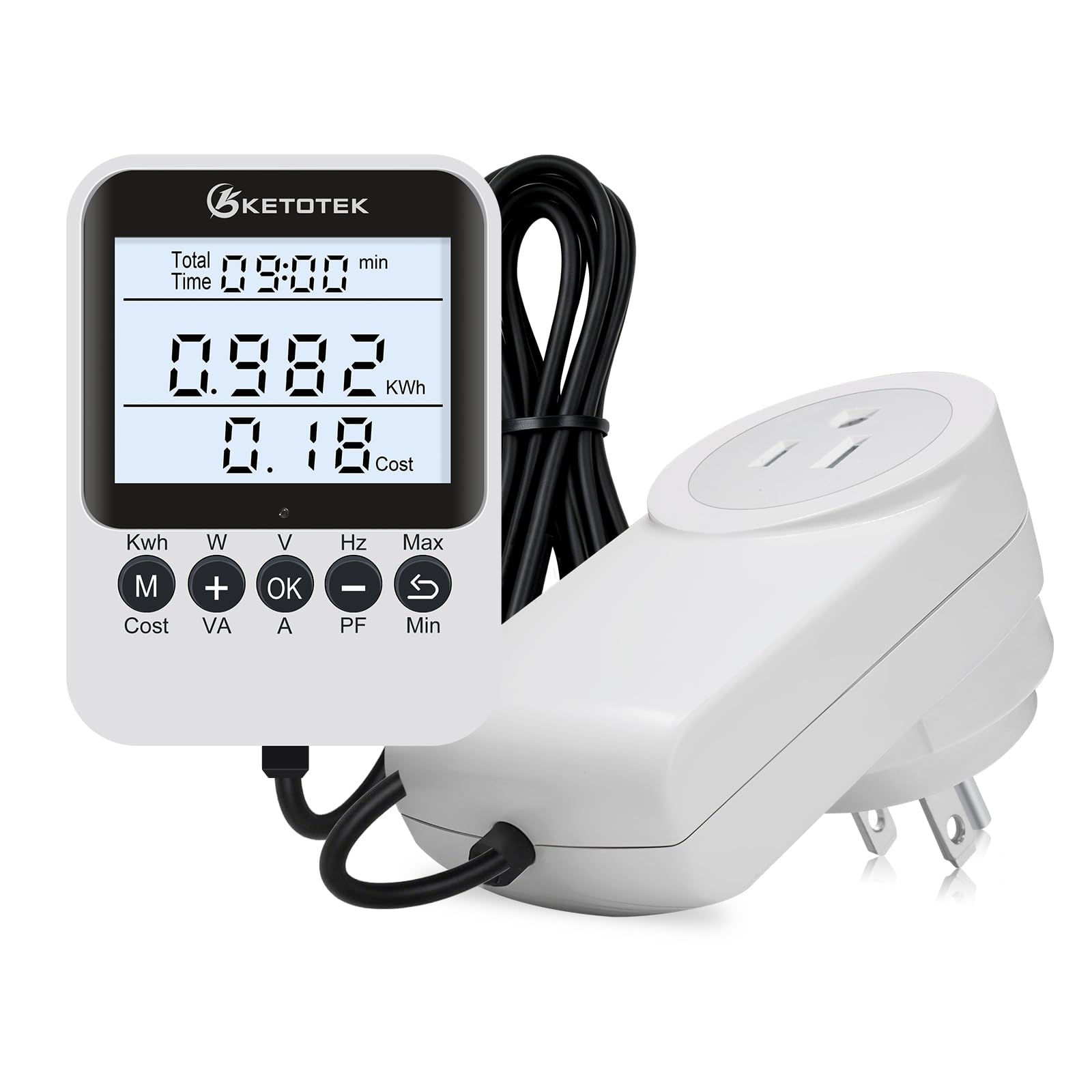
Type: Plug-in power meter
Display: Connected via cable
Display feature: Backlight
Protection: Overload protection
Measures: Wattage and consumption
Intended use: Home electrical monitoring
Price tier: Mid-range
The feature that sets this meter apart is the display, which connects to the plug body by cable. That means the readout can sit on a counter or shelf while the meter stays plugged in behind a heavy appliance. Backlight and overload protection are both present, and the unit tracks wattage and consumption for home electrical monitoring.
This pick earns its place for awkward installs: a freezer pushed into a corner, a dryer in a tight alcove, or any outlet where reading a built-in screen would mean moving furniture. It suits buyers who plan to leave a meter connected long-term and want the numbers visible. The trade-off is the extra cable, which adds a little clutter and a higher price than the compact plug-in meters.
Before You Buy
- Monitoring level: Circuit-level sensors track a whole property; plug-in meters track one appliance at a time. Match the tool to the question being asked.
- Sensor count: A multi-sensor monitor covers many circuits at once, but only pays off if the panel has room and the buyer is comfortable with the install.
- Compatibility: Check that a smart monitor works with the existing hub — the circuit-level pick lists Home Assistant support.
- Display placement: A cable-connected display helps where the outlet is hidden; a built-in screen suits open, reachable outlets.
- Number of meters: A two-pack allows side-by-side comparison over the same period; a single meter means testing devices one after another.
- Protection: Overload protection appears across the plug-in picks and is worth confirming on any meter attached to a heavy load.
- Price tier: Budget plug meters cover the basics; premium money buys circuit-level coverage and app history.
Frequently Asked Questions
-
What is appliance level power monitoring?
It is the practice of measuring how much electricity each individual appliance draws, rather than reading a single whole-home figure from a utility bill. -
Does a plug-in meter work for every appliance?
No. Plug-in meters suit devices that connect through a standard outlet; hardwired appliances such as a central AC unit need a circuit-level monitor instead. -
Can a renter use these meters?
Plug-in meters are renter-friendly since they need no panel work. The circuit-level monitor is aimed at rental properties and shared apartments but requires access to the electrical panel. -
How long should a meter stay connected?
Long enough to capture a full use cycle — a day for a fridge, a wash cycle for a washer — since standby and peak draw differ widely across a single day. -
Why choose a meter with a cable-connected display?
The cable lets the readout sit somewhere visible while the meter stays plugged in behind a heavy or hard-to-reach appliance. -
What does overload protection do?
It guards the meter when a connected appliance pulls more current than the unit is built to handle, which matters most on heaters and large motors.
Bottom Line
For a full picture of what every circuit in a property costs, the Smart Home Energy Monitor with 16 50A Circuit Level Sensors is the top pick — it is the only option here that separates appliances at the panel and logs history in an app. Buyers who only need to test one device at a time can spend far less on a plug-in meter and get the answer just as clearly.