Why there are Amazon links here: Brave Review is paid a commission for qualifying Amazon purchases made through the links below. Your price does not change, and using our links is entirely optional. How this works
ARCCTV Solar Security Cameras Wireless Outdoor, 2 Pack: The Wire-Free Pick for Renters and Remote Corners
The ARCCTV solar security cameras are a two-camera wireless kit built for buyers who cannot or will not run power cable to a fence line, a shed wall or a rental porch. Each unit runs on a rechargeable battery topped up by its own solar panel, records 2.5K video with a spotlight-assisted night mode, and pans a full 360 degrees. This review covers the specifications, the installation realities, the maintenance rhythm and the trade-offs that come with a solar-powered camera at this price tier. Buyers who need a fast, cable-free answer to outdoor coverage should read on; buyers who want continuous 24/7 recording should look elsewhere.
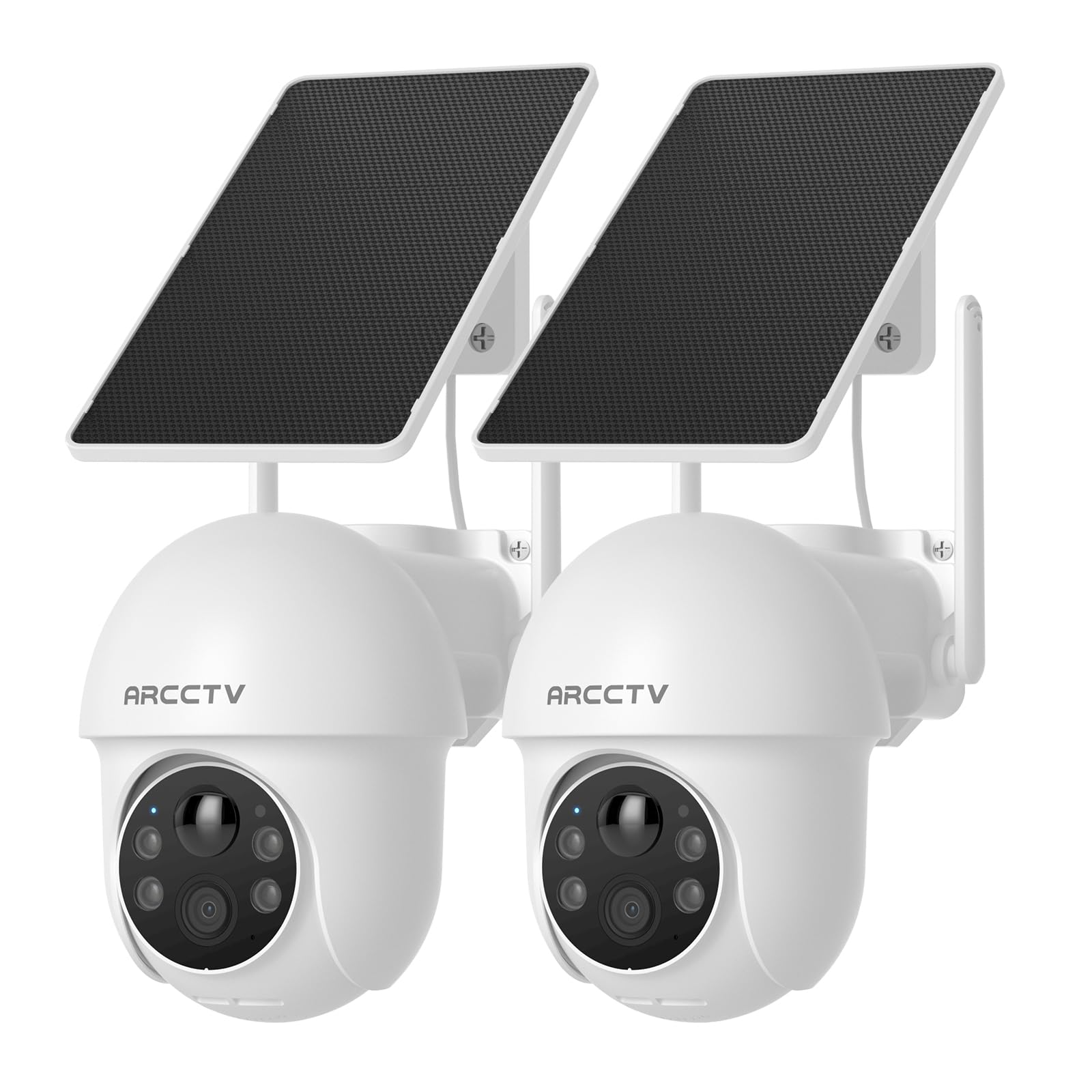
Features and Specifications
Resolution: 4MP, 2.5K HD
Field of View: 360°
Connectivity: 2.4G/5G dual band WiFi
Power Source: Battery powered with solar charging
Night Vision: Spotlight-assisted
Audio: Two-way
Motion Detection: PIR sensor
Pack Size: 2 cameras
The headline here is the resolution and the pan range sitting together in one battery-powered body. A 4MP sensor at 2.5K is enough to read a license plate at a driveway distance and to identify a face at a doorway, which is the practical floor for a security camera that is meant to produce evidence rather than just a vague sense that something moved. The 360-degree view means one camera can cover a side yard or a garage corner that would otherwise need two fixed units angled at each other.
Dual-band WiFi is a more meaningful inclusion than it first appears. The 5GHz band carries more data at shorter range and suffers less interference from neighbouring networks, which matters for a 2.5K stream; the 2.4GHz band reaches further through walls and around the back of a house. A camera that offers both lets the buyer put a unit on a far fence post on 2.4GHz and a unit near the router on 5GHz without buying two different products.
The two-pack structure is the other specification worth flagging. Two cameras cover a front and back approach, or a driveway and a side gate, and they arrive as a matched pair that shares one setup routine. For a first security purchase, that is a sensible unit of sale.
Build, Power and Installation
The solar panel is the piece that decides whether this kit works for a given property. A battery camera without solar charging needs to come down every few weeks for a USB top-up, which is tolerable for one camera and a chore for two. The integrated panel means the camera can, in good light, stay on a wall for months at a time. The caveat is orientation: a panel mounted under a deep eave, on a north-facing wall or in the shadow of a tree will not keep up, and the buyer is then back to manual charging.
Installation itself is the strong suit. There is no mains cable to run, no electrician to book and no hole drilled through a wall for a power feed. A bracket, a few screws and a WiFi signal are the whole requirement. That makes the kit unusually well suited to renters, to sheds and outbuildings far from the house, and to anyone who wants coverage at a gate or a detached garage where running power would cost more than the cameras.
The PIR sensor is the right choice for this power budget. Passive infrared detection triggers on body heat rather than on every leaf that moves, so the camera stays asleep until something worth recording walks into frame. That conserves battery and cuts the false alerts that make a camera feel like a nuisance. The trade-off is that PIR is less reliable in extreme heat and at the very edge of its range, so placement still matters.
Video, Night Vision and Audio
The 2.5K sensor does its best work in daylight, where colour, contrast and detail are strong enough to identify a person or a vehicle. At night the spotlight changes the character of the footage: instead of the flat, grainy monochrome of plain infrared, the spotlight illuminates the scene and the camera can hold colour. That is a real advantage for identifying clothing and vehicle colour, and it also acts as a mild deterrent when the light kicks on as someone approaches.
The cost of that approach is visibility. A spotlight-mounted camera announces itself, and it draws on the same battery that has to last through the night. Buyers who want a camera to be genuinely hidden should understand that this is a visible, active model rather than a covert one.
Two-way audio rounds out the package. It lets a homeowner speak to a delivery driver, warn off a stranger or check in with a family member at the door from a phone. The practical limit is the same as on every camera of this type: the speaker is small and the microphone picks up wind, so conversation is functional rather than hi-fi.
The ARCCTV App and Daily Use
Day-to-day, the experience is built around the phone app: live view, motion alerts, playback and the two-way audio all live there. Dual-band WiFi support means the live feed holds up better than a 2.4GHz-only camera when the phone and the router are on the same band, and the 360-degree pan means a single camera can be swept across a yard from the app rather than physically repositioned.
The recurring question with any battery camera is storage. Local microSD recording keeps footage on the camera with no subscription, while cloud storage typically requires a paid plan. Buyers should check which options the app supports before purchase, because the subscription is the hidden cost that changes the value calculation on a kit at this price.
Strengths and Weaknesses
The strengths are straightforward: true wire-free installation, 2.5K detail, a full 360-degree view per camera, dual-band WiFi and a two-pack that covers two approaches out of one box. The spotlight night mode and two-way audio make it a genuinely useful doorbell-adjacent tool rather than a passive recorder.
The weaknesses follow from the power source. Solar charging is weather-dependent, so a shaded or north-facing mounting point will underperform. Battery cameras of this type also record on motion rather than continuously, which means a determined intruder who waits out the PIR delay may not be captured from the first second. And the spotlight makes the camera conspicuous by design.
Trade-off: The solar panel and battery that make installation effortless also make continuous 24/7 recording impractical, so buyers who want an always-on record should budget for a wired system instead.
Check the current price on Amazon
FAQ
-
Do the ARCCTV solar security cameras need to be plugged in?
No. Each camera runs on its own battery and is charged by its integrated solar panel, so no mains wiring is required at the mounting point. A USB charge is the fallback during long stretches of poor light. -
How much light does the solar panel need?
The panel needs direct sun for a good part of the day to keep the battery topped up. A mounting spot under a deep overhang, on a shaded north wall or beneath dense tree cover will not keep pace, and the camera will need occasional manual charging. -
Is 2.5K resolution good enough to identify a face?
Yes, at typical domestic distances. A 4MP 2.5K sensor resolves facial features and vehicle details at driveway and doorway range, which is the practical standard for a home security camera. -
What does the 360-degree view actually mean?
The camera can pan through a full circle, so one unit can cover an area that would otherwise need two fixed cameras. The view is controlled from the app rather than being a single ultra-wide fixed lens. -
Does the camera work with 5GHz WiFi?
Yes. It supports both 2.4GHz and 5GHz networks. The 5GHz band gives a smoother 2.5K stream near the router, while 2.4GHz reaches further for cameras mounted at the edge of the property. -
Will the spotlight come on at night?
The spotlight is part of the night vision system and illuminates the scene when the camera detects activity in the dark, allowing colour footage instead of infrared monochrome. It also makes the camera visible when it triggers. -
Is a subscription required to use the cameras?
The cameras function without one, but cloud storage for recorded clips is typically a paid service. Local microSD storage, where supported, avoids a recurring fee. Buyers should confirm the storage options in the app before purchase. -
Can two people view the cameras at once?
Camera apps of this type generally allow the account holder to share access with other household members, so more than one phone can view the live feed. The exact sharing options sit inside the ARCCTV app. -
How many cameras come in the box?
Two. The product is sold as a 2-pack, which suits a front-and-back or driveway-and-gate setup. -
Who are these cameras not right for?
Buyers who want continuous 24/7 recording, or who need coverage in permanent deep shade, should look at a wired system. The solar battery design is a poor fit for both.
Bottom Line
The ARCCTV solar security cameras are the sensible pick for a buyer who wants two outdoor cameras running this weekend without an electrician, a ladder run of cable or a landlord’s permission. The 2.5K sensor, 360-degree pan, dual-band WiFi and spotlight night vision cover the essentials, and the solar charging removes the chore that makes most battery cameras annoying. Buyers with direct sun and a motion-triggered mindset will get the most from the kit; buyers who need always-on recording should keep shopping.
