Why there are Amazon links here: Brave Review is paid a commission for qualifying Amazon purchases made through the links below. Your price does not change, and using our links is entirely optional. How this works
Best Frost Protection Thermostat for a Cold Conservatory
A conservatory loses heat fast and sits far from the boiler, which makes it the first room in the house to drop toward freezing. The best frost protection thermostat for a cold conservatory is a plug-in unit that switches a heater on automatically at a set air temperature and off again once the room warms. This short roundup covers five thermostatically controlled outlets and plugs, each suited to a different setup: a small tubular heater, a pair of appliances, a plug that sits under a cover, or a roof-heating cable run. The overview table below shows the key differences at a glance.
The Picks At A Glance
| Product | Key Spec | Best Use | Price Tier |
|---|---|---|---|
| HEATIT ET-21 Freeze Protection Thermostat Outlet | 38°F on / 50°F off | General conservatory heater control | Budget |
| Farm Innovators TC-3 Cold Weather Thermo Cube | 35°F on / 45°F off, double outlet | Two heaters or a heater plus fan | Budget |
| Thermostatically Controlled Outlet Extension Cord | 37°F on / 50°F off, 20-inch cord | Reaching a covered outdoor socket | Mid |
| Frost King 09900A Roof Cable Thermostat | Self-regulating heat cable control | Roof deicing and gutter cable | Mid |
| Thermostatically Controlled Outlet Freeze Protection Switch | 38°F on / 50°F off, heavy-duty plug | High-draw heaters | Budget |
1. HEATIT ET-21 Freeze Protection Thermostat Outlet

Type: Plug-in thermostatically controlled outlet
On Temperature: 38°F
Off Temperature: 50°F
Outlet: Grounded
Housing: Weather-resistant
Use: Indoor and outdoor
HEATIT ET-21 Freeze Protection Thermostat Outlet
This is the straightforward option: a small unit that plugs into a wall socket and passes power through to whatever is connected to it. The 38°F on and 50°F off points are well matched to a conservatory, because they keep the room just above freezing without running the heater constantly. The grounded outlet and weather-resistant housing mean the unit is not limited to dry interior walls, which helps in a conservatory where damp air and condensation are common. It suits a single tubular heater or a small oil-filled radiator left in place through the winter.
The case for this pick is simplicity. There is nothing to wire, nothing to program, and no app to pair — the unit is set by its fixed temperature points and left alone. A buyer who wants a heater to look after itself from October to March will find it does exactly that. The trade-off is that the fixed points cannot be adjusted, so a conservatory that needs a slightly different cut-in temperature has to accept the factory setting.
2. Farm Innovators TC-3 Cold Weather Thermo Cube Double Outlet

Type: Thermostatically controlled double outlet
On Temperature: 35°F
Off Temperature: 45°F
Rating: 15A, 120V
Outlets: Two
Use: Deicers, heaters, pump houses, greenhouses
Farm Innovators TC-3 Cold Weather Thermo Cube Double Outlet
The Thermo Cube is a compact cube that turns two outlets on and off together as air temperature moves. Its 35°F on and 45°F off points are lower than most of the picks here, which makes it a better fit for a conservatory that only needs protection against hard frost rather than a steady background warmth. The 15A, 120V rating is generous enough for a reasonably powerful heater, and the double outlet lets one unit look after a heater and a small fan, or two modest heaters on opposite sides of the room.
This pick earns its place for buyers who want to run more than one appliance from a single control. A conservatory that is cold at one end and milder at the other can carry two small heaters from the same cube. The trade-off is the lower trigger point — a buyer who wants the room held comfortably above freezing will find this unit waits longer before switching on than the 38°F models.
3. Thermostatically Controlled Outlet Extension Cord
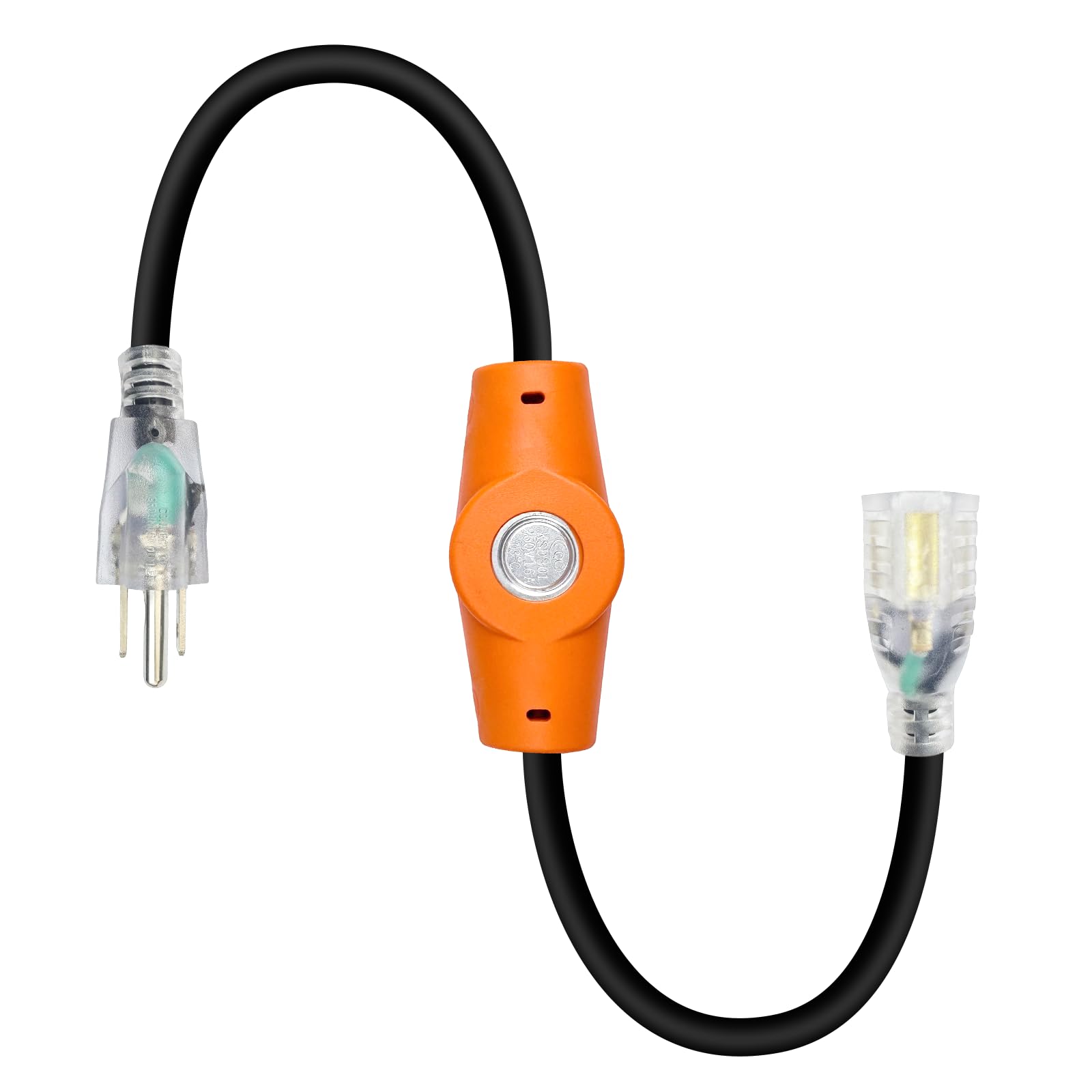
Type: Thermostatically controlled outlet extension cord
On Temperature: 37°F
Off Temperature: 50°F
Cord Length: 20 inches
Rating: 15A, 120V
Use: Covered outdoor plug
Thermostatically Controlled Outlet Extension Cord
This unit combines the thermostat and a short extension cord in one piece, which solves a specific problem: the socket is in a covered outdoor position but the heater is a little further away. The 20-inch cord bridges that gap without a separate extension lead, and the 37°F on and 50°F off points sit between the two extremes of the other picks. The 15A, 120V rating covers most domestic conservatory heaters.
It suits a conservatory with an external or covered socket where a standard plug-in thermostat would hang awkwardly or be exposed. The single-piece design keeps the connection tidy and reduces the number of joints in a damp location. The trade-off is that 20 inches is a short reach — a buyer whose socket is well away from the heater will still need a separate extension, which partly defeats the purpose.
4. Frost King 09900A Roof Cable Thermostat

Type: Self-regulating thermostat for heat cable kits
Use: Roof deicing and gutter heating
Control: Automatic
Colour: Black
Frost King 09900A Roof Cable Thermostat
This is the specialist of the group. It is built to control heat cable rather than a freestanding heater, so it belongs in a conservatory where the frost risk comes from the roof, gutters or a glazed roof edge rather than from the floor. The self-regulating design works with heat cable kits, switching the cable automatically as conditions demand. For a conservatory with a shallow or flat roof that ices over, this is the control that addresses the actual problem.
It earns its place for buyers who have already installed, or plan to install, roof or gutter heating cable and need the switching side of the system. It is not a general-purpose room thermostat, and a buyer wanting to run a plug-in heater should look elsewhere in this list. The trade-off is narrow compatibility: it is designed around cable kits, so it offers little value in a conservatory without one.
5. Thermostatically Controlled Outlet Freeze Protection Switch

Type: Thermostatically controlled outlet switch
On Temperature: 38°F
Off Temperature: 50°F
Plug: Heavy-duty, 120V
Control: Automatic
Thermostatically Controlled Outlet Freeze Protection Switch
This switch uses the same 38°F on and 50°F off points as the HEATIT unit but pairs them with a heavy-duty plug, which matters when the heater draws a steady current for long stretches. The automatic control needs no setting up, and the heavy-duty plug is the feature that distinguishes it from the cheapest plug-in thermostats. It suits a conservatory running a larger heater, or one where the plug is asked to carry load through the coldest weeks without complaint.
It is the value pick for buyers whose main worry is the plug rather than the temperature points. Where a lightweight plug might feel like the weak link in a system running all night, this one is built for the job. The trade-off is that the fixed points offer no fine tuning, and a buyer wanting adjustable cut-in and cut-out temperatures will need a different class of controller entirely.
Before You Buy
- Temperature points: Check the on and off temperatures against the conservatory’s needs — a 35°F trigger protects against frost, while a 38°F trigger keeps the room a little warmer.
- Outlet count: A single outlet suits one heater; a double outlet is worth having for a heater plus a fan or two small heaters.
- Load rating: Match the 15A, 120V rating to the heater’s draw, and favour a heavy-duty plug for a heater that runs for long periods.
- Socket position: Measure the distance from socket to heater — a short built-in cord helps only if the socket is close.
- Compatibility: A roof cable thermostat is for heat cable kits, not freestanding heaters; confirm the control matches the appliance.
- Housing: A weather-resistant housing is worth having in a conservatory where condensation and damp air are routine.
- Simplicity: Fixed-point thermostats need no setup and cannot be misconfigured, which suits a set-and-forget winter routine.
Frequently Asked Questions
-
What temperature should a conservatory frost thermostat switch on at?
A trigger around 35–38°F keeps the room above freezing with a margin. The 38°F models here hold a little more warmth; the 35°F model waits longer before switching on. -
Can a plug-in thermostat run an oil-filled radiator?
Yes, provided the radiator’s draw stays within the 15A, 120V rating. A heavy-duty plug is the safer choice for a radiator that runs for hours at a time. -
Is a double outlet worth it for one heater?
Only if a second appliance is likely — a small fan to move air, or a second heater at the cold end of the room. For a single heater, a single outlet is enough. -
Does a roof cable thermostat work with a normal space heater?
No. It is designed for heat cable kits and roof or gutter heating, not for a plug-in conservatory heater. -
Do these thermostats need wiring or an app?
No. Each unit plugs into a socket and the heater plugs into the unit; the switching is automatic and there is nothing to program. -
Will a weather-resistant housing survive a damp conservatory?
It is built for indoor and outdoor use, which makes it a sensible choice where condensation is routine, though the plug connection should still be kept off the floor.
Bottom Line
For most cold conservatories, the HEATIT ET-21 Freeze Protection Thermostat Outlet is the pick: 38°F on and 50°F off, a grounded outlet, a weather-resistant housing and nothing to configure. Buyers running two appliances should take the Farm Innovators TC-3 double outlet, and anyone with roof or gutter heat cable should go straight to the Frost King 09900A.
