Why there are Amazon links here: Brave Review is paid a commission for qualifying Amazon purchases made through the links below. Your price does not change, and using our links is entirely optional. How this works
Best Cable Tester for Home Ethernet: 5 Picks for Fast, Reliable Cable Checks
A home ethernet run that fails can waste hours, and the right tester turns that guessing game into a two-minute check. The five picks below cover the field: a budget continuity unit for a single reterminated jack, a mid-range wire mapper for a full patch panel, a professional-grade handheld for network installers, and one tool that adds PoE and cable-length testing for troubleshooting power-over-ethernet devices. The overview table below shows each pick at a glance, then each review explains who it suits.
Overview of the Picks
| Product | Key Spec | Best Use | Price Tier |
|---|---|---|---|
| Network Cable Tester (RJ11, RJ12, RJ45, CAT3, CAT5e, CAT6/6A) | RJ11/RJ12/RJ45, remote included | Whole-home jack and phone-line checks | Budget |
| TLP-123A Network Cable Tester | RJ11/RJ45, CAT5 to CAT7, UTP/STP | Cheap second tool for quick continuity | Budget |
| HT812A Network Ethernet Cable Tester | RJ45/RJ11, CAT5 to CAT7, UTP/STP | One-off repairs and telephone line finding | Budget |
| Klein Tools VDV526-200 LAN Scout Jr | RJ45 only, CAT5e/CAT6/6A, batteries included | Terminating new runs and patch panels | Mid-range |
| NOYAFA NF-8209 Network Cable Tester | PoE and NCV, length test, wire tracer | Troubleshooting PoE cameras and long runs | Premium |
Network Cable Tester with Remote (RJ11, RJ12, RJ45, CAT3, CAT5e, CAT6/6A)

Type: Handheld LAN and telephone tester
Connectors: RJ11, RJ12, RJ45
Cable support: CAT3, CAT5e, CAT6/6A
Remote unit: Included
Intended use: Home network and phone line testing
A two-piece tester with a main unit and a detachable remote, this model is built for checking a cable that runs between two rooms. The remote plugs into the far end, so one person can test a wall jack without walking back and forth. It handles both data and telephone connectors, which suits a home with legacy phone wiring alongside ethernet. The remote also makes it the better pick for verifying a jack that disappears behind furniture or into a basement.
Buyers comparing this unit against the cheaper picks are paying for the remote, and that is the main reason it earned a place here. It fits a homeowner who has just reterminated a wall jack and needs to confirm all eight conductors land correctly. The caution is that this is a continuity tester, not a certification tool: it confirms wiring order, not whether the cable will hit full gigabit speed over a long run.
Trade-off: The build is basic plastic at this price, so it is a tool for occasional home checks rather than daily job-site use.
TLP-123A Network Cable Tester for RJ11 RJ45 (Green)
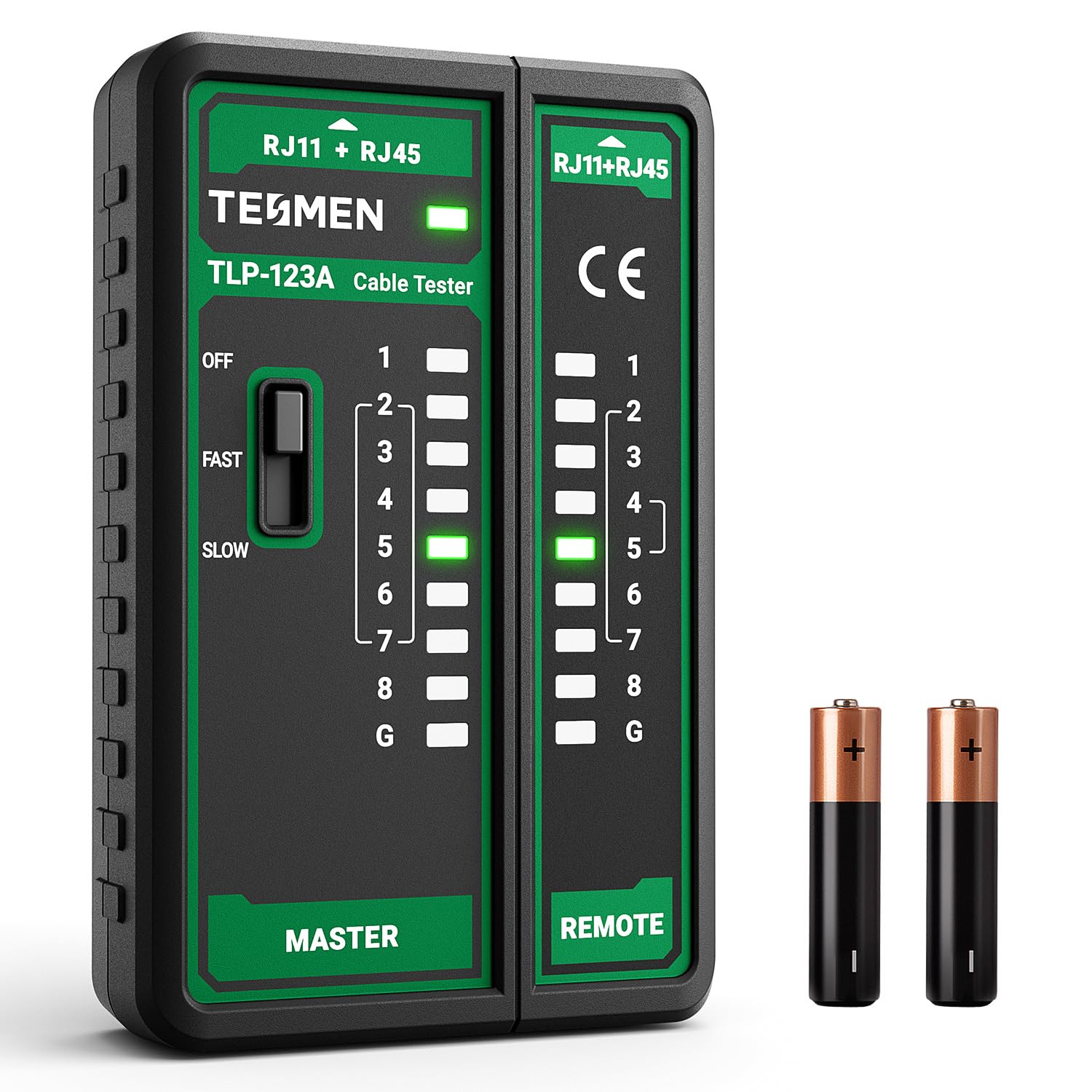
Type: Handheld continuity tester
Connectors: RJ11, RJ45
Cable support: CAT5, CAT5E, CAT6, CAT6A, CAT7
Shielding: UTP and STP
Intended use: LAN and telephone continuity checks
This is the value pick: a compact green handheld that covers both shielded and unshielded cable up to CAT7. It runs the standard continuity test across the pins and reports whether each conductor is connected in the right order. The CAT7 and STP support matters for a home that has moved to shielded runs for a workshop or a long outdoor-rated cable. It is small enough to live in a drawer and cheap enough to buy as a spare.
The pick suits a renter or first-time homeowner who wants one tool for occasional checks and does not want to spend much. It also works as a second tester to leave in a garage or shed. The caution is that a single-piece continuity tester means walking the cable to check both ends, which slows down testing a jack on the far side of the house.
Trade-off: No remote unit, so a two-person job or a lot of walking is needed to test a cable end to end.
HT812A Network Ethernet Cable Tester

Type: Handheld LAN tester
Connectors: RJ45, RJ11
Cable support: CAT5, CAT5E, CAT6, CAT6A, CAT7
Shielding: UTP and STP
Intended use: Home repair and telephone line finding
The HT812A is the lowest-cost way into ethernet testing, and its name calls out telephone line finding as a use case. It runs continuity checks across RJ45 and RJ11 connectors and supports the same CAT5 through CAT7 range as the pricier budget pick. For a household with a single misbehaving run or a phone jack that needs tracing, it covers the basics. The compact body fits in a toolbox and needs no setup.
This is the pick for the buyer who has one cable to check and does not want to spend more than necessary. It suits a quick repair after a move, or a check on a cable that was stapled into a wall years ago. The caution is the same as any single-unit continuity tester: it has no remote, and the low price means the display and connectors are built for occasional use rather than repeated plugging.
Trade-off: The bargain price points at a basic build, so expect a short working life if the tool is used heavily.
Klein Tools VDV526-200 LAN Scout Jr Cable Tester Kit

Type: Handheld LAN tester kit
Connectors: RJ45
Cable support: CAT5e, CAT6/6A
Included: Tester, remote, batteries
Intended use: Ethernet cable testing and termination checks
The LAN Scout Jr is the pro-grade pick from a well-known hand-tool brand, and it arrives as a kit with the remote and batteries in the box. It focuses on RJ45 ethernet only and covers CAT5e and CAT6/6A, which is exactly the range a modern home network uses. The remote makes end-to-end checks a one-person job, and the kit format means no separate trip for batteries. It is built for the person who terminates a lot of cable and wants a tool that holds up.
This pick suits a homeowner wiring a new build, a home-office installer, or anyone running cable through a patch panel and several rooms. It earns its place on build quality and the included remote. The caution is the lack of RJ11 support: a house with legacy telephone wiring needs a second tool for phone jacks.
Trade-off: RJ45 only, so this kit is the wrong choice for anyone who also needs to test telephone lines.
NOYAFA NF-8209 Network Cable Tester

Type: Multi-function network tester kit
Connectors: RJ45
Cable support: CAT5, CAT6
Features: PoE, NCV, wire tracer, length test
Intended use: Cable tracing and PoE troubleshooting
The NF-8209 is the most capable pick here and the one to choose when a simple continuity check is not enough. It adds PoE detection, non-contact voltage sensing, a wire tracer and a length test, which together cover the common home-network faults: a dead PoE camera, a cable that is too long for its run, or a wire that disappears into a wall. The wire tracer helps locate a specific cable in a bundle. The kit format keeps the tracer and adapters together.
Buyers who run PoE security cameras, access points or a smart doorbell get the most from this unit. It also suits anyone troubleshooting a long run where length is the suspect. The caution is complexity: the extra functions mean a learning curve, and a buyer who only needs a pass-or-fail continuity check is paying for features that will go unused.
Trade-off: The premium price buys features, not simplicity, so casual buyers may find it overkill.
Before You Buy
- Connector type: Match the tester to the jacks in the home. RJ45 covers ethernet; RJ11 and RJ12 cover telephone and DSL lines. A mixed setup needs a tester that supports both.
- Remote unit: A remote turns a two-person job into a one-person job. Testing a jack on the far side of the house is much faster with one.
- Cable category: Check the tester supports the cable in use. CAT5e and CAT6 are the home standard; CAT6A and CAT7 runs need a tester that lists them.
- Shielding: Shielded (STP) cable needs a tester rated for it. Unshielded (UTP) cable works with either.
- Extra functions: PoE detection, wire tracing and length testing matter for cameras and access points. A basic continuity tester is enough for a single reterminated jack.
- Build and included accessories: Batteries and a remote in the box save a separate purchase. A sturdier body matters for repeated use.
- Price tier: Budget testers confirm wiring order; premium testers diagnose faults. Match the spend to how often the tool will be used.
Frequently Asked Questions
-
What does a home ethernet cable tester actually check?
It checks continuity and wiring order: whether each conductor in the cable is connected and lands on the correct pin at both ends. That catches a bad crimp, a crossed pair or a broken wire. -
Is a cheap tester good enough for home use?
For occasional checks on a single jack, yes. A budget continuity tester confirms wiring order, which is the most common home fault. A premium tester adds PoE, tracing and length testing for more complex setups. -
Do I need a remote unit?
A remote is not required, but it makes testing a cable that runs between two rooms a one-person job. Without one, the tester has to be carried to both ends of the run. -
Can a cable tester tell me the cable speed?
No. A continuity tester confirms wiring, not throughput. A cable can pass continuity and still fall short of full speed on a long run; length testing helps flag that. -
What is PoE testing for?
PoE testing checks whether power is present on an ethernet cable. It matters for PoE cameras, access points and doorbells that draw power over the same cable as data. -
Do testers work on telephone lines?
Only models that list RJ11 or RJ12 support. A tester with RJ45 only will not check a phone jack, so a mixed home needs a dual-connector model.
Bottom Line
For most homes, the Network Cable Tester with Remote is the best cable tester for home ethernet: it covers RJ45 and telephone jacks, includes a remote for one-person testing, and stays in the budget tier. Buyers wiring a new home or running PoE cameras should step up to the Klein Tools kit or the NOYAFA NF-8209 for build quality and fault diagnosis.
