Why there are Amazon links here: Brave Review is paid a commission for qualifying Amazon purchases made through the links below. Your price does not change, and using our links is entirely optional. How this works
8 Best Generators for a House — Portable to Whole-Home Backup Power
A house generator is the difference between a short outage and a week of spoiled food, dead sump pumps, and dark rooms. This guide covers eight verified units across the range — portable dual-fuel and tri-fuel models that run a few circuits, inverter units for quieter smaller loads, and one automatic whole-home system that takes over without anyone flipping a switch.
The top pick for most households is the Westinghouse 12500 Watt Dual Fuel Home Backup Portable Generator. It balances real house-sized output, dual-fuel flexibility, and remote start at a price that undercuts the bigger tri-fuel units.
Picks were judged on power output and starting watts, fuel flexibility, transfer-switch readiness, starting method, and how well each unit matches a realistic house load. The overview table below puts all eight side by side; full reviews, a buying guide, and an FAQ follow.
At a Glance
| Product | Key Spec | Best Use | Price Tier |
|---|---|---|---|
| Westinghouse 12500 Watt Dual Fuel | 12,500 W, dual fuel, remote electric start | All-around home backup | Mid |
| Westinghouse 14500 Peak Tri-Fuel | 14,500 peak W, gas/propane/natural gas | Homes with natural gas hookup | Upper-mid |
| Westinghouse 14500 Peak Dual Fuel | 14,500 peak W, gas/propane, remote start | Large homes, no gas line | Upper-mid |
| Generac 14kW Whole Home with 200A Switch | 14 kW, automatic 200A transfer switch | Fully automatic whole-home | Premium |
| Power Equipment 4400 W Inverter | 4,400 W, inverter, ECO mode | Quiet essentials backup | Budget |
| 4400-Watt Inverter Open Frame | 4,400 W, inverter, 30A RV outlet | RV plus light home backup | Budget |
| Generac 12,500 Starting Watt Tri-Fuel | 12,500 starting W, tri-fuel, COsense | Fuel-flexible mid-size backup | Mid |
| Westinghouse 6500 Watt Dual Fuel | 6,500 W, dual fuel, CO sensor | Small homes and essentials | Entry |
Top 8 Best Generator for a House Reviews
Westinghouse 12500 Watt Dual Fuel Home Backup Portable Generator

Type: Portable home backup generator
Power source: Gas and propane (dual fuel)
Starting: Remote electric start
Transfer switch: Ready
Rated output: 12,500 watts
This is the unit that fits the widest range of houses, which is why it heads the list. The 12,500-watt rating is enough to carry a well pump, refrigerator, furnace blower, and a spread of lights and outlets through an outage, and the dual-fuel design means a propane tank can keep it running when gasoline is hard to find after a storm.
Remote electric start is the feature that matters most in bad weather — the unit can be started from indoors rather than in the rain. Transfer-switch readiness means an electrician can wire it into a house panel for a cleaner, safer connection than running cords through a window.
The caution is weight and noise. A generator at this output level is heavy and needs two people to move, and open-frame units of this size are loud enough to draw complaints in a dense neighborhood. Buyers without a paved path to the outdoor location should plan the placement before delivery.
Trade-off: High output and dual-fuel flexibility come with a heavy, loud open-frame package that is awkward to relocate.
Check the current price on Amazon
Westinghouse 14500 Peak Watt Tri-Fuel Home Backup Portable Generator
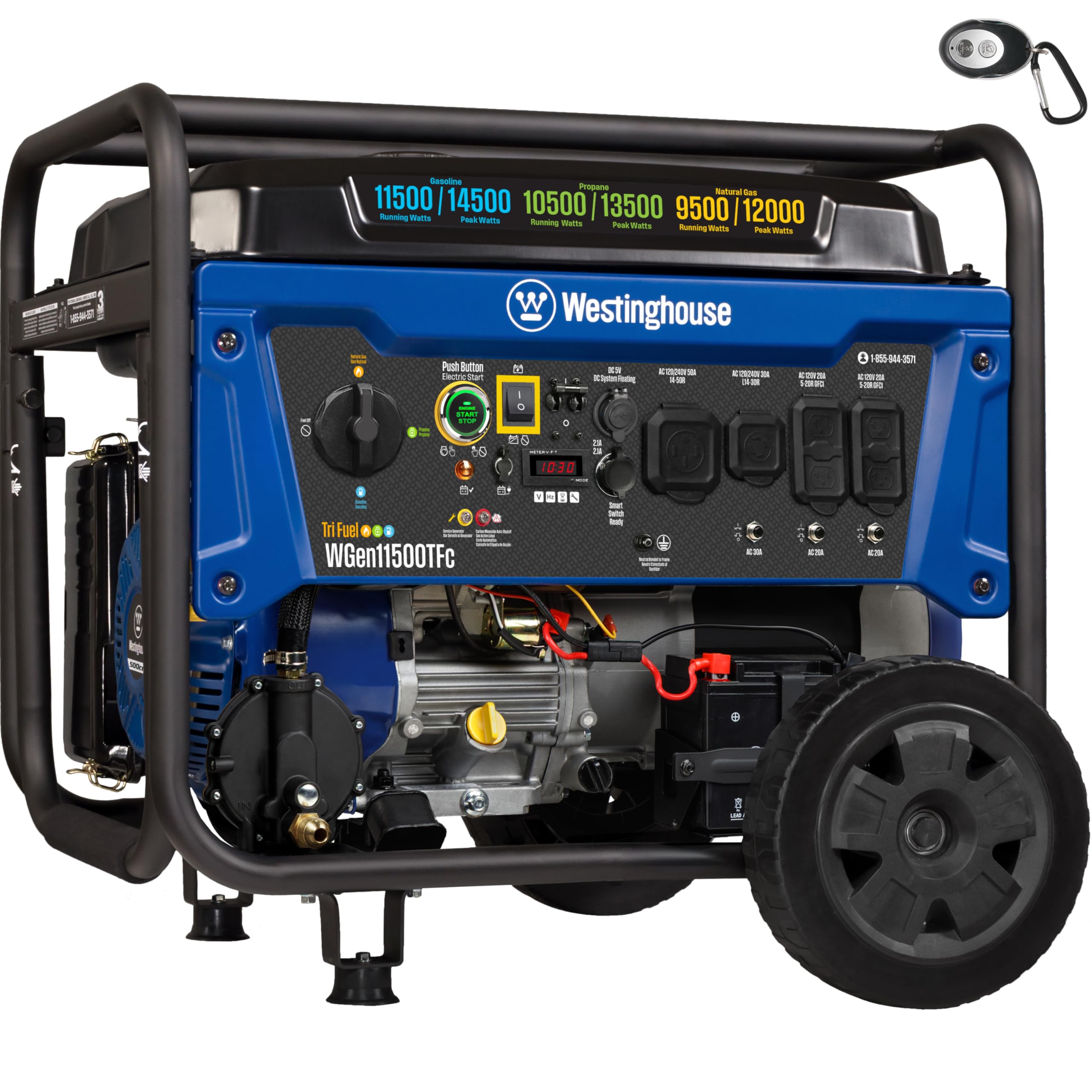
Type: Portable home backup generator
Power source: Gas, propane, and natural gas (tri-fuel)
Starting: Remote electric start
Transfer switch: Ready
Peak output: 14,500 watts
Tri-fuel is the headline here. Gasoline and propane are common, but natural gas is the fuel that never runs out during a regional outage — a home already plumbed for gas can run this unit indefinitely off the meter. That makes it the pick for houses in areas where storms knock out both power and fuel deliveries.
The 14,500 peak wattage puts it above the 12,500-watt unit for starting large loads like central air or a big well pump. Remote start and transfer-switch readiness carry over, so the installation path is the same.
The trade-off is cost and complexity. Tri-fuel units sit at a higher price tier, and natural-gas operation usually needs a qualified installer to set up a safe connection. Buyers without a gas line get no benefit from the third fuel and should look at the dual-fuel version instead.
Trade-off: The natural-gas capability adds cost and installation complexity that only pays off for homes already plumbed for gas.
Check the current price on Amazon
Westinghouse 14500 Peak Watt Dual Fuel Home Backup Portable Generator
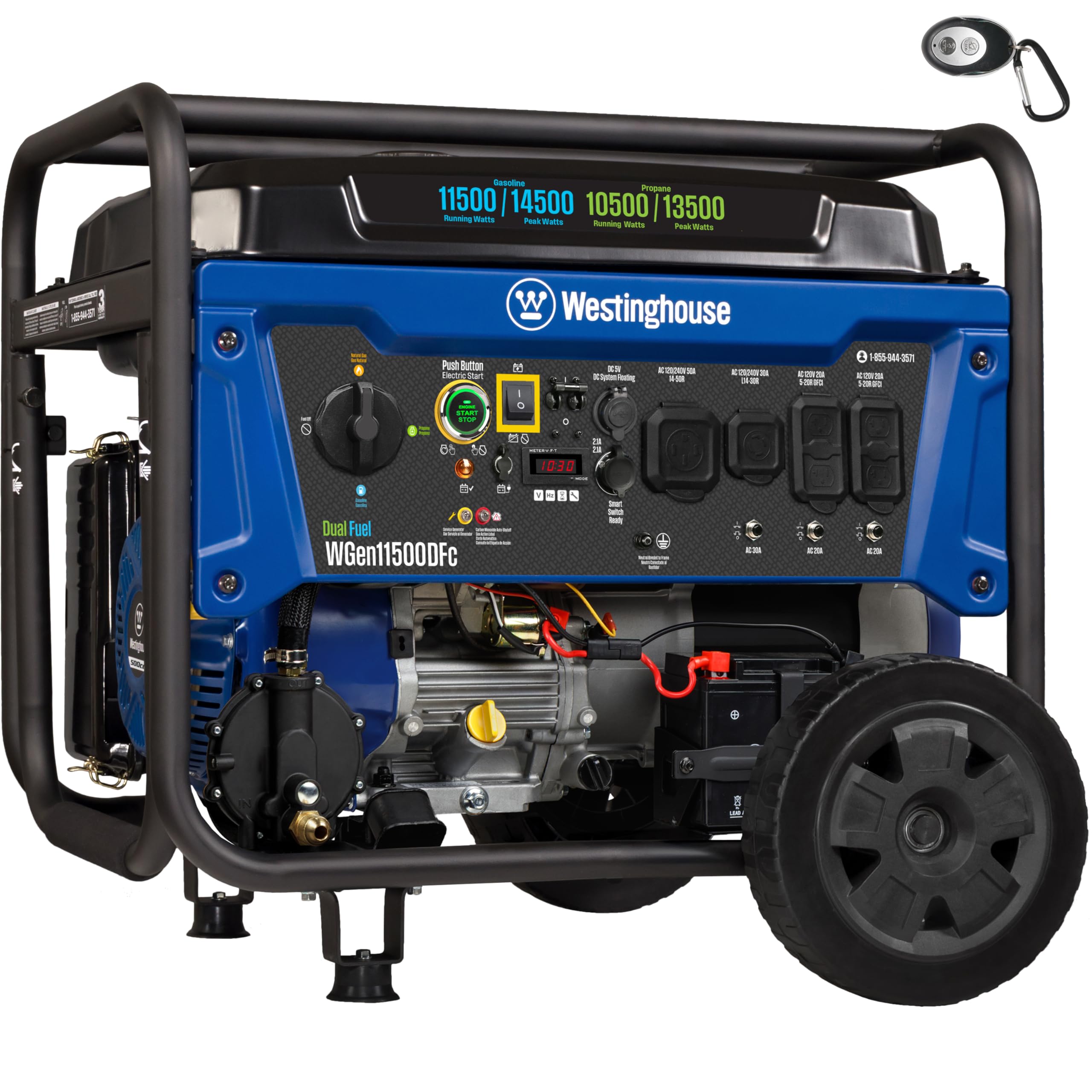
Type: Portable home backup generator
Power source: Gas and propane (dual fuel)
Starting: Remote electric start
Transfer switch: Ready
Peak output: 14,500 watts
This is the same high-output platform as the tri-fuel unit but without the natural-gas option, which makes it the better fit for large homes that rely on gasoline and propane. The 14,500 peak watts give it the headroom to start big inductive loads — air conditioning, well pumps, freezers — that smaller units stall on.
Remote electric start and transfer-switch readiness mean the same convenient setup: start it from the house, feed a panel through a proper switch. For a household with a long list of circuits to keep alive, the extra peak capacity over the 12,500-watt model is worth the step up.
The caution is fuel consumption. A generator this size drinks gasoline and propane quickly under load, so buyers should plan for a rotating fuel supply and safe storage. It is also a heavy open-frame unit that is not practical to carry up stairs.
Trade-off: The higher peak output burns fuel faster, so a sustained outage demands a serious fuel stockpile and storage plan.
Check the current price on Amazon
Generac 14kW Whole Home Generator with 200 Amp Transfer Switch

Type: Automatic whole-home standby generator
Power source: Outdoor gas propane
Transfer switch: Automatic 200 amp
Output: 14 kW
Monitoring: Cellular capability
This is the only unit on the list that does not need a person present. It is a permanently installed standby generator paired with a 200-amp automatic transfer switch — when utility power drops, the switch disconnects the grid and the generator takes over the whole panel on its own, then shuts down when power returns.
Cellular capability adds remote monitoring, so the homeowner can check status without walking outside. For anyone who travels, is elderly, or has critical equipment like a sump pump or medical device, automatic operation is the real selling point.
The trade-off is the price tier and the installation. A whole-home system at this level is a premium purchase that requires professional installation, a fuel supply, and permitting. It is not a DIY product, and the total cost is far above any portable unit here.
Trade-off: Premium price and professional installation put this well beyond the budget and effort of a portable generator.
Check the current price on Amazon
Power Equipment 4400 Watts Inverter Generator
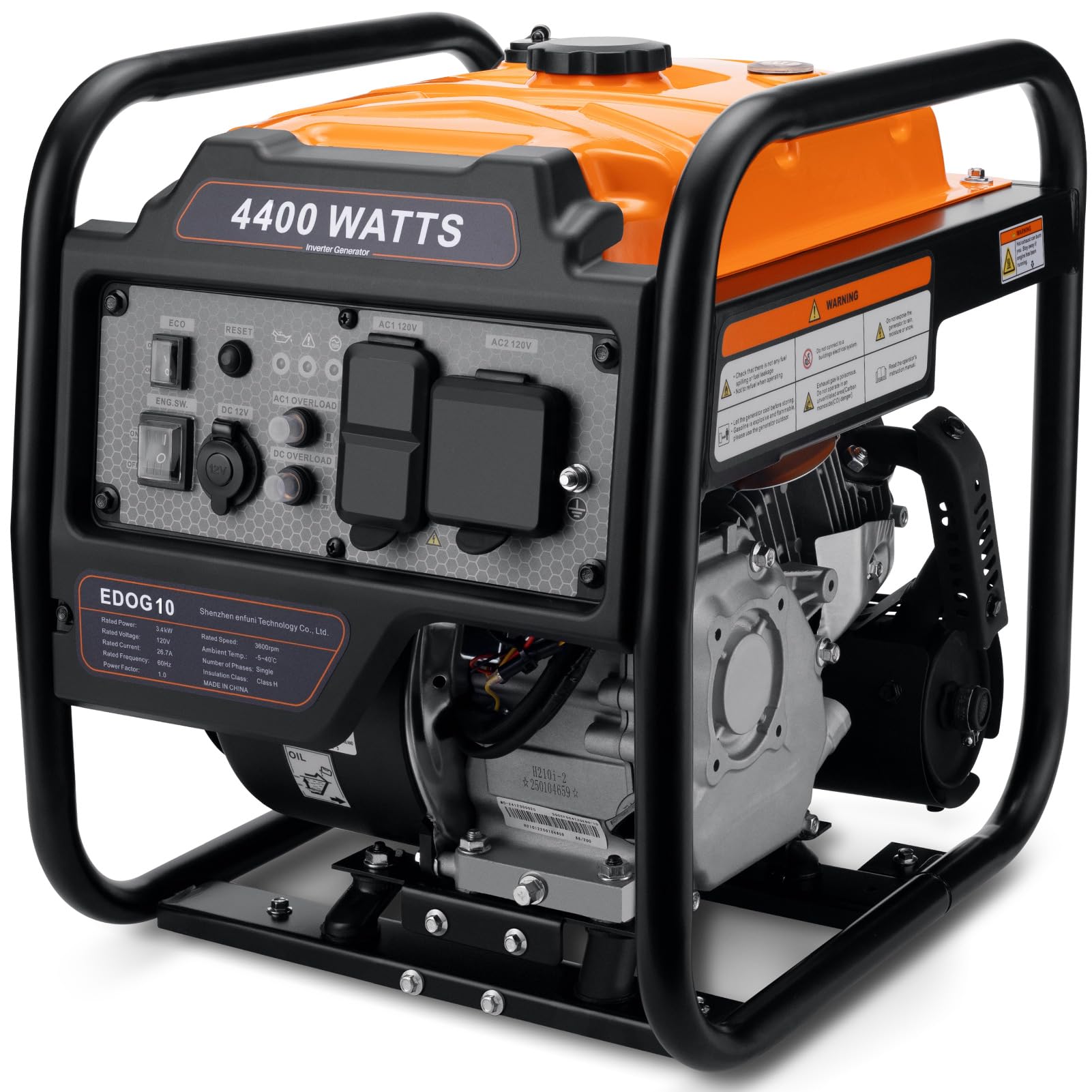
Type: Portable inverter generator
Power source: Gas
Output: 4,400 watts
Noise: Low noise with ECO mode
Use: RV ready, emergency home backup
Inverter generators produce cleaner power and run quieter than open-frame conventional units, and this one adds ECO mode to throttle down when the load is light. That combination makes it the pick for households that want to keep the essentials running — fridge, lights, internet, phone charging — without the noise of a full-size unit.
At 4,400 watts it is not a whole-house solution. It covers a few circuits, which is exactly what many small homes and apartments actually need during a short outage.
The caution is capacity. Buyers with electric heat, central air, or a well pump should not expect this unit to carry them; it is an essentials-only machine. Running it on gasoline only also means fuel storage is part of the plan.
Trade-off: The quiet inverter design trades total capacity for portability, so it cannot carry large house loads.
Check the current price on Amazon
4400-Watt Inverter Generator, Open Frame
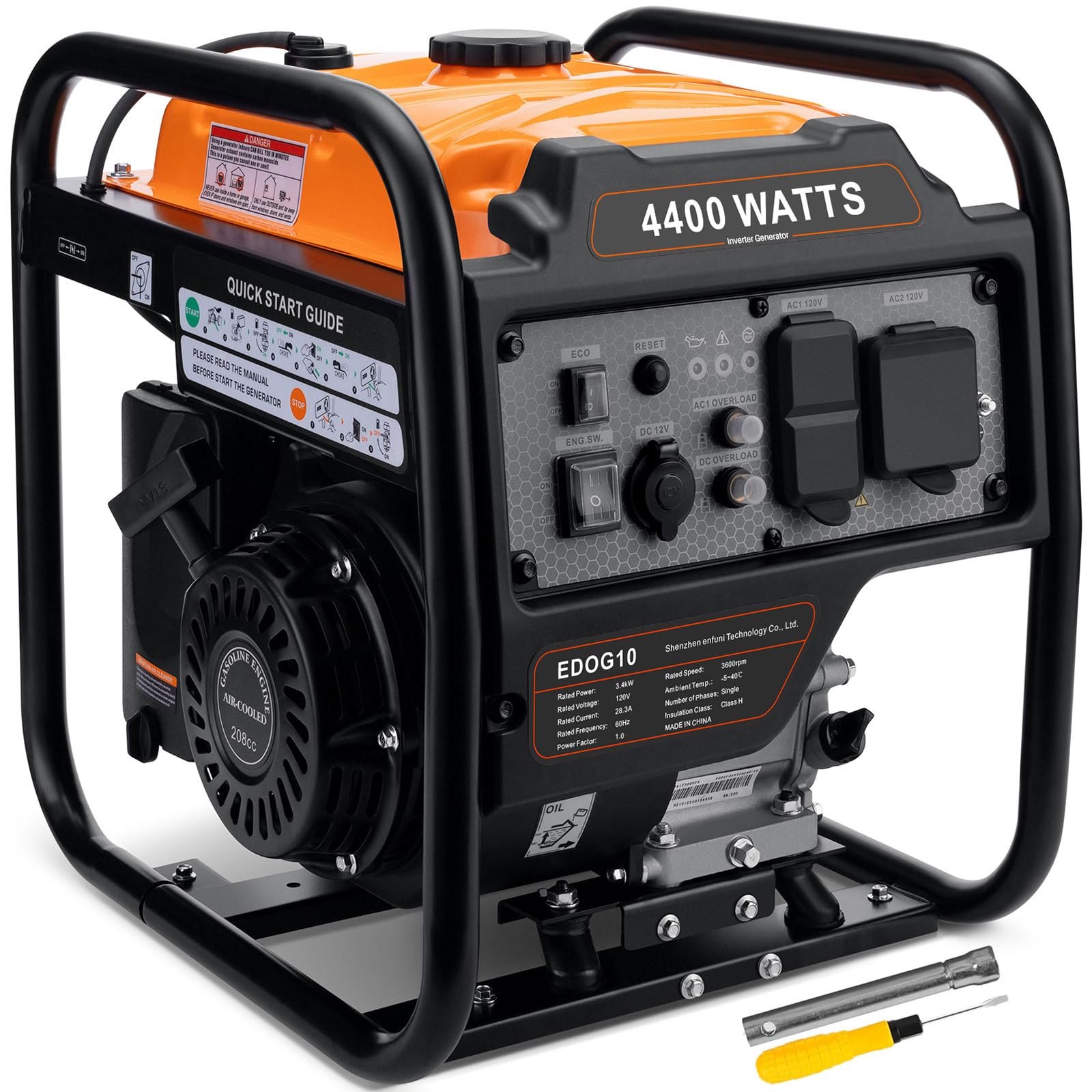
Type: Portable inverter generator
Power source: Gas
Output: 4,400 watts
Outlet: RV ready 30A
Compliance: EPA compliant
This unit matches the inverter class above but leans toward RV use with its 30A outlet, which also suits a transfer-switch connection for a small home circuit. Inverter output is stable enough for sensitive electronics, so laptops, routers, and TVs run without concern.
It is a sensible dual-purpose buy: run the RV on trips, then roll it out for home essentials during an outage. The price tier is budget-friendly for an inverter, especially with a coupon available.
The weak spot is the open-frame housing. It is an inverter, so it runs quieter than a conventional open-frame generator, but the exposed frame does less to contain noise than a fully enclosed inverter case. Buyers who need near-silent operation should weigh that against the lower price.
Trade-off: The open-frame housing keeps the price down but lets more noise escape than an enclosed inverter design.
Check the current price on Amazon
Generac 12,500 Starting Watt Tri-Fuel Portable Generator
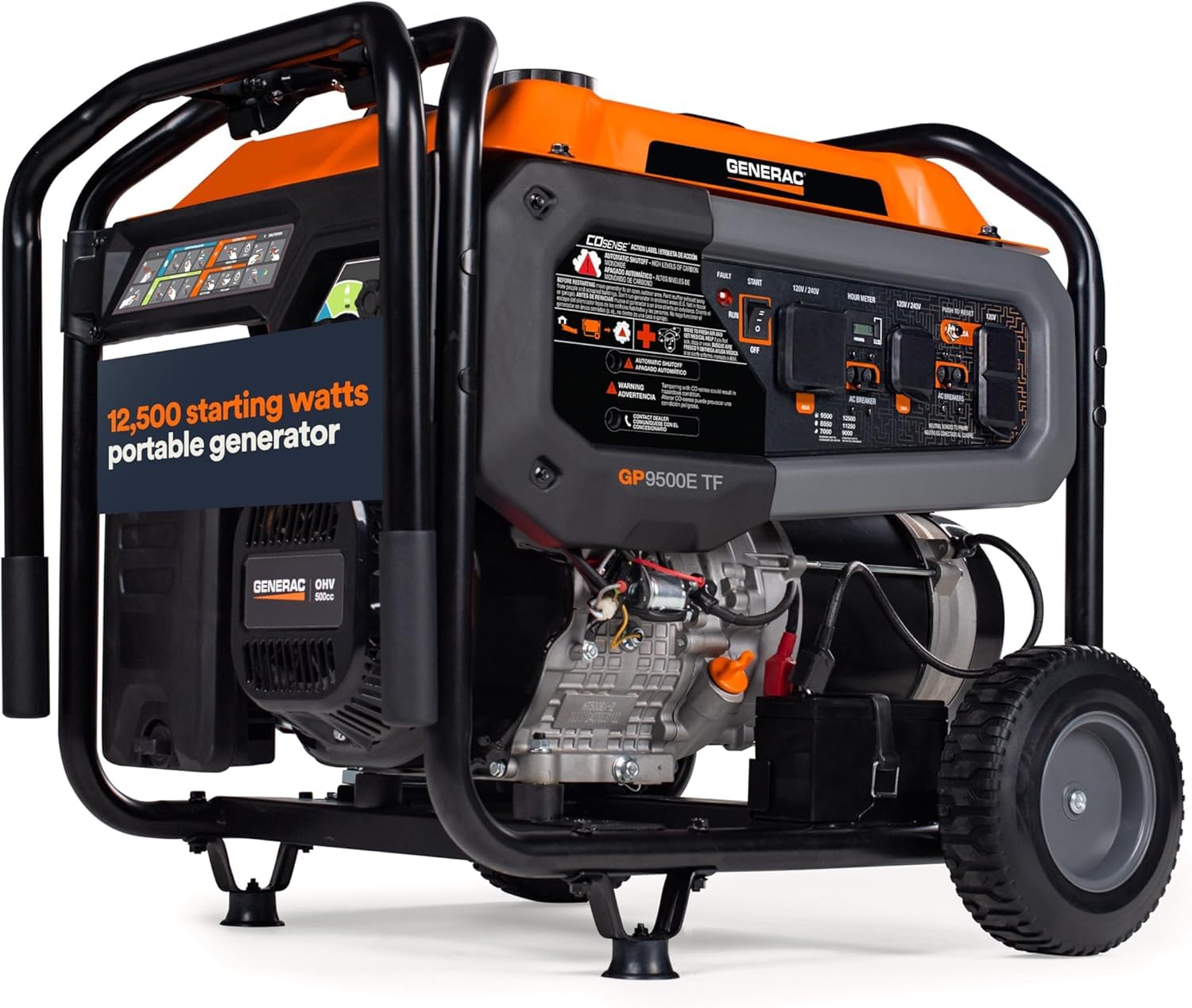
Type: Portable home backup generator
Power source: Gas, propane, or natural gas (tri-fuel)
Starting: Electric start
Safety: COsense CO detection
Runtime: 9.5 hours
Compliance: 49 state compliant
This is the mid-size tri-fuel option, and it carries two features worth noting. COsense carbon monoxide detection shuts the unit down if CO builds up to a dangerous level — a meaningful safety layer for a generator running near a house. The 9.5-hour runtime figure gives buyers a planning number for overnight outages.
Tri-fuel flexibility means it can run off a home’s natural gas line, propane, or gasoline, which suits households that want options without stepping up to the largest units. Electric start keeps the setup simple.
The trade-off is that 12,500 starting watts is a starting figure, and sustained running capacity is lower — buyers with heavy loads should size carefully rather than assume the full number is continuous. The 49-state compliance note also means it is not for California buyers.
Trade-off: The 12,500-watt figure is a starting rating, and the unit is not compliant for sale in California.
Check the current price on Amazon
Westinghouse 6500 Watt Dual Fuel Home Backup Portable Generator

Type: Portable home backup generator
Power source: Gas and propane (dual fuel)
Output: 6,500 watts
Outlets: Transfer switch ready 30A, RV ready 30A
Safety: CO sensor
The 6,500-watt dual-fuel unit is the entry point for whole-circuit backup. It is enough to run a refrigerator, furnace, lights, and a few outlets through an outage, and the dual-fuel design gives the option of propane when gasoline runs short.
The 30A transfer-switch-ready outlet makes it easy to connect to a house panel through a proper switch, and the matching 30A RV outlet adds travel flexibility. A built-in CO sensor adds a safety layer for close-to-home placement.
The caution is capacity relative to the larger units. Houses with electric heat, central air, or large well pumps will find 6,500 watts limiting and should size up. It is best treated as an essentials generator rather than a whole-house solution.
Trade-off: The lower output makes this an essentials-only unit that will not carry central air or electric heat.
Check the current price on Amazon
Before You Decide
The first decision is how much of the house needs to stay powered. Essentials-only backup points to a 4,400-watt inverter or the 6,500-watt dual-fuel unit, while whole-home coverage needs the 12,500-watt class or the automatic Generac system. The second decision is fuel: natural gas never runs out but requires a gas line, propane stores well, and gasoline is easy to find until a storm hits.
What It Changes
- Keeps refrigerators and freezers running so food does not spoil during multi-day outages.
- Powers sump pumps and furnace blowers, protecting the house from water damage and frozen pipes.
- Runs medical devices and internet equipment for remote work and health needs.
- Removes dependence on utility restoration timelines after storms.
- Provides portable power for RV trips and job sites between outages.
- Automatic systems protect the home even when nobody is there to start a generator.
The Buying Guide
Output and Starting Watts
Running watts set what the generator can carry continuously; starting watts cover the surge that motors draw at startup. Air conditioners, well pumps, and freezers all spike well above their running draw, so buyers should add up starting loads, not just nameplate watts. The Westinghouse 12500 Watt Dual Fuel sits in the range that handles a full spread of house loads, while the Power Equipment 4400 W Inverter is sized for essentials only.
Fuel Type
Gasoline is convenient but stores poorly and disappears from stations during regional outages. Propane stores indefinitely and is the safer long-term fuel. Natural gas is the only option that never runs out, but it requires a home gas line and professional hookup. Tri-fuel units like the Generac 12,500 Starting Watt Tri-Fuel cover all three.
Transfer Switch and Connection
Running cords through windows is unsafe and limited. A transfer switch connects the generator to the house panel properly, and a 30A transfer-switch-ready outlet is the common path for portable units. Buyers should confirm the outlet type matches their planned switch before purchase.
Starting Method
Remote and electric start matter in bad weather. Pull-start units require going outside in the storm; remote electric start lets the unit be fired up from indoors. All the larger units here carry electric or remote start, and the Generac whole-home system starts itself with no human involvement.
Noise and Placement
Open-frame generators are loud; inverter models run quieter and produce cleaner power. Placement matters for both noise and safety — units must run outdoors, away from windows and doors, with clearance for exhaust. CO detection, as on the Westinghouse 6500 Watt Dual Fuel, adds a safety layer for close placement.
Automatic vs. Manual Operation
Portable generators require someone to start them, connect them, and refuel them. Standby systems with an automatic transfer switch handle all of that, which matters for travel, mobility limitations, or critical equipment. The trade-off is price and professional installation.
FAQ
-
How many watts does a house need from a generator?
It depends on what must stay on. Essentials like a fridge, lights, and furnace typically need a few thousand watts, while whole-home coverage with central air and a well pump needs the 12,500-watt class or a 14 kW standby system. Buyers should add up starting watts for every motor-driven appliance. -
Is dual fuel or tri-fuel better for a house?
Tri-fuel adds natural gas, which never runs out during an outage, but it only helps homes already plumbed for gas. Homes without a gas line get the same benefit from a dual-fuel unit at a lower price and with less installation work. -
Can a portable generator power a whole house?
A large portable unit can carry most or all of a house’s circuits when connected through a transfer switch, but it requires manual starting and refueling. A permanently installed standby system does the same job automatically. -
How long can a generator run during an outage?
Runtime depends on load and fuel supply. The Generac tri-fuel unit lists a 9.5-hour runtime, and larger units burn fuel faster under heavy load. Buyers should plan a rotating fuel supply for outages lasting more than a day. -
Are inverter generators safe for electronics?
Yes. Inverter generators produce stable, clean power suitable for laptops, routers, and TVs, which is why they are popular for both RV use and home essentials backup. -
Does a generator need a transfer switch?
A transfer switch is the safe way to connect a generator to house wiring. It prevents backfeeding the grid, which endangers utility workers, and it lets the generator power selected circuits through the panel rather than extension cords.
Bottom Line
For most houses, the Westinghouse 12500 Watt Dual Fuel Home Backup Portable Generator is the best generator for a house — real house-sized output, dual-fuel flexibility, remote start, and transfer-switch readiness at a mid-tier price. Buyers who want automatic, hands-off protection should step up to the Generac 14kW Whole Home Generator, while households that only need the essentials can save with a 4,400-watt inverter.
