Why there are Amazon links here: Brave Review is paid a commission for qualifying Amazon purchases made through the links below. Your price does not change, and using our links is entirely optional. How this works
Best Network for a Home With Cameras: 5 Mesh Systems That Keep Every Feed Live
A home full of security cameras lives or dies on its network. Every camera streaming to the cloud competes for upload bandwidth, and every dead corner of Wi-Fi turns into a dropped feed or a missed clip. The five mesh systems below are chosen for camera-heavy homes: one budget pick, three mainstream performers, and one premium multi-gig option for large properties with a lot of devices. The overview table shows the key differences up front; the full reviews explain who each one suits.
Overview of the Picks
| Product | Key Spec | Best Use | Price Tier |
|---|---|---|---|
| TP-Link Deco S4 (3-Pack) | AC1900 dual-band, up to 5,500 sq ft | Budget camera homes | Budget |
| TP-Link Deco X55 (3-Pack) | AX3000 WiFi 6, up to 6,500 sq ft | Most homes with cameras | Mid-range |
| NETGEAR Orbi 370 (3-Pack) | WiFi 7 dual-band, up to 6,000 sq ft | Easy Orbi setup | Mid-range |
| NETGEAR Orbi 770 (3-Pack) | WiFi 7 tri-band, up to 8,000 sq ft | Large homes, many devices | Upper mid-range |
| TP-Link Deco BE63 (2-Pack) | WiFi 7 tri-band, 10 Gbps, 2.5G ports | Premium, multi-gig backhaul | Premium |
TP-Link Deco S4 Mesh AC1900 WiFi System, Deco S4(3-Pack)

Coverage: Up to 5,500 sq ft
Standard: AC1900 dual-band Wi-Fi
Units: 3-pack
Ports: Gigabit ports
Voice control: Works with Alexa
Design: Replaces existing router and extender
Check the current price on Amazon
The Deco S4 is the value entry point for a camera-heavy home. Three units blanket a mid-size house in dual-band Wi-Fi, and the gigabit ports handle a wired camera or a small switch without drama. It replaces an aging router and extender setup with a single mesh network, which matters when cameras need to roam between rooms without dropping.
This pick suits renters and first-time mesh buyers running a handful of cameras on a budget. It earns its place as the cheapest way to get whole-home coverage with wired ports. The trade-off is that dual-band AC Wi-Fi shares airtime with every other device, so a large camera count on a busy network will feel the squeeze.
Trade-off: Older AC Wi-Fi and no dedicated backhaul mean this system is the first to struggle as camera count and streaming load grow.
TP-Link Deco X55 AX3000 WiFi 6 Mesh System, Deco X55(3-Pack)

Coverage: Up to 6,500 sq ft
Standard: AX3000 WiFi 6
Units: 3-pack
Ports: 3 Gigabit ports per unit
Backhaul: Supports Ethernet backhaul
Design: Replaces wireless router and extender
Check the current price on Amazon
The Deco X55 is the sweet spot for most camera homes. WiFi 6 handles many connected devices far better than older AC gear, and three gigabit ports per unit make it easy to hardwire cameras or a small switch where the signal is weakest. Ethernet backhaul support means the mesh can run on cable between units for a rock-solid backbone.
This pick suits households with a growing camera count that want modern Wi-Fi without paying flagship prices. It earns its place as the best all-rounder here. The trade-off is that the X55 is dual-band, so the fastest speeds and the heaviest camera traffic still share the same lanes.
Trade-off: Dual-band design leaves no dedicated backhaul radio, so wired Ethernet between units is the only way to keep camera traffic off the main Wi-Fi.
NETGEAR Orbi 370 Series WiFi 7 Mesh System, 3 Pack

Coverage: Up to 6,000 sq ft
Standard: WiFi 7 dual-band, up to 5 Gbps
Devices: Up to 70 devices
Ports: 2.5 Gig port
Units: Router + 2 satellite extenders
Setup: Easy set up, security features included
Check the current price on Amazon
The Orbi 370 brings WiFi 7 to a mid-size home without the flagship price. A router plus two satellites cover around 6,000 square feet, and the 2.5 Gig port gives a fast wired link to a NAS or a switch full of cameras. The 70-device rating is comfortable for a camera-heavy smart home.
This pick suits buyers who want the latest Wi-Fi standard and Orbi’s straightforward setup. It earns its place for homes that value ease of use over raw throughput. The trade-off is that dual-band WiFi 7 delivers the standard’s efficiency gains but not its full multi-gig ceiling.
Trade-off: Dual-band WiFi 7 and a single 2.5 Gig port cap the wired ceiling, so this is not the pick for buyers chasing maximum multi-gig throughput.
NETGEAR Orbi 770 Series WiFi 7 Mesh System, 3 Pack

Coverage: Up to 8,000 sq ft
Standard: WiFi 7 tri-band, up to 11 Gbps
Devices: Up to 100 devices
Ports: 2.5 Gig port
Units: Router + 2 satellite extenders
Setup: Easy set up, security features included
Check the current price on Amazon
The Orbi 770 is built for big homes with a lot of connected gear. Tri-band WiFi 7 adds a dedicated lane for mesh traffic, so camera streams and backhaul no longer fight for the same airtime. Coverage reaches around 8,000 square feet and the 100-device rating covers a serious camera and smart-home load.
This pick suits large properties and buyers running a dozen or more cameras. It earns its place as the best Orbi for camera density. The trade-off is that the 2.5 Gig port, not multi-gig, is the wired limit, and the price climbs well above the mid-range.
Trade-off: The 2.5 Gig wired port is modest for a system at this price, and only very large homes will justify the outlay over the 370.
TP-Link Deco 7 Pro BE63 Tri-Band WiFi 7 BE10000 Whole Home Mesh System (2-Pack)
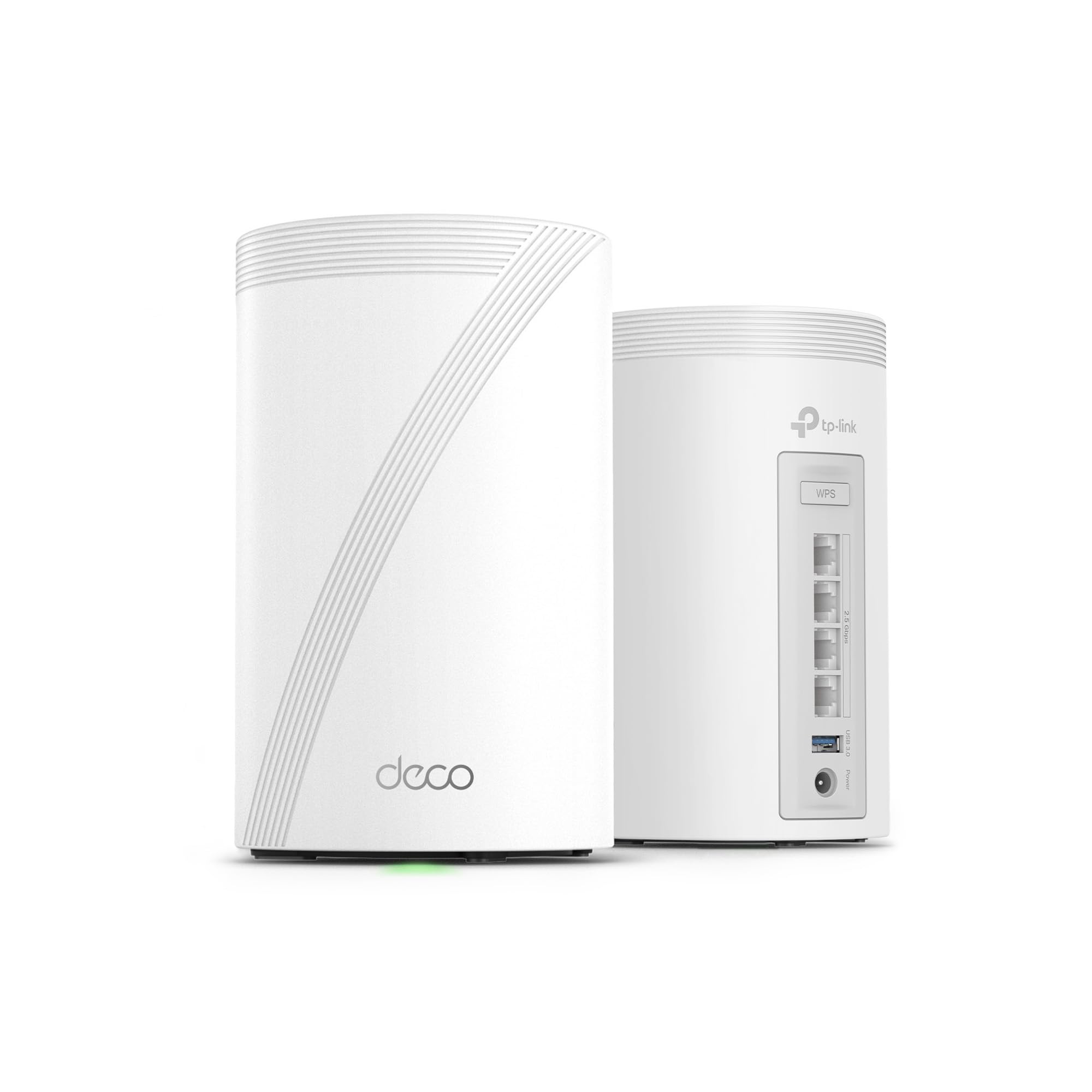
Standard: WiFi 7 tri-band, BE10000, 6-stream
Speed: Up to 10 Gbps
Ports: 4x 2.5G ports, wired backhaul
Antennas: 4x smart internal antennas
Features: VPN, HomeShield
Units: 2-pack
Check the current price on Amazon
The Deco BE63 is the premium pick for camera-heavy homes that want headroom. WiFi 7 tri-band with 6 streams and a 10 Gbps rating gives the mesh plenty of capacity, and four 2.5G ports per unit support wired backhaul and a switch full of cameras. HomeShield security and VPN support round out the package.
This pick suits buyers with multi-gig internet, a large camera array, and a wired backbone. It earns its place as the most capable system here. The trade-off is the price: a two-pack costs more than most three-packs, and only a wired, multi-gig home will use its full potential.
Trade-off: Premium pricing and only two units mean buyers pay for capacity they may not need unless the home already has multi-gig internet and wired backhaul.
Before You Buy
- Coverage: Match the square-foot rating to the home, then add a unit for thick walls or a detached garage with cameras.
- Backhaul: Ethernet backhaul between units keeps camera traffic off Wi-Fi and is the single biggest reliability upgrade.
- Standard: WiFi 6 is the practical minimum for many cameras; WiFi 7 helps most in dense, device-heavy homes.
- Ports: Count the wired ports per unit against the number of cameras and switches that need a cable.
- Device count: Check the rated device limit against cameras plus phones, TVs, and smart-home gear.
- Security features: Built-in security and VPN support matter when cameras stream to the cloud.
Frequently Asked Questions
-
How many cameras can one mesh system handle?
Most systems here rate for 70 to 100 devices, which comfortably covers a typical camera count plus household gear. Dense setups benefit from tri-band and wired backhaul. -
Is WiFi 7 worth it for security cameras?
WiFi 7 helps most in crowded homes where many devices compete for airtime. For a small camera count, WiFi 6 is usually enough. -
Does Ethernet backhaul help cameras?
Yes. Wired backhaul frees the wireless bands for camera streams and keeps mesh units stable, which reduces dropped feeds. -
Do these systems replace an existing router?
The Deco models are designed to replace a router and extender, while the Orbi kits include a router and satellites. Either way, the old router comes out of the chain. -
Will a mesh system work with wired cameras?
Yes, as long as the units have enough gigabit or 2.5G ports. The Deco X55 and BE63 are the strongest here for wired camera counts.
Bottom Line
For most camera homes, the TP-Link Deco X55 is the best network for a home with cameras: WiFi 6, three gigabit ports per unit, and Ethernet backhaul at a mid-range price. Buyers with large properties and many cameras should step up to the Orbi 770, and multi-gig homes with wired backhaul get the most from the Deco BE63. Budget buyers can start with the Deco S4 and upgrade as the camera count grows.
