Why there are Amazon links here: Brave Review is paid a commission for qualifying Amazon purchases made through the links below. Your price does not change, and using our links is entirely optional. How this works
Best WiFi Analyzer for Finding Interference: 5 Tools That Pinpoint Signal Problems
Interference is the invisible reason a network drops packets, and the right handheld analyzer makes it visible in seconds. This roundup covers five tools for three kinds of buyers: home and small-office users chasing a congested 2.4 GHz band, tinkerers and radio hobbyists who want to see the whole RF picture, and IT pros running site surveys on managed networks. The overview table below ranks all five by their strongest capability so a pick can be made before reading a single review.
Overview of the Picks
| Product | Key Spec | Best Use | Price Tier |
|---|---|---|---|
| SeeSii TinySA Ultra+ ZS406 Spectrum Analyzer | 100kHz to 5.4GHz range, 4.0 inch screen | Wideband interference hunting | Mid |
| WiFi Analyzer 2.4G 5G TFT Screen Aluminum Casing | Dual band, TFT screen | Dedicated WiFi-only scanning | Mid |
| EMF Meter GQ EMF-390 Multi-Field | RF up to 10GHz, data logger | EMF plus RF combined checks | Mid |
| WiFi Analyzer 2.4 Inch TFT Color Screen | 600mAh rechargeable battery | Budget signal strength checks | Budget |
| NetAlly AirCheck G3 Pro | Wi-Fi 6 & Wi-Fi 7 tester | Professional site surveys and audits | Premium |
1. SeeSii TinySA Ultra+ ZS406 Spectrum Analyzer

Range: 100kHz to 5.4GHz
Display: 4.0 inch
Form Factor: Handheld
Storage: 32Gb card included
Function: 2-in-1 spectrum analyzer and signal generator
Input: MF/HF/VHF UHF
SeeSii TinySA Ultra+ ZS406 Spectrum Analyzer on Amazon
This is a true spectrum analyzer rather than a WiFi-only scanner, and that distinction matters when tracking interference. A 100kHz to 5.4GHz sweep covers the 2.4 GHz and 5 GHz WiFi bands plus the microwave ovens, cordless phones, and Bluetooth devices that bleed into them. The 4.0 inch display is large enough to read a sweep trace without squinting, and the included 32Gb card handles stored captures. The signal generator side adds a second job for bench testing.
It earns its place as the pick for buyers who want to see every emitter in the room, not just access points. Radio hobbyists, installers troubleshooting a stubborn dead zone, and anyone who suspects a non-WiFi source will get more from this than from a phone app. The trade-off is a steep learning curve: a full spectrum analyzer asks the user to understand sweep settings and reference levels before the display means anything.
2. WiFi Analyzer 2.4G 5G TFT Screen Aluminum Casing Dual Band
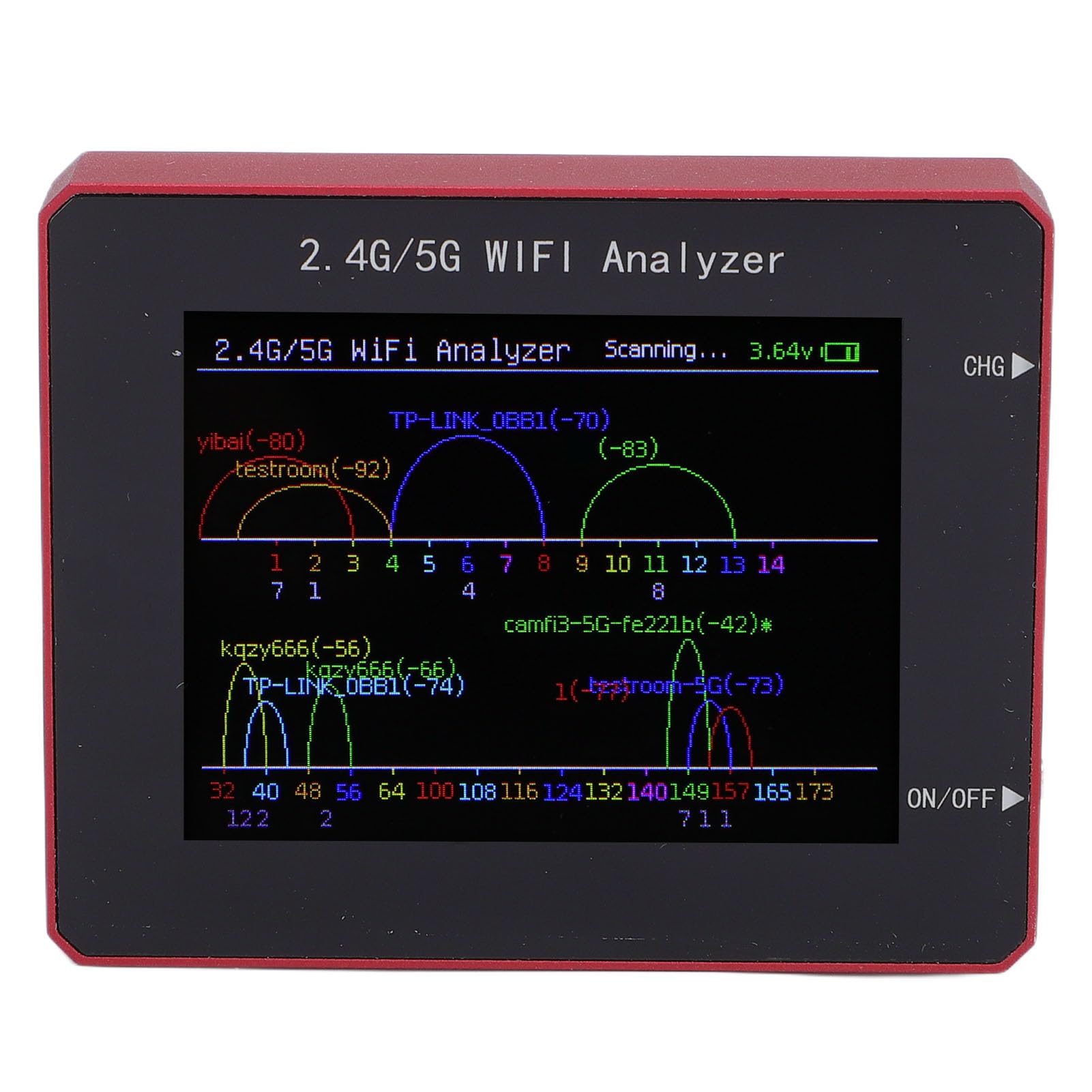
Bands: 2.4G and 5G dual band
Display: TFT screen
Casing: Aluminum
Charging: Type C
Function: Frequency point adjustment, signal usage view, network diagnostics
Form Factor: Portable
WiFi Analyzer 2.4G 5G TFT Screen Aluminum Casing Dual Band on Amazon
This unit is purpose-built for WiFi work, with a dual-band radio and a TFT screen that shows signal usage across both bands. The aluminum casing gives it a sturdier feel than plastic-shelled competitors and helps shield the internals from stray RF. Frequency point adjustment lets the user tune to a specific channel rather than scanning everything, which speeds up the hunt for a single offending device. The network diagnostic tool rounds out the feature set for basic troubleshooting.
It suits the buyer who wants a dedicated WiFi scanner without paying for wideband spectrum coverage. Home users mapping channel congestion and small-office admins checking coverage will find the dual-band view directly useful. The trade-off is coverage: this tool reads WiFi bands, so interference from a microwave or a baby monitor outside those frequencies stays invisible.
3. EMF Meter GQ EMF-390 Multi-Field Electromagnetic Radiation 3-in-1

Type: 3-in-1 EMF, ELF, and RF meter
RF Range: Up to 10GHz
Spectrum Analyzer: 2.5GHz
Features: Data logger
Coverage: 5G cell tower and smart meter detection
Function: WiFi signal detection
EMF Meter GQ EMF-390 Multi-Field Electromagnetic Radiation 3-in-1 on Amazon
The EMF-390 is the odd pick here and the most versatile for mixed concerns. It reads three fields — EMF, ELF, and RF — and reaches up to 10GHz on the RF side, which covers cell tower and smart meter emissions alongside WiFi. The built-in data logger records readings over time, useful for confirming whether interference is constant or intermittent. The 2.5GHz spectrum analyzer view adds a visual trace for the main WiFi band.
It earned its spot for buyers who suspect the interference source is not a router at all. Anyone worried about a nearby cell installation, a smart meter, or household wiring will get readings a WiFi-only tool cannot provide. The trade-off is that this is a general-purpose field meter first: its spectrum display tops out at 2.5GHz, so it will not resolve 5 GHz or 6 GHz WiFi channels in detail.
4. WiFi Analyzer, 2.4 Inch TFT Color Screen Network Signal Analyzer

Display: 2.4 inch TFT color screen
Battery: 600mAh rechargeable
Interface: Type C
Function: WiFi signal strength measurement
Feature: Battery display
Form Factor: Handheld
WiFi Analyzer, 2.4 Inch TFT Color Screen Network Signal Analyzer on Amazon
This is the budget entry, and it keeps its job narrow: measuring WiFi signal strength and showing it on a 2.4 inch color screen. The 600mAh rechargeable battery charges over Type C, and the on-screen battery indicator removes the guesswork of when it needs a top-up. The compact body slips into a pocket for walk-around checks. For the price, it covers the basic question of where a signal dies.
It suits renters, students, and anyone who wants a cheap second opinion on router placement without installing an app. The pick makes sense for a quick strength survey across a small apartment. The trade-off is depth: a strength meter shows how loud a signal is, not what else is occupying the band, so diagnosing a specific interferer still needs a tool with a spectrum view.
5. NetAlly AirCheck G3 Pro

Wireless Standards: Wi-Fi 6 and Wi-Fi 7
Also Tests: Bluetooth and BLE
Functions: Site surveys, air quality test, device discovery, path analysis, security audits
Spectrum Analyzer: Optional
Intended Use: Professional network testing
NetAlly AirCheck G3 Pro on Amazon
The AirCheck G3 Pro is the professional tier, built for technicians who test networks for a living. It handles Wi-Fi 6 and Wi-Fi 7 plus Bluetooth and BLE, and bundles site surveys, air quality testing, device discovery, path analysis, and security audits into one handheld. The RF spectrum analyzer is an optional addition rather than standard, which lets buyers scale the tool to the job. This is the unit that produces a report a client will accept.
It earned its place for managed-network work where a phone app will not do: multi-floor surveys, interference audits, and security walkthroughs. The trade-off is the entry price, which puts it out of reach for casual home use and makes the optional spectrum module a further cost to plan for.
Before You Buy
- Frequency coverage: A WiFi-only tool reads the 2.4 GHz and 5 GHz bands; wideband spectrum analyzers also catch microwaves, cordless phones, and other non-WiFi emitters that cause interference.
- Display size: A 4.0 inch screen makes sweep traces readable at arm’s length, while a 2.4 inch screen is fine for strength readings and pocket carry.
- Spectrum versus strength: A spectrum view identifies what is causing interference; a strength meter only shows how loud the signal is at a given spot.
- Power and charging: Rechargeable batteries with Type C charging remove the need for disposable cells; check the on-screen battery indicator before a long survey.
- Storage and logging: A memory card or built-in data logger matters if readings need to be compared over time or shared with someone else.
- Optional modules: Professional units may sell the RF spectrum analyzer as a separate add-on, so budget for it if spectrum work is the goal.
- Build and portability: Aluminum casings resist knocks during site work; compact bodies suit walk-around checks but trade screen size for portability.
Frequently Asked Questions
-
What is the best WiFi analyzer for finding interference?
The SeeSii TinySA Ultra+ ZS406 is the strongest general pick because its 100kHz to 5.4GHz range catches non-WiFi emitters as well as routers. Buyers who only need WiFi band detail can spend less on a dual-band unit. -
Do I need a spectrum analyzer or just a signal strength meter?
A strength meter answers where coverage is weak. A spectrum analyzer answers why, by showing other devices occupying the same frequencies — which is the actual question when interference is suspected. -
Can a WiFi analyzer detect interference from microwaves or cordless phones?
Only if it tunes outside the WiFi bands. Wideband spectrum analyzers and RF meters cover those emissions; WiFi-only scanners do not. -
Is a phone app enough for interference hunting?
Apps are useful for a rough channel map, but phone hardware limits sensitivity and cannot see non-WiFi emitters. A dedicated handheld gives cleaner readings and a real spectrum trace. -
What does a professional WiFi tester add over a budget analyzer?
Site survey reporting, device discovery, path analysis, security audits, and support for newer standards such as Wi-Fi 6 and Wi-Fi 7. That matters when results go to a client rather than a homeowner. -
Does an EMF meter work as a WiFi analyzer?
Partly. A multi-field meter reads RF levels and can flag a strong emitter, but its spectrum view may top out below the full WiFi range, so it complements rather than replaces a dedicated analyzer.
Bottom Line
For most buyers hunting interference, the SeeSii TinySA Ultra+ ZS406 Spectrum Analyzer is the pick: its wide 100kHz to 5.4GHz range exposes both WiFi congestion and the non-WiFi devices that cause it, at a mid-tier price. Home users who only need band detail can save with the dual-band aluminum unit, while IT professionals running client-facing surveys should go straight to the NetAlly AirCheck G3 Pro.
