Why there are Amazon links here: Brave Review is paid a commission for qualifying Amazon purchases made through the links below. Your price does not change, and using our links is entirely optional. How this works
Best Cable Trunking for a Network Run: 5 Clean Wall Solutions
A network run looks tidy or terrible depending on the trunking chosen to carry it. The five kits below cover the range: long single-cable channels for a router-to-room Ethernet line, wide multi-cable raceways for a bundle of patch cords, and open-slot ducting for a rack or desk. Home network installers will find the slim, paintable options most useful, while rack owners and small-office builders should look at the open-slot kit. The overview table gives a one-glance read on each pick before the detailed reviews.
Overview of the Picks
| Product | Key Spec | Best Use | Price Tier |
|---|---|---|---|
| Delamu Cord Hider, 157in | 157in total, W0.95 H0.55in | Long single-run wall concealment | Budget |
| 315in Cord Hider Kit | 20 x 15.7in sections, paintable | Whole-room network runs | Mid |
| EVEO Cable Hider | 300in, one-cord raceway | Slim single Ethernet line | Mid |
| Cable Duct Management Raceway Kit | 62.8in, open slot, 4 pack | Server rack and desk cable track | Budget |
| Delamu Cord Hider, 62.8in | 4 x 15.7in, W2.36 H0.75in | Bundled network cables on wall | Mid |
1. Delamu Cord Hider, 157in
Total Length: 157in
Channel Size: W0.95 H0.55in
Type: Adhesive cable raceway
Color: White
Intended Use: Wall-mounted TV and single-cable runs
Material: Plastic channel with adhesive backing

This Delamu kit is the longest single-channel option in the group, which makes it the natural fit for a straight run from a router to a distant room. The narrow channel suits one Ethernet cable plus a thin power lead rather than a bundle. The sections snap together, so the run can be built up piece by piece along a skirting board or door frame. The white finish blends into light walls without painting.
It suits someone running one network cable across a room and wanting the job finished in an afternoon. The length is the selling point: fewer joins means a cleaner line. The narrow width is the limit — a bundle of patch cords will not fit, and the channel is too shallow for thick shielded cable plus a power cord.
Trade-off: The slim, low-profile channel is built for one or two thin cables, so a multi-cable network bundle will need a wider raceway instead.
2. 315in Cord Hider Kit
Total Length: 315in across 20 sections
Section Size: L15.7 x W0.96 x H0.57in
Type: Paintable cable raceway
Color: White, paint-ready
Intended Use: Wall-mounted TV and room-wide cable concealment

This kit offers the most total length of any pick, split into twenty short sections for flexible routing around corners and along walls. The paintable surface is the differentiator: on a colored wall, the channel can be matched to the paint rather than left bright white. The channel is still narrow, so it is a single-cable concealer rather than a bundle carrier. Short sections make it easy to follow a route that turns often.
It suits a whole-room network install where the cable has to travel around door frames and along a skirting board. The section count gives plenty of spare pieces for a long run. The trade-off is that the paint-ready surface needs a separate painting step to look truly integrated, and the plastic finish shows brush marks if not primed first.
Trade-off: The narrow channel and short sections mean more joins to line up, and the paintable surface adds a finishing step that a plain white kit skips.
3. EVEO Cable Hider
Total Length: 300in
Channel Type: One-cord raceway
Size: Small
Color: White
Intended Use: Single-cable wall concealment
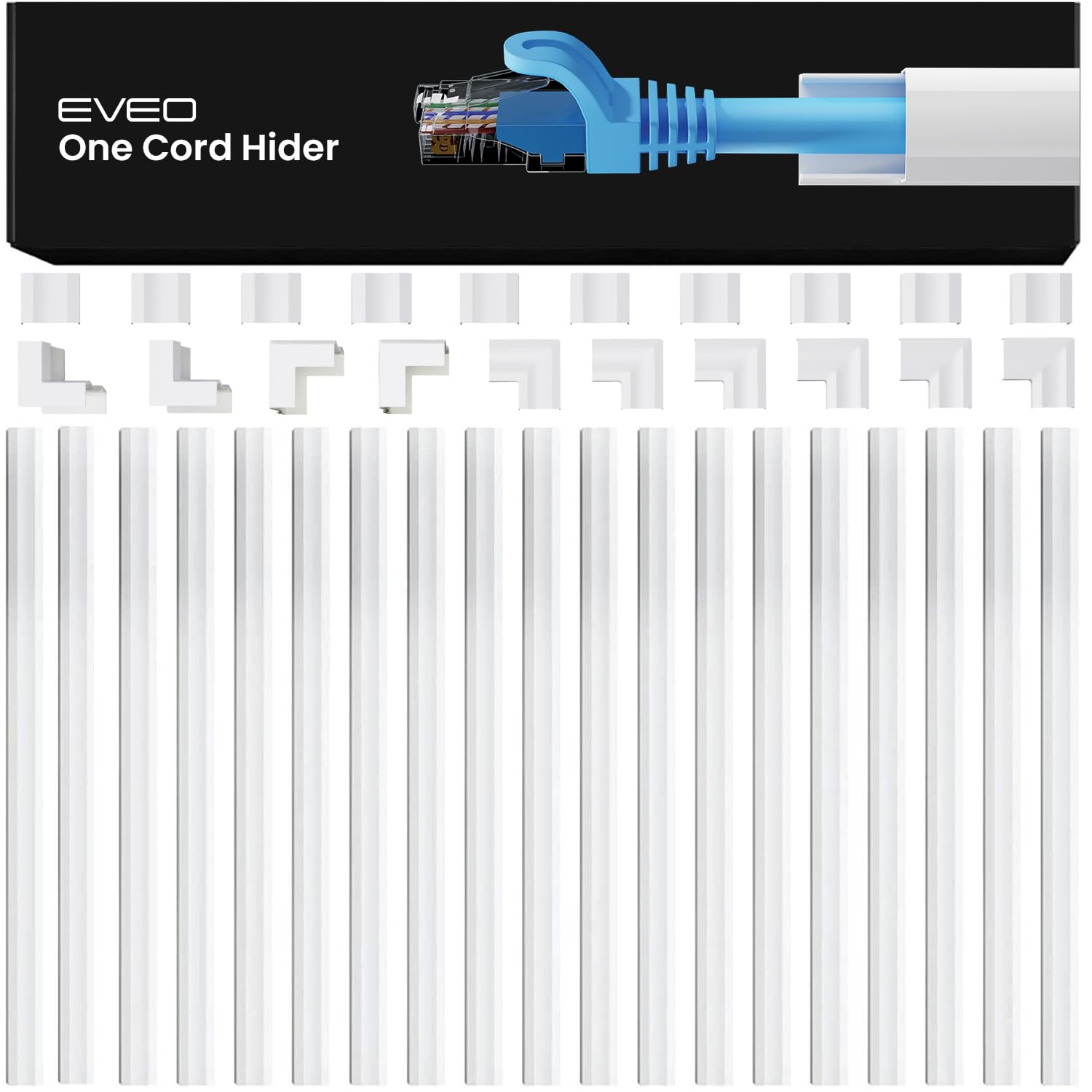
The EVEO kit is explicitly a one-cord raceway, and that is the clearest statement of its purpose in the group. It is designed to carry a single Ethernet or power cable in a slim, unobtrusive channel along a wall. The 300in length is generous for a single run and gives room for a route with several turns. The small profile keeps the channel visually quiet on a painted wall.
It suits a homeowner running one cable from a router to a desk or a wall-mounted access point. The single-cord design keeps the installation simple and fast. The limitation is built into the name: it will not carry a bundle, and adding a second cable means buying a second kit rather than using spare capacity.
Trade-off: The one-cord channel is deliberately narrow, so a network run that grows to two or three cables will need a second kit or a wider raceway.
4. Cable Duct Management Raceway Kit
Total Length: 62.8in across 4 sections
Section Size: 15.7in each
Type: Open-slot cable track
Pack: 4 pack
Color: White
Intended Use: Server rack, desk and network cable management

Cable Duct Management Raceway Kit
This is the odd one out in a good way: an open-slot cable track rather than a closed wall raceway. The open slot lets cables be dropped in and pulled out without removing a lid, which is what a rack or desk setup needs when cables change often. The four sections can be mounted on a rack frame, under a desk, or along a wall behind network gear. It handles HDMI, VGA and Ethernet cables in a mixed bundle.
It suits the buyer who needs a network run organized at the rack or desk end rather than hidden along a wall. The open design keeps patch cables accessible for changes. The caution is that open-slot ducting is not a concealer — it organizes cables but leaves them visible — and the total length is the shortest in the group, so it is not a room-spanning solution.
Trade-off: The open-slot track organizes and routes cables but does not hide them, and the 62.8in total suits a rack or desk rather than a long wall run.
5. Delamu Cord Hider, 62.8in
Total Length: 62.8in across 4 sections
Section Size: L15.7 W2.36 H0.75in
Channel Size: Wide, for 6-8 wires
Type: Adhesive cable raceway
Color: White
Intended Use: Bundled cable concealment on wall

This Delamu kit is the wide-channel option, sized for a bundle of six to eight wires rather than a single cable. That capacity is what makes it the best pick for a network run with multiple Ethernet cables plus power. The larger cross-section means fewer runs along the wall, since everything travels in one channel. The four sections are short, but the width does the work.
It suits a home office or media wall where several network and AV cables need to disappear together. The wide channel is the reason it earns its place: the other wall kits here cannot carry a bundle. The caution is that a wide channel is more visible on a wall and harder to bend tightly around corners, so the route needs some planning before mounting.
Trade-off: The wide channel hides more cables but is more conspicuous and less flexible around tight corners than the slim kits.
Before You Buy
- Material: Most wall raceways are plastic with adhesive backing; check that the adhesive suits the wall surface, since paint and wallpaper can release under load.
- Channel width: A one-cord raceway carries a single Ethernet cable, while a wide channel is needed for six to eight wires — match the width to the bundle, not the room.
- Total length: Measure the actual route including corners before buying; short-section kits need more pieces and more joins for a long run.
- Intended use: Open-slot tracks organize cables at a rack or desk, while closed raceways conceal them along a wall — the two are not interchangeable.
- Paintability: A paintable raceway can be matched to the wall, but it needs priming and a separate painting step to look integrated.
- Corners and fittings: Bends and corners are where most kits run short, so plan the route and count the turns before ordering.
Frequently Asked Questions
-
What is cable trunking for a network run used for?
It carries Ethernet and power cables along a wall or rack in a protected channel, keeping the run neat and preventing loose cables from being snagged or damaged. -
How wide should trunking be for an Ethernet cable?
A single Ethernet cable fits a one-cord raceway such as the EVEO kit, while a bundle of six to eight wires needs a wide channel like the 62.8in Delamu kit. -
Can cable trunking be painted?
Paintable raceways exist, and the 315in kit is designed for it, but the surface usually needs priming first so the paint adheres evenly. -
Is open-slot ducting the same as a wall raceway?
No — open-slot ducting organizes cables at a rack or desk and leaves them accessible and visible, while a closed raceway conceals them behind a lid. -
How long should the trunking be for a room-to-room run?
Measure the full route including vertical drops and corners, then add spare; long single-channel kits suit straight runs, while short sections suit routes with many turns. -
Does adhesive trunking damage paint when removed?
Adhesive backing can lift paint or wallpaper on removal, so it is worth testing a small patch first or choosing a route along a skirting board where minor marks are less noticeable.
Bottom Line
For most home network runs, the Delamu Cord Hider, 157in is the pick: its long single-channel length covers a router-to-room Ethernet line with few joins and a clean white finish. Buyers concealing a bundle of network cables should step up to the wide 62.8in Delamu kit, and rack or desk owners should choose the open-slot track instead.