Why there are Amazon links here: Brave Review is paid a commission for qualifying Amazon purchases made through the links below. Your price does not change, and using our links is entirely optional. How this works
GL.iNet GL-E5800 MUDI 7 5G Tri-Band Wi-Fi 7 Travel Router: One Router, Every Network
The GL.iNet GL-E5800 MUDI 7 is a travel router built for people who refuse to rely on hotel Wi-Fi or a single carrier’s SIM. It combines 5G cellular, eSIM plus dual nano-SIM support, tri-band Wi-Fi 7 and a 2.5G Ethernet port in one battery-powered unit. This review covers what the hardware does, where it fits, and which buyers should look elsewhere.
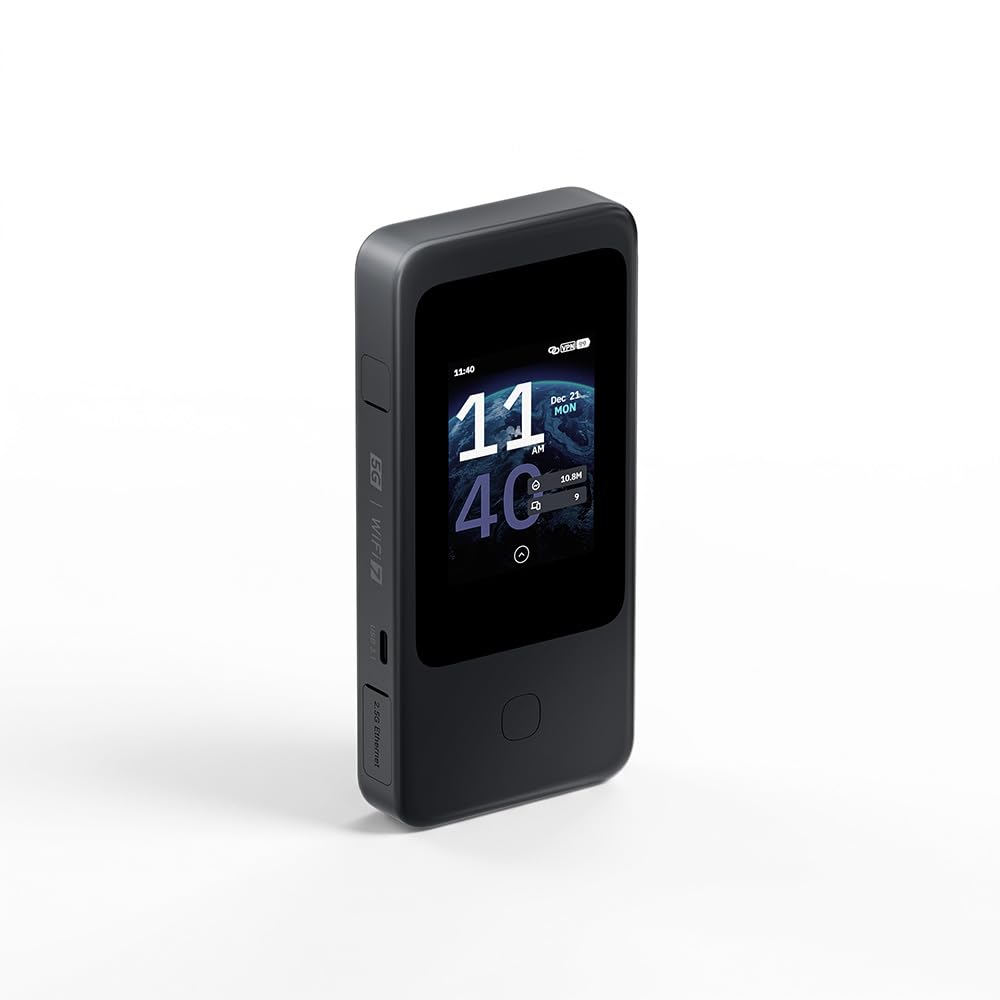
Features and Specifications
Type: Battery-powered 5G travel router
Wireless Standard: Tri-band Wi-Fi 7
Cellular: 5G with eSIM plus dual nano-SIM
Wired Port: 2.5G Ethernet
Display: 2.8-inch touchscreen
Battery Life: 13.5 hours
VPN Throughput: 700 Mbps
Model: GL-E5800 NA (North America)
The headline here is the cellular stack. An eSIM plus two physical nano-SIM slots means the MUDI 7 can hold multiple carrier profiles at once, so a buyer can switch networks from the touchscreen without swapping cards. That is the feature that separates it from a plain Wi-Fi repeater.
The 13.5-hour battery figure is the other number that matters. It means the unit can run a full working day off a charge, which suits a laptop bag or a rental car dashboard more than a fixed desk. The 2.8-inch touchscreen handles status and switching without a phone app.
Build and Design
The MUDI 7 is a compact, self-contained box rather than a dongle or a bare board. The touchscreen on the face is the control surface: network status, SIM selection and settings are readable at arm’s length, which matters in a hotel room where a phone might be charging across the room.
The 2.5G Ethernet port is the detail that signals intent. Most travel routers settle for a single gigabit jack; a 2.5G port lets the unit feed a wired connection to a laptop or a small switch without becoming the bottleneck. Buyers who tether a work laptop by cable will notice the difference.
The trade-off in this group is size and weight. A router with a battery, a screen and three radios is not a pocket accessory in the way a tiny travel repeater is. It occupies real space in a bag, and the screen is one more surface to protect.
Cellular and SIM Flexibility
This is the core of the product. The eSIM plus dual nano-SIM arrangement gives three carrier identities in one device, and the touchscreen makes switching between them a menu action rather than a screwdriver job. For a buyer who crosses borders or works in areas where one carrier is weak, that redundancy is the whole point.
The 5G radio is the primary uplink, and the whole design assumes cellular is the source of internet rather than a fallback. That inverts the usual travel-router logic, where a hotel’s wired connection is primary and cellular is backup.
The caution is carrier and regional fit. The model is designated NA, meaning North America, and buyers outside that region should confirm band support before committing. A cellular router is only as good as the bands it can hear.
Wi-Fi 7 and Wired Performance
Tri-band Wi-Fi 7 is a forward-looking spec for a travel router. It means the unit can spread clients across three bands, which reduces congestion when several devices are attached in a space full of competing networks. Buyers with recent laptops and phones get the most from it; older devices will simply connect on the bands they support.
The 2.5G Ethernet port serves the wired side, and the 700 Mbps VPN figure is the number to weigh for remote work. That throughput is enough for a full workday of video calls and file transfers through a tunnel, but it is a ceiling, not a promise — real-world VPN speed depends on the server on the other end.
The trade-off here is that Wi-Fi 7 clients are still a minority. A buyer with older hardware pays for a capability the devices cannot yet use.
Battery and Portability
The 13.5-hour battery rating is the figure that defines how the MUDI 7 gets used. It supports a full day of work away from an outlet, which is the scenario this product is built for: a train, a cafe, a client site with no guest network worth trusting.
The battery also changes the failure mode. A dead travel router with no cell is a brick; a router with a day of runtime is a tool. Buyers who work long days off-site will value the buffer more than any single spec on the box.
The trade-off is charge management. A battery this size takes time to refill, and a buyer who forgets to charge overnight starts the day at a disadvantage. It is a device that rewards a charging routine.
Who It Suits and Who It Does Not
The MUDI 7 suits the mobile professional who works from multiple locations and needs a private, carrier-independent network. It also suits the frequent international traveler who wants one device that can hold several carrier profiles and switch between them without hardware changes.
It does not suit the buyer who only needs to extend a home network to a garage or a backyard. That job belongs to a mesh node or a simple extender, and the cellular hardware here would go unused. It also does not suit the buyer on a strict budget, since the price tier reflects the 5G radio, the screen and the Wi-Fi 7 platform together.
Trade-off: The MUDI 7 is a premium, feature-dense unit, so buyers who do not need cellular redundancy pay for radios and a screen they will never use.
Check the current price on Amazon
FAQ
-
What is the GL.iNet GL-E5800 MUDI 7?
It is a battery-powered travel router with a 5G cellular modem, eSIM plus dual nano-SIM support, tri-band Wi-Fi 7 and a 2.5G Ethernet port. -
Does the MUDI 7 need a SIM card to work?
No. The eSIM provides a carrier profile without a physical card, and the dual nano-SIM slots let a buyer add two more profiles alongside it. -
How long does the battery last?
The rated battery life is 13.5 hours, which covers a full working day away from an outlet for most users. -
What does the 2.8-inch touchscreen do?
It shows network status and settings and lets a buyer switch between SIM profiles and adjust configuration without opening a phone app. -
Is the MUDI 7 fast enough for VPN use?
The rated VPN throughput is 700 Mbps, which is enough for remote work, video calls and large file transfers through a tunnel. -
What is the 2.5G Ethernet port for?
It provides a wired connection to a laptop, switch or access point at a higher ceiling than a standard gigabit port. -
Is this model for North America?
Yes, the NA designation indicates the North America variant. Buyers in other regions should confirm band support before buying. -
Does tri-band Wi-Fi 7 matter if the connected devices are older?
Less so. Older devices connect on the bands they support, so the full benefit of Wi-Fi 7 shows up mainly with recent hardware. -
Who should not buy the MUDI 7?
Buyers who only need to extend a home network, or who will never use cellular, are better served by a simpler and cheaper router. -
Can the MUDI 7 replace a home router?
It can serve as one, but its design targets travel and mobile work. A fixed home setup usually gets more from a mains-powered router with more ports.
Bottom Line
The GL.iNet GL-E5800 MUDI 7 is the pick for the buyer who needs one private network that works anywhere: 5G cellular with eSIM and dual nano-SIM redundancy, Wi-Fi 7 for crowded airwaves, a 2.5G wired port and a 13.5-hour battery in a single unit. Buyers who only need to extend a home network should skip it; everyone else who works on the move should check the current price on Amazon before committing.
