Why there are Amazon links here: Brave Review is paid a commission for qualifying Amazon purchases made through the links below. Your price does not change, and using our links is entirely optional. How this works
Linkind Matter Smart Light Bulbs: Color Control Without a Hub
The Linkind Matter smart light bulbs are a six-pack of color-changing A19 bulbs that pair directly with Apple Home, Alexa and Google Home over 2.4 GHz Wi-Fi — no bridge or hub required. They suit renters and first-time smart-home buyers who want mood lighting in several rooms without buying into a proprietary ecosystem. This review covers what the Matter label actually changes, how the bulbs are built, and the trade-offs worth knowing before ordering a pack.
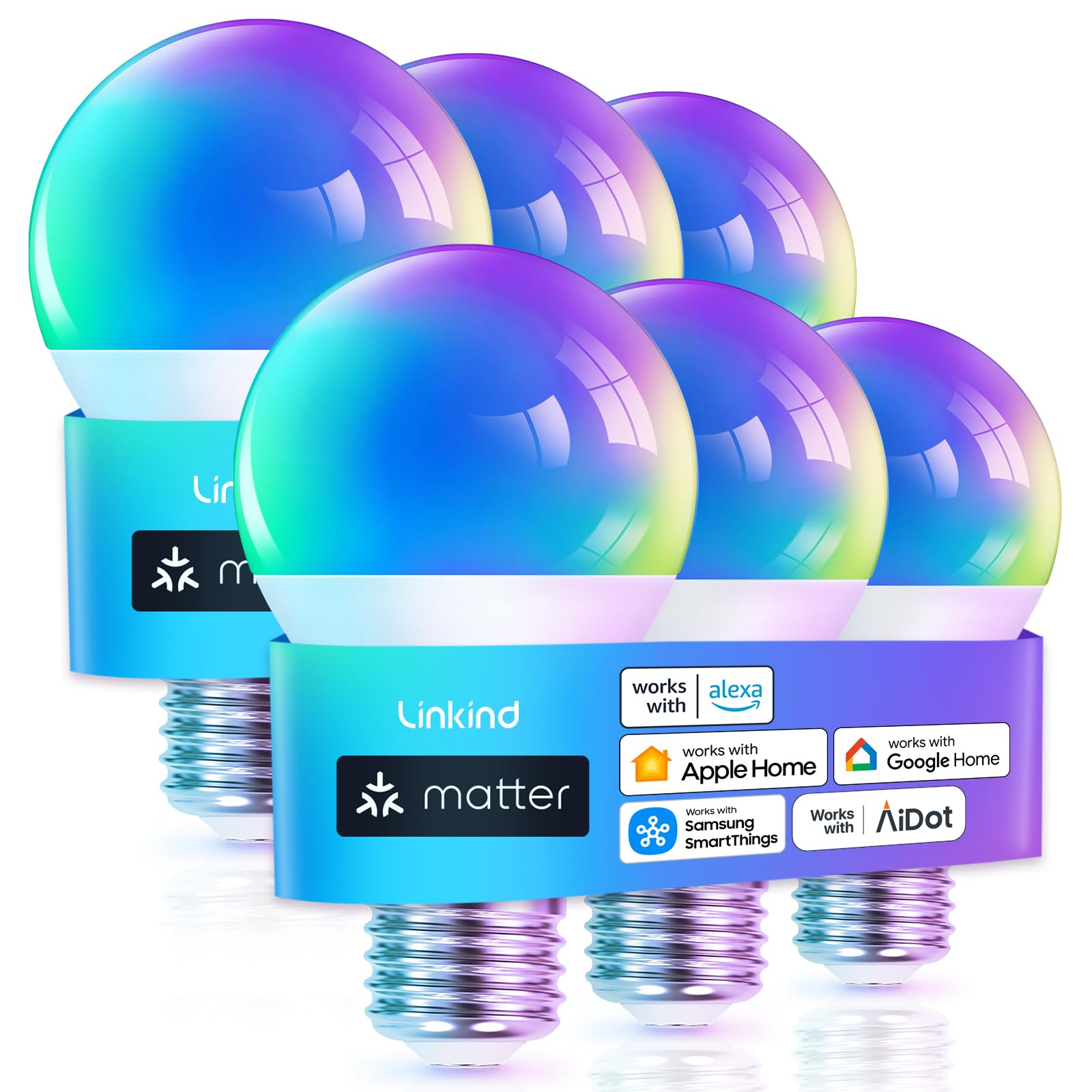
Features and Specifications
Type: LED color-changing smart bulb, A19 shape
Base: E26 standard screw base
Brightness: 800 lumens, 60W-equivalent output
Connectivity: 2.4 GHz Wi-Fi, Matter-enabled direct connect
Ecosystems: Apple Home, Amazon Alexa, Google Home
Pack Size: 6 bulbs
Each bulb is a standard A19 — the pear-shaped silhouette that fills most table lamps, ceiling fans and open fixtures in US homes — on an E26 screw base, so it drops into existing sockets without adapters. At 800 lumens it matches a traditional 60W incandescent for everyday room lighting, which is enough for a bedroom, hallway or living-room lamp but not for task lighting over a workbench.
The Matter certification is the headline here. Matter is the cross-platform smart-home standard, and a Matter-enabled bulb pairs directly to a controller app rather than to a manufacturer’s private cloud. In practice that means a buyer can set the bulbs up in Apple Home on an iPhone and still control them from an Echo speaker later — the bulbs are not locked to one brand’s app the way many older Wi-Fi bulbs are.
The 2.4 GHz Wi-Fi radio is the other detail that matters. These bulbs talk to the router directly, so there is no hub to buy, power or lose. The catch is that 2.4 GHz is the crowded band — the one microwaves, baby monitors and older routers fight over — and these bulbs cannot use a 5 GHz network.
Build, Brightness and Color
The physical build is ordinary in the best sense: a plastic diffuser dome over an LED array, with a heatsink body that is slightly taller and heavier than a plain LED bulb. That extra bulk is normal for color bulbs, which pack red, green and blue emitters alongside the white LEDs. In a tight lampshade or a fixture with a shallow canopy, the added length is worth checking before ordering six.
Color changing is the reason most buyers pick this pack over a white-only set. The bulbs produce tunable whites for everyday use and a full color range for mood lighting — accent washes behind a TV, a warm amber for evening, a saturated color for a party or a kid’s room. The 800-lumen ceiling applies to the white output; colored light reads dimmer to the eye, which is normal for this class of bulb and worth expecting rather than treating as a fault.
Mood lighting is where a six-pack earns its place. One bulb is a novelty; six let a buyer color a whole room, split a room into zones, or scatter bulbs across a house and control them as groups. That is the practical argument for buying the multi-pack rather than singles, and it is the reason this product is positioned the way it is.
Trade-off: Color bulbs at this price tier tend to render deep reds and saturated blues less richly than premium Hue-class bulbs, and the plastic diffuser is functional rather than premium-feeling.
Power, Connectivity and Setup
Direct Wi-Fi connection is the defining convenience and the defining constraint. Setup runs through the Matter pairing flow in the chosen app — scan a code, join the 2.4 GHz network, assign the bulb to a room. There is no hub to buy, which keeps the total cost of a six-bulb install low compared with hub-based systems.
The constraint is network load. Six Wi-Fi bulbs means six devices on the router, and a household that adds more smart devices later will feel the 2.4 GHz band get crowded. Buyers with a mesh system or a router that handles many clients well will have an easier time than those on an older single-band router.
Matter’s cross-platform promise is real but conditional. The bulbs work with Apple Home, Alexa and Google Home, but the feature set inside each app differs — some controllers expose scheduling and scenes more fully than others, and advanced effects may live in the manufacturer’s own app rather than the Matter controller. A buyer should expect the basics (on/off, dimming, color, grouping) to work everywhere and the extras to vary.
Maintenance and Daily Use
These are LEDs, so there is no filament to burn out and no routine maintenance beyond an occasional dusting of the diffuser. The realistic maintenance question is firmware: Matter devices receive updates through the controller app, and a bulb that stops responding usually needs a power cycle or a re-pair rather than a replacement.
Daily use is where the design either fits a household or does not. Voice control through Alexa, Siri or Google Assistant handles the common cases — dim the lamp, change the color, turn everything off — and schedules cover the rest. A buyer who wants physical switches to keep working normally will find that smart bulbs and wall switches interact awkwardly: cutting power at the switch takes the bulb offline, which is true of every Wi-Fi bulb in this class, not just this one.
Trade-off: Because the bulbs need constant power to stay reachable, a household that habitually flips wall switches off will lose remote control until the switch goes back on.
Who These Bulbs Suit — and Who They Don’t
The pack suits renters and first-time smart-home buyers who want color and voice control without a hub, and households already inside the Apple, Alexa or Google ecosystems that want bulbs that move between them. It also suits anyone lighting several rooms at once, since the six-pack spreads the per-bulb cost down.
It does not suit buyers who need a single bulb, who want the deepest color saturation available at any price, or who live in a home where wall switches are routinely cut and expect app control to survive that. Buyers with a 5 GHz-only network segment should confirm a 2.4 GHz band is available before ordering.
Check the current price of the Linkind Matter smart light bulbs on Amazon
FAQ
-
Do Linkind Matter smart light bulbs need a hub?
No. They connect directly to a 2.4 GHz Wi-Fi network and pair through a Matter controller app such as Apple Home, Alexa or Google Home. No bridge is required. -
Do these bulbs work with Apple Home, Alexa and Google Home?
Yes. The Matter certification is what allows the same bulb to pair with any of the three, rather than being tied to one manufacturer’s app. -
Are these bulbs dimmable?
They are dimmable through the app and by voice, not through a traditional wall dimmer. A standard dimmer switch is not the right way to control a smart bulb. -
What kind of socket do they fit?
They use the standard US E26 screw base in the A19 shape, which fits most table lamps, ceiling fans and open fixtures. The bulb body is slightly longer than a plain LED because of the color hardware. -
How bright are they?
800 lumens, equivalent to a 60W incandescent. That is everyday room lighting rather than task lighting, and colored output will look dimmer than white output at the same setting. -
Can they connect to a 5 GHz Wi-Fi network?
No. The radio is 2.4 GHz only, which is standard for smart bulbs. The router needs a 2.4 GHz band available during setup. -
Is a six-pack the right choice for one room?
A six-pack suits a whole room, several lamps, or a multi-room install. A buyer who needs one or two bulbs will pay for spares they may not use. -
What happens if the wall switch is turned off?
The bulb loses power and drops offline until the switch is turned back on. App and voice control resume once power returns, though a re-pair may occasionally be needed. -
Do the bulbs remember their color setting after a power cut?
Matter bulbs generally restore their last state when power returns, but behavior can vary by controller app. Buyers who rely on a specific color scene should confirm the setting in their app. -
Are these bulbs suitable outdoors?
The product is an indoor A19 bulb. It is not described as weather-rated, so it belongs in indoor fixtures rather than exposed outdoor sockets.
Bottom Line
The Linkind Matter smart light bulbs are the sensible pick for a buyer who wants color-changing, voice-controlled lighting across several rooms without buying a hub or committing to one ecosystem. The six-pack spreads the cost, the Matter certification keeps the bulbs portable between Apple, Alexa and Google, and the 800-lumen output covers everyday room lighting. The caveats are the ones that come with the category at this price — color depth short of premium bulbs, a 2.4 GHz-only radio, and the usual smart-bulb friction with wall switches. For a first smart-lighting setup or a rental where nothing can be rewired, the pack does the job.
Check the current price of the Linkind Matter smart light bulbs on Amazon