Why there are Amazon links here: Brave Review is paid a commission for qualifying Amazon purchases made through the links below. Your price does not change, and using our links is entirely optional. How this works
Luna Light Bulb Security Camera: Screw-In 2K Coverage for Renters
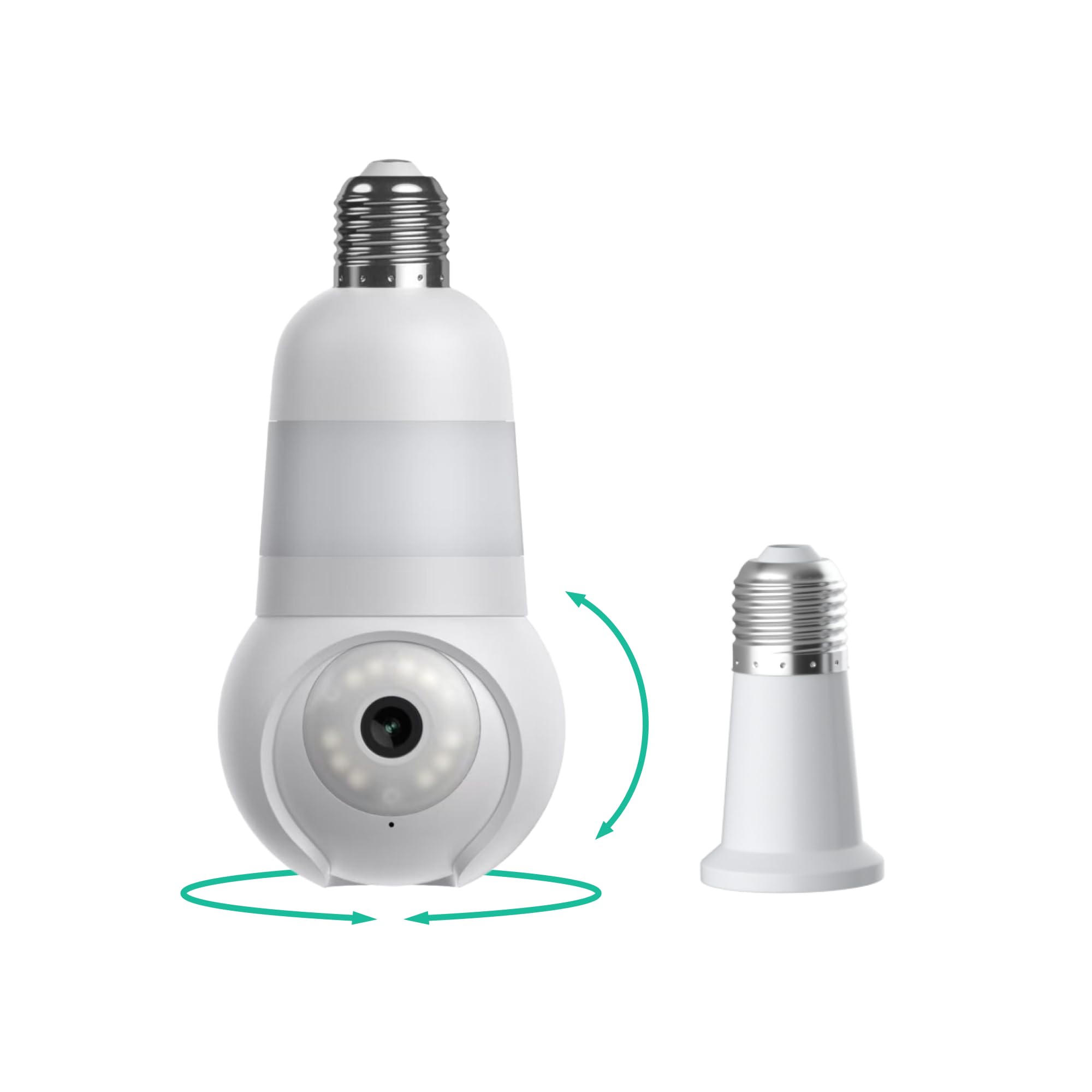
The Luna light bulb security camera is a screw-in outdoor and indoor camera that turns an ordinary porch light socket into a 2K pan-tilt security view. It is built for renters, apartment dwellers and homeowners who want camera coverage without drilling holes or running cable. This review covers what the hardware does, where the design runs into limits, and which households should look elsewhere.
Check the current price on Amazon
Features and Specifications
- Resolution: 2K
- Field of View: 360° pan and tilt
- Night Vision: Color night vision with built-in spotlight
- Connectivity: 2.4GHz and 5GHz Wi-Fi
- Form Factor: Light bulb camera, wireless
- Placement: Outdoor and indoor
- Compatibility Note: Not for Verizon cellular Wi-Fi 6 routers
The headline is the mounting method. This camera threads into a standard light bulb socket, so the socket supplies the power and the camera hangs where the bulb used to be. That removes the two biggest jobs in a camera install, which are finding an outlet and drilling mounting holes.
The 2K sensor and 360° pan-tilt head put it a step above the fixed, low-resolution bulb cameras that defined the early version of this category. A camera that can swing its lens means one unit can cover a driveway, a walkway and a side gate instead of staring at a single cone of ground.
Trade-off: A screw-in camera inherits every weakness of the socket it lives in, so the view is only as good as the fixture’s height and angle, and a switched socket cuts the camera off at the wall.
Build and Mounting
The housing is a bulb-shaped body with the lens and spotlight on the face and the threaded base at the back. A camera of this type is built to hang lens-down from a porch fixture, which is why the pan-tilt mechanism does the aiming rather than a bracket. Buyers should check the fixture’s load rating and depth before committing, since a camera body is heavier and longer than the bulb it replaces.
Mounting is the whole selling point. A renter can install one in minutes and take it down just as fast, with no holes in the siding and no landlord conversation. The same logic applies indoors, where a lamp socket in a hallway or garage becomes a camera position without an electrician.
The catch is that the camera needs a socket that stays powered. Porch lights wired to a switch are common, and a household that flips that switch at bedtime will find the camera offline every night. Fixtures on a timer or a dusk-to-dawn photocell are the better host.
Coverage and Image Quality
The 2K resolution is the part that matters most for identification. At the distances a porch camera typically watches, a sharper sensor is the difference between a shape at the end of the walk and a face or a license plate. Pan and tilt extend that reach by letting one camera sweep a wide arc rather than sit fixed on one spot.
Color night vision changes how the footage reads after dark. Instead of the flat monochrome of standard infrared, the camera uses its spotlight to keep color in the frame, which helps with clothing and vehicle color. The spotlight also works as a deterrent, and it is bright enough to be noticed by anyone approaching the door.
Buyers should expect the usual trade-offs of the category. Pan-tilt is mechanical, so the camera has to move to see a given area, and continuous sweeping costs power. A moving head is also a moving part, and it is the component most likely to wear over years of use.
Connectivity and Power
Dual-band Wi-Fi is a real advantage here. A 5GHz connection is less crowded than 2.4GHz in dense neighborhoods, and it handles the bandwidth of a 2K stream with more headroom. The 2.4GHz band remains the fallback for distance and for walls that block the higher frequency.
The compatibility warning in the product name deserves attention. This camera is not built for Verizon cellular Wi-Fi 6 routers, which means buyers on a cellular home internet plan should confirm their setup before ordering. The camera expects an ordinary home router broadcasting on 2.4GHz or 5GHz.
Power comes from the socket, so there is no battery to charge and no solar panel to mount. That is a genuine convenience for a device that has to run a spotlight and a pan-tilt motor. It also means the camera’s uptime is tied entirely to the fixture’s wiring.
Trade-off: Because the socket is the power source, the camera cannot be placed anywhere a bulb does not already go, and a fixture controlled by a wall switch gives anyone at that switch an off button for the whole camera.
App, Storage and Daily Use
Setup runs through the manufacturer’s app, which handles the Wi-Fi pairing, the pan-tilt joystick and the live view. Motion alerts push to the phone, and the spotlight can be triggered by detected movement. The pan-tilt control is the feature that gets used most, since it lets a homeowner check a different part of the yard without climbing a ladder.
Storage is the decision buyers should make before purchase. Local storage on a microSD card keeps clips on the device with no subscription, while cloud plans add remote backup and longer history. A budget camera of this type typically supports both, and the app is where the choice gets made.
Daily use is straightforward for a single-camera household. The camera is always on, the app is the interface, and the only routine maintenance is an occasional wipe of the lens and a check that the socket is still powered. Multi-camera households should look at how the app groups devices before buying several.
Who It Suits and Who It Doesn’t
This camera suits renters who cannot modify a building, apartment dwellers with a porch or balcony fixture, and homeowners who want a second camera position without an electrician. It also suits anyone who wants pan-tilt coverage from a single unit rather than several fixed cameras.
It does not suit households whose porch light is on a switch they use every night, buyers on Verizon cellular Wi-Fi 6 routers, or anyone who needs a camera in a location with no socket at all. Households that want continuous 24/7 recording with no subscription should confirm local storage support first. Buyers who need a camera on a fence post or in a detached garage should look at a battery-powered model instead.
FAQ
-
Does the Luna light bulb security camera need an electrician to install?
No. It threads into an existing light bulb socket, so installation is a matter of screwing it in and pairing it with the app. -
Can the Luna light bulb camera be used indoors?
Yes. The product is rated for outdoor and indoor use, so a lamp socket in a garage, hallway or shop works as a camera position. -
Does this camera work with 5GHz Wi-Fi?
Yes. It supports both 2.4GHz and 5GHz networks, and the 5GHz band is the better choice when the router is close and the channel is congested. -
Will the Luna light bulb camera work on Verizon cellular Wi-Fi 6 routers?
No. The product name explicitly excludes Verizon cellular Wi-Fi 6 routers, so buyers on that service should check compatibility before ordering. -
Does the camera record in color at night?
Yes. It uses color night vision with a built-in spotlight, which keeps color in the footage after dark instead of switching to monochrome infrared. -
Can the camera pan and tilt remotely?
Yes. The 360° pan-tilt head is controlled from the app, so the view can be aimed at a driveway, a door or a side yard without remounting. -
What happens if the porch light switch is turned off?
The camera loses power and goes offline. The socket has to stay live for the camera to keep watching. -
Does the Luna light bulb camera need a subscription?
The camera supports local storage on a memory card, so a subscription is optional rather than required for basic recording. -
Is 2K resolution enough to identify a face at the door?
2K is a meaningful step up from 1080p for identification at porch distances, though results depend on how high the fixture sits and how far the subject stands from the lens. -
Can one camera cover a whole front yard?
The pan-tilt head extends coverage well beyond a fixed camera, but it still has to move to see each area, so a single unit covers a wide arc rather than every angle at once.
Bottom Line
The Luna Light Bulb Security Camera is the practical answer for anyone who wants 2K pan-tilt coverage without drilling, wiring or asking a landlord for permission. Its dual-band Wi-Fi, color night vision and spotlight put it well past the basic bulb cameras, and the screw-in install is about as low-friction as home security gets. The limits are equally clear: it needs a live socket, it will not work on Verizon cellular Wi-Fi 6 routers, and a switched porch light becomes an off switch for the whole camera. Buyers with a powered fixture and an ordinary router get a lot of coverage for a budget-tier price.
