Why there are Amazon links here: Brave Review is paid a commission for qualifying Amazon purchases made through the links below. Your price does not change, and using our links is entirely optional. How this works
Reolink RLK16-800D8 vs Reolink RLK8-800D4: Eight Cameras or Four?
The Reolink RLK16-800D8 and the Reolink RLK8-800D4 are both 4K PoE camera kits built around a Reolink NVR, and the choice between them comes down to scale. The RLK16-800D8 covers a large property with eight cameras and a sixteen-channel recorder; the RLK8-800D4 covers a house or small shop with four cameras and an eight-channel recorder for roughly half the outlay. This comparison walks through camera count, recorder headroom, storage and installation so a buyer can pick one without second-guessing.
The Picks at a Glance
| Product | Key Spec | Best Use | Price Tier |
|---|---|---|---|
| Reolink RLK16-800D8 | 8 cameras, 16CH NVR, 4TB HDD | Large homes, multi-building lots, small commercial sites | Premium |
| Reolink RLK8-800D4 | 4 cameras, 8CH NVR, 2TB HDD | Single-family homes, garages, small retail spaces | Mid-range |
Reolink RLK16-800D8: The Eight-Camera 16-Channel Kit

Camera Count: 8 dome cameras
Resolution: 8MP (4K)
Recorder: 16-channel NVR
Storage: 4TB HDD preinstalled
Power: PoE wired
Compression: H.265
The RLK16-800D8 is a dome-camera system, which means the cameras mount flush to a ceiling or soffit and point outward under a fixed housing. That shape suits covered porches, garage ceilings and storefront overhangs where a camera can sit out of easy reach. Each camera runs on a single Ethernet cable that carries both power and video back to the NVR, so there is no separate power adapter at the camera end.
The headline number here is sixteen channels. Eight are filled by the included cameras, which leaves eight spare ports for expansion later — a second building, a gate, a back alley. The 4TB drive is sized for that larger camera load, and H.265 compression keeps file sizes down compared with older codecs so the drive goes further. Person and vehicle detection runs on the cameras themselves, which cuts down on nuisance alerts from moving branches and passing shadows.
Trade-off: A sixteen-channel, eight-camera system is a serious installation project — running cable to eight locations and terminating it at a central recorder is a weekend job for most buyers, not an afternoon one.
Check the current price on Amazon
Reolink RLK8-800D4: The Four-Camera 8-Channel Kit
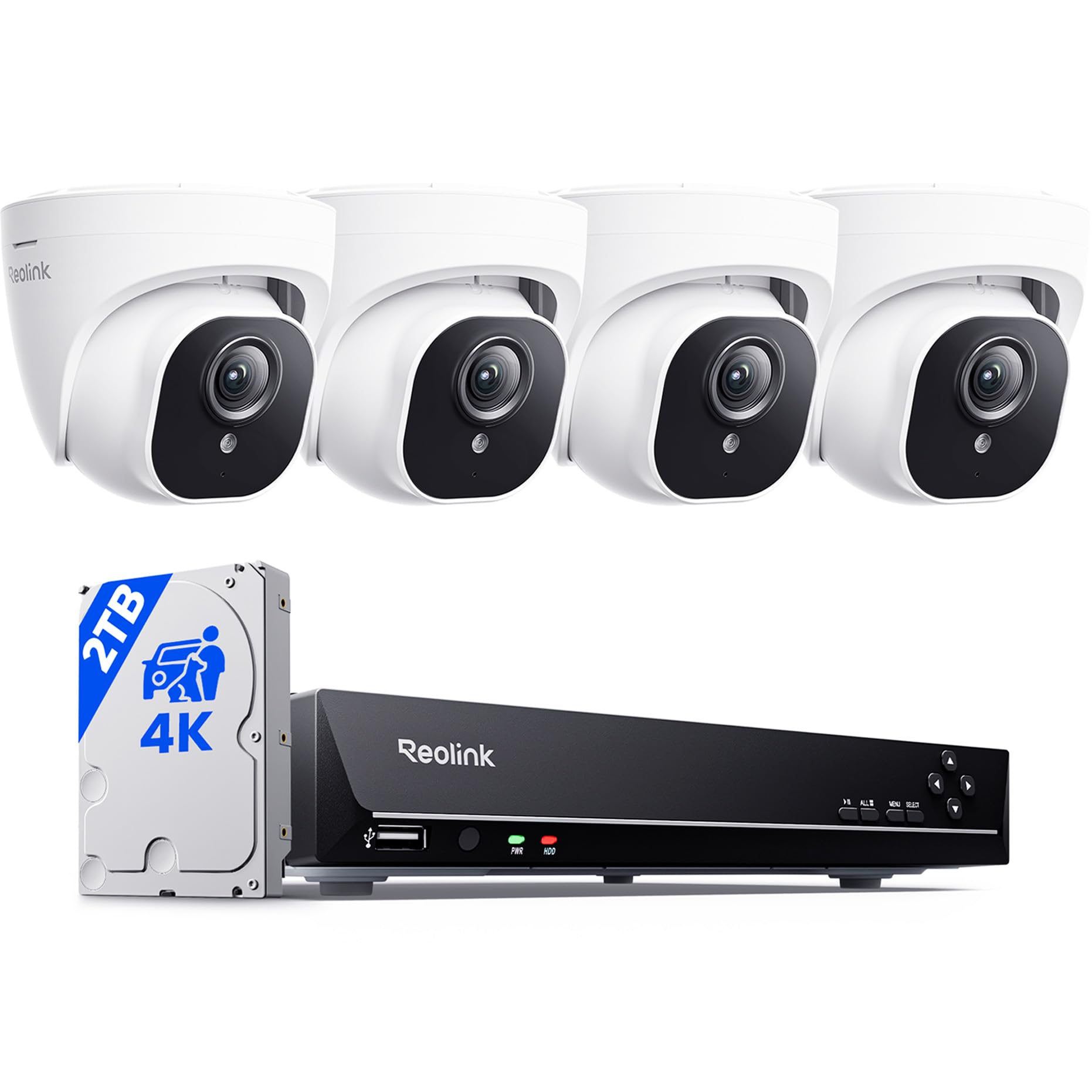
Camera Count: 4 turret cameras
Resolution: 8MP (4K)
Recorder: 8-channel NVR
Storage: 2TB HDD preinstalled
Power: PoE wired
Compression: H.265
The RLK8-800D4 uses turret cameras rather than domes. A turret body sits on a short stalk and can be aimed in almost any direction after mounting, which makes it easier to dial in a specific field of view — a driveway, a side gate, a back door. The housing is exposed rather than shrouded, so turrets tend to be the better pick for wall mounting at head height or above.
Four cameras cover the four corners of a typical house, and the eight-channel NVR leaves four ports open for later. The 2TB drive is matched to that smaller camera count, and the same H.265 compression and person/vehicle detection carry over from the larger kit. For a single-family home with a front door, a driveway, a back yard and a side yard, four cameras is usually the right number.
Trade-off: Four cameras and four spare channels leave less room to grow, and a buyer who already knows they want coverage of a detached garage or a second structure will likely outgrow this kit faster than expected.
Check the current price on Amazon
Side-by-Side Comparison
| Specification | Reolink RLK16-800D8 | Reolink RLK8-800D4 |
|---|---|---|
| Cameras included | 8 | 4 |
| Camera type | Dome | Turret |
| Resolution | 8MP (4K) | 8MP (4K) |
| NVR channels | 16 | 8 |
| Spare channels | 8 | 4 |
| Preinstalled storage | 4TB | 2TB |
| Compression | H.265 | H.265 |
| Power | PoE wired | PoE wired |
| Detection | Person/vehicle | Person/vehicle |
| Recording | 24/7 | 24/7 |
The table shows two kits built on the same foundation. Resolution, compression, detection and the PoE wiring model are identical, so image quality and alert behavior should be broadly comparable between them. The real separation sits in three rows: camera count, channel headroom and storage.
Camera count is the obvious one. Eight cameras cover a large lot, a corner property, a multi-unit building or a small commercial site with front, back and side coverage plus interior or outbuilding cameras. Four cameras cover the perimeter of a standard house and nothing more. A buyer who maps out camera positions before ordering will usually find the answer falls clearly on one side.
Channel headroom matters for anyone planning to add cameras later. The RLK16-800D8 doubles the spare ports, so a buyer can expand to sixteen cameras without replacing the recorder. The RLK8-800D4 tops out at eight, which is still double its included count but a lower ceiling.
Storage scales with the camera load. The 4TB drive in the larger kit is sized for eight streams recording around the clock; the 2TB drive in the smaller kit is sized for four. Neither is a constraint at the included camera count, but a buyer who pushes either NVR toward its channel limit will want to check drive capacity before adding cameras.
The camera shape is the quiet difference. Domes are harder to redirect and better protected against tampering, which suits high mounted positions under eaves. Turrets aim more freely and are easier to fine-tune after installation. Neither is better in the abstract — it depends on where the cameras go.
Which Should You Buy?
Choose the Reolink RLK16-800D8 if the property has more than four coverage points: a large lot, a detached garage, a second building, a shop floor, or a home where front, back, sides and interior all need cameras. It also suits a buyer who wants room to expand without buying a second recorder.
Choose the Reolink RLK8-800D4 if the job is a single house or a small retail space with four clear camera positions. It costs roughly half as much, needs half the cable runs, and covers the standard perimeter without paying for channels that will sit empty.
Buyers who are unsure should sketch the camera positions first. If the sketch lands on four or fewer, the smaller kit is the sensible buy. If it lands on five or more, the larger kit is the only one that covers the plan without compromise.
FAQ
-
What is the main difference between the Reolink RLK16-800D8 and the RLK8-800D4?
Camera count and recorder size. The RLK16-800D8 ships eight dome cameras with a sixteen-channel NVR and a 4TB drive; the RLK8-800D4 ships four turret cameras with an eight-channel NVR and a 2TB drive. -
Do both kits record in 4K?
Yes. Both use 8MP cameras, which is the 4K class, and both record 24/7 to a preinstalled hard drive. -
Can the RLK8-800D4 be expanded past four cameras?
Yes, up to eight cameras total, since the NVR has eight channels and four are already in use. -
Can the RLK16-800D8 be expanded past eight cameras?
Yes, up to sixteen cameras total, leaving eight spare channels out of the box. -
Do these systems need internet to record?
No. Both record locally to the NVR’s hard drive, so 24/7 recording continues without a network connection. Remote viewing is the part that needs the network. -
Dome or turret cameras — which is better?
Domes suit high, covered mounting points where tamper resistance matters. Turrets suit wall mounting where the field of view needs adjusting after installation. Both kits use the same resolution and detection features. -
Is PoE hard to install?
PoE means one Ethernet cable per camera carries both power and data back to the NVR. The cabling work is the labor — running and terminating cable to each camera location — rather than any complexity in the connection itself. -
Which kit suits a small business?
The RLK16-800D8, in most cases. A shop floor, a stockroom, a register and an exterior usually exceed four camera positions, and the sixteen-channel recorder leaves room for later additions.
Bottom Line
The Reolink RLK16-800D8 is the better buy for anyone who needs more than four camera positions or expects to add cameras later — the extra channels and larger drive make it the more future-proof of the two. The Reolink RLK8-800D4 is the smarter pick for a standard house or small shop where four cameras cover the perimeter and the budget matters. Map the camera positions first, then buy the kit that matches the count.
Check the current price of the Reolink RLK16-800D8 on Amazon
